




EUR/GBP Price Forecast: Steady above 0.8650 with ECB and BoE in the spotlight
- EUR/GBP has found support at 0.8655 but remains capped below the 0.8680 area so far.
- The pair is trading rangebound ahead of the ECB and BoE monetary policy decisions on Thursday.
- The technical picture shows a potential double bottom formation at 0.8650.
The Euro (EUR) edges higher against the British Pound (GBP) for the second consecutive day on Wednesday, although it remains contained within the weekly range, with upside attempts capped below the 0.8680 area for now. Recent price action, however, starts to show signs of a potential trend shift, as investors brace for the monetary policy decisions of the European Central Bank (ECB) and the Bank of England (BoE), due on Thursday.
The ECB is widely expected to keep interest rates on hold, awaiting further data to better assess the impact of the Middle East war on economic growth and inflation. ECB officials, however, have shown their willingness to tighten monetary policy, and therefore, the bank will most likely hint at an interest rate hike in June or July.
The BoE is also expected to leave rates unchanged on Thursday, but the UK central bank, on the contrary, is seen keeping its monetary policy unchanged in the near term. BoE Governor Andrew Bailey affirmed earlier in April that there is no need to change policy given the weak labour market and lack of corporate pricing power, a stance that might provide some advantage to the Euro.
Technical Analysis: Potential double bottom at 0.8650
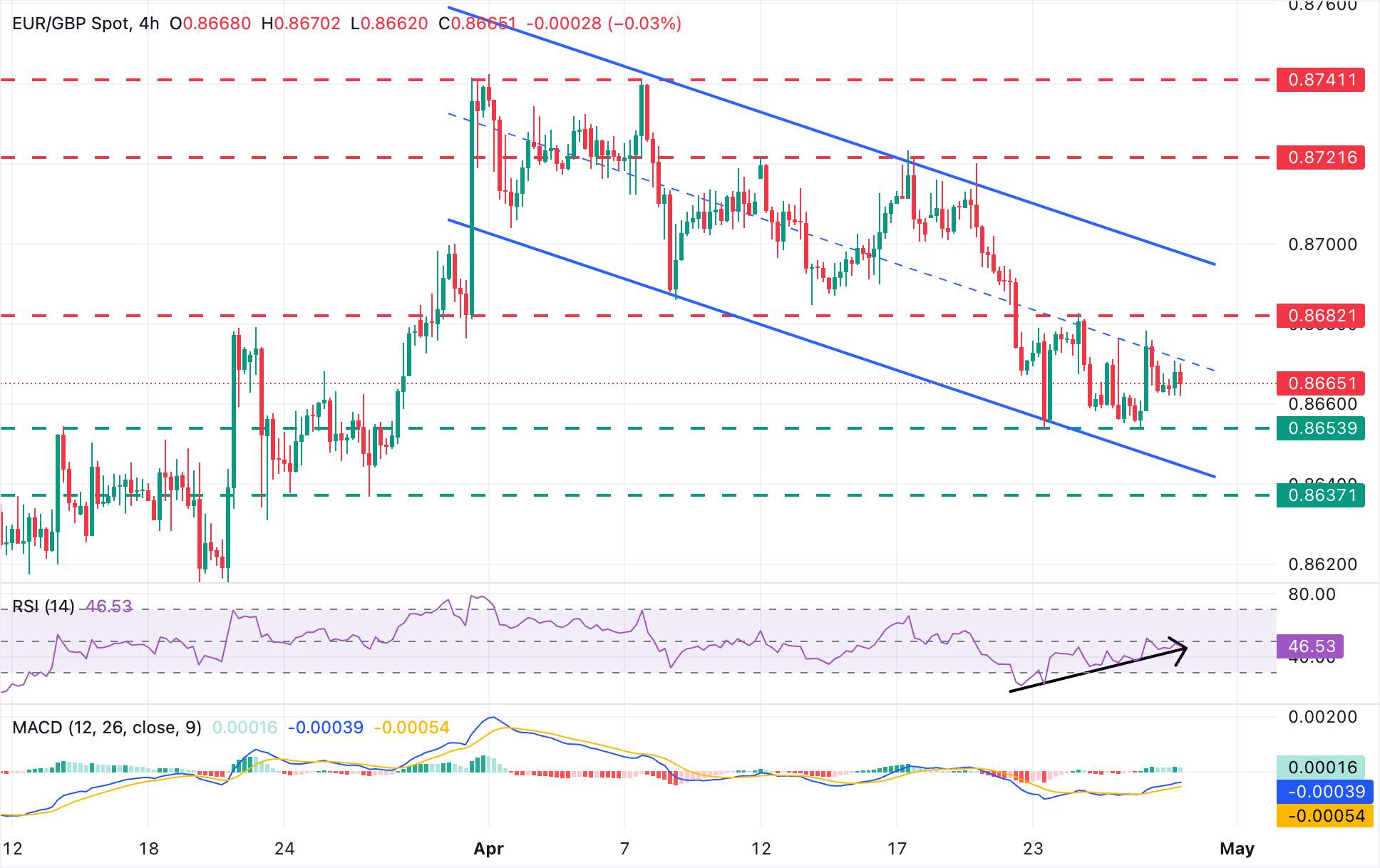
EUR/GBP keeps trading within a downward channel and remains capped by nearby overhead levels. The pair, however, has found an important support around 0.8650-0.8655 and is hinting at a potential double bottom, a formation that often anticipates a trend shift.
Technical indicators in the 4-hour chart are also hinting at fading bearish pressure. A bullish divergence in the Relative Strength Index (RSI) and the Moving Average Convergence Divergence (MACD), which is popping up modestly into positive territory, suggests a tentative buying interest.
On the topside, initial resistance emerges at the April 24 high of 0.8682, the neckline of the previously mentioned double bottom. Above here, the top of the bearish channel lies at 0.8700. A confirmation above here would bring the 0.8720 area (April 13, 17, and 21 highs) into focus
A bearish reaction, below 0.8655, on the contrary, would reactivate selling pressure and expose the channel's base near 0.8645 ahead of the area between 0.8630 and 0.8637, which capped bears several times in late March.
(The technical analysis of this story was written with the help of an AI tool.)
Euro Price This week
The table below shows the percentage change of Euro (EUR) against listed major currencies this week. Euro was the strongest against the Swiss Franc.
| USD | EUR | GBP | JPY | CAD | AUD | NZD | CHF | |
|---|---|---|---|---|---|---|---|---|
| USD | -0.06% | 0.02% | 0.19% | -0.03% | -0.37% | 0.15% | 0.29% | |
| EUR | 0.06% | 0.10% | 0.21% | 0.07% | -0.27% | 0.23% | 0.37% | |
| GBP | -0.02% | -0.10% | 0.15% | -0.04% | -0.39% | 0.13% | 0.27% | |
| JPY | -0.19% | -0.21% | -0.15% | -0.16% | -0.53% | 0.07% | 0.22% | |
| CAD | 0.03% | -0.07% | 0.04% | 0.16% | -0.29% | 0.24% | 0.31% | |
| AUD | 0.37% | 0.27% | 0.39% | 0.53% | 0.29% | 0.52% | 0.65% | |
| NZD | -0.15% | -0.23% | -0.13% | -0.07% | -0.24% | -0.52% | 0.14% | |
| CHF | -0.29% | -0.37% | -0.27% | -0.22% | -0.31% | -0.65% | -0.14% |
The heat map shows percentage changes of major currencies against each other. The base currency is picked from the left column, while the quote currency is picked from the top row. For example, if you pick the Euro from the left column and move along the horizontal line to the US Dollar, the percentage change displayed in the box will represent EUR (base)/USD (quote).
Recommended Articles


