


Is It Too Late to Buy Palantir Stock? Here Is What Its Valuation Says About Its Future.
Key Points
Palantir's growth rate must stay elevated for the valuation to make sense.
There are several years' worth of growth already priced into Palantir's stock.
- 10 stocks we like better than Palantir Technologies ›
Palantir Technologies (NASDAQ: PLTR) has been one of the best investments of the artificial intelligence (AI) investing era. If you were an early investor in the AI trend and bought $10,000 worth of shares at the start of 2023, that investment is now worth $200,110. That's a pretty impressive return, but at its peak stock price in early November 2025, that sum was worth more than $322,000.
Palantir's stock is in a nasty sell-off, trading down about 38% from its all-time high. That may be giving some investors fear that the run is over, while also giving some investors a second chance at one of the biggest gainers over the past few years.
Where to invest $1,000 right now? Our analyst team just revealed what they believe are the 10 best stocks to buy right now, when you join Stock Advisor. See the stocks »
But is the run over, and have investors missed the boat? Or is there more ahead? I think there's one metric that tells the truth, and it's a harsh reality.
Image source: The Motley Fool.
Palantir is still expensive despite the sell-off
Nobody can find fault with Palantir's growth rates and profitability. In the first quarter, Palantir's revenue grew by 85% year over year, and it posted a jaw-dropping 53% net income margin. Countless companies are likely jealous of Palantir's financials, as few can grow that quickly and maintain impressive profit margins. However, because Palantir's profit margin is already optimized, it doesn't have a ton of room to continue expanding it, which eliminates one catalyst for rapidly improving its earnings.
Instead, Palantir must grow its way into its valuation through raw revenue growth, which it has done a great job of so far. But that could start to become more difficult in the near future. There are other AI products launching, such as those from Anthropic, that can rival Palantir's AI-powered data analytics software. This rising competition could dampen Palantir's growth, which is a problem.
Data by YCharts.
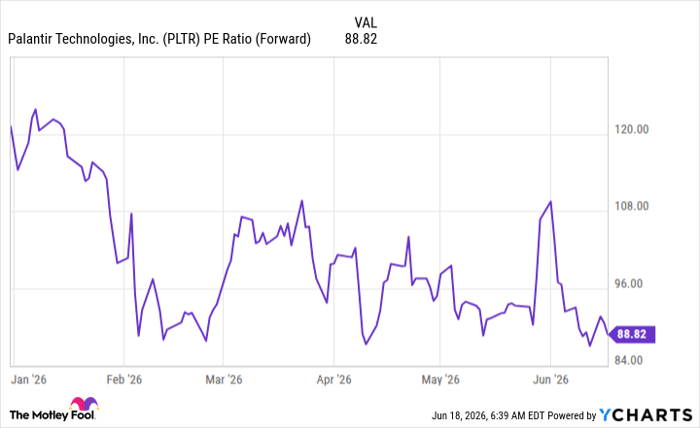
Palantir stock trades at nearly 90 times forward earnings, and that multiple already factors in the strong growth analysts expect in 2026. In 2027, analysts expect Palantir's growth rate to remain elevated at 45%, but that's not enough to justify a forward price-to-earnings ratio of nearly 90. For reference, Nvidia, which grew revenue at an 85% year-over-year clip during its most recent quarter and is expected to grow revenue at a 41% pace next year, trades for a mere 23 times forward earnings.
For Palantir's valuation to fall to a more reasonable 30 times forward earnings, it must triple its earnings starting in 2027. Should Palantir maintain its 45% growth rate, it would take three years to accomplish this. Palantir still has a long way to go before its valuation is even remotely reasonable, and paying for four years of growth in advance is far too high a price to pay. As a result, I think investors are better off purchasing other stocks.
Should you buy stock in Palantir Technologies right now?
Before you buy stock in Palantir Technologies, consider this:
The Motley Fool Stock Advisor analyst team just identified what they believe are the 10 best stocks for investors to buy now… and Palantir Technologies wasn’t one of them. The 10 stocks that made the cut could produce monster returns in the coming years.
Consider when Netflix made this list on December 17, 2004... if you invested $1,000 at the time of our recommendation, you’d have $417,305!* Or when Nvidia made this list on April 15, 2005... if you invested $1,000 at the time of our recommendation, you’d have $1,293,148!*
Now, it’s worth noting Stock Advisor’s total average return is 936% — a market-crushing outperformance compared to 209% for the S&P 500. Don't miss the latest top 10 list, available with Stock Advisor, and join an investing community built by individual investors for individual investors.
See the 10 stocks »
*Stock Advisor returns as of June 21, 2026.
Keithen Drury has positions in Nvidia. The Motley Fool has positions in and recommends Nvidia and Palantir Technologies. The Motley Fool has a disclosure policy.
Recommended Articles


