


Prediction: Oil Will Hit $60 a Barrel in 2027. Here's How to Invest Now.
Key Points
Oil prices shot higher when the Middle East geopolitical conflict began.
Energy prices have been driven by newsflow, but will soon be driven by market fundamentals.
Once depleted reserves have been replenished, there could be a glut of oil.
- 10 stocks we like better than Chevron ›
The one big thing investors have learned from the geopolitical conflict in the Middle East is that oil and natural gas remain vital to the world's normal functioning. This is why most investors should have some exposure to the sector. That said, the next year is likely to be complicated for the energy industry because of the lingering impact of the war.
I expect oil prices to fall back to where they were before the conflict in 2027, to around $60 per barrel for Brent Crude. However, getting to that point could be a bit of a rollercoaster ride, as industry fundamentals take center stage as newsflow from the conflict becomes less important. Here's how I'd invest in the energy sector today to prepare.
Where to invest $1,000 right now? Our analyst team just revealed what they believe are the 10 best stocks to buy right now, when you join Stock Advisor. See the stocks »

Image source: Getty Images.
The big picture view of the energy sector
Right now, there is too little oil and natural gas to go around because the Strait of Hormuz has been shut down. The impact of that has been muted by companies and countries working down their oil and natural gas reserves. As the Strait reopens, oil tankers stuck on the wrong side will likely lead to a rush of oil hitting the market, but global reserves still need to be replenished.
So oil prices may fall initially, only to rise again as market fundamentals become increasingly important. This is basically what ExxonMobil (NYSE: XOM) and Chevron (NYSE: CVX), two of the world's largest energy companies, have been discussing for months. At this point, the U.S. strategic oil reserve is near levels last seen in 1983. That's a situation that has to be rectified, and it is just one example of what has been taking place around the world.
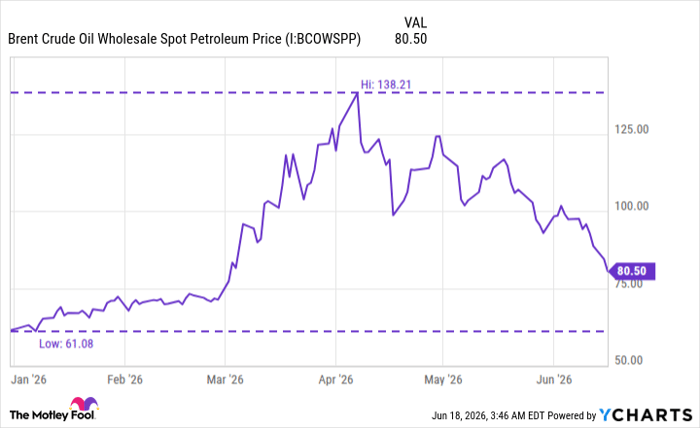
Brent Crude Oil Wholesale Spot Petroleum Price data by YCharts
At the same time, there have been fundamental changes in the global energy market. For example, the United Arab Emirates (UAE) has left OPEC, freeing it from the production limits set by the group. Also, the United States has ramped up exports, and countries around the world may take an increasing interest in energy security. Then you have to take into account lingering demand changes as countries attempt to reduce energy use to address supply constraints from the conflict.
How oil moves will likely be different in the future, and there might actually be more of it, as the International Energy Agency just warned. That would lead to lower energy prices, but only after a period of elevated demand that pushes oil and gas prices higher. The energy sector could be volatile for a bit, and that assumes that the agreement to end the conflict holds.
The best way to get your oil exposure
While most investors should probably have some exposure to the energy sector, it is probably best not to attempt to time oil and natural gas prices. Sure, if oil prices rise, companies like Diamondback Energy (NASDAQ: FANG) and Devon Energy (NYSE: DVN) will likely benefit. It is also appealing that they operate in the onshore U.S. market, far from geopolitical tensions. But when oil prices fall, these producers typically get hit quite hard.
A more conservative route is probably better. That's where energy giants like Exxon and Chevron come in. They have assets spread across the world and portfolios spanning the entire energy value chain. This diversification helps to soften the peaks and valleys in the energy market. In addition, they have the two strongest balance sheets in their integrated peer group. They are, basically, designed to survive the entire energy cycle.
The proof is Exxon and Chevron's dividends
The strength of these two businesses shines through in their dividends, which have been increased annually for decades. Exxon, the larger of the two companies, has a dividend yield of 2.9% right now. Chevron's yield is 4%. While the most conservative investors may prefer Exxon, the extra yield Chevron offers today probably makes it the more attractive buy for income-focused investors. Either one, however, would be a good option for navigating what is likely to be an unusual year ahead in the energy market.
Should you buy stock in Chevron right now?
Before you buy stock in Chevron, consider this:
The Motley Fool Stock Advisor analyst team just identified what they believe are the 10 best stocks for investors to buy now… and Chevron wasn’t one of them. The 10 stocks that made the cut could produce monster returns in the coming years.
Consider when Netflix made this list on December 17, 2004... if you invested $1,000 at the time of our recommendation, you’d have $417,305!* Or when Nvidia made this list on April 15, 2005... if you invested $1,000 at the time of our recommendation, you’d have $1,293,148!*
Now, it’s worth noting Stock Advisor’s total average return is 936% — a market-crushing outperformance compared to 207% for the S&P 500. Don't miss the latest top 10 list, available with Stock Advisor, and join an investing community built by individual investors for individual investors.
See the 10 stocks »
*Stock Advisor returns as of June 19, 2026.
Reuben Gregg Brewer has no position in any of the stocks mentioned. The Motley Fool has positions in and recommends Chevron. The Motley Fool has a disclosure policy.
Recommended Articles


