


1 Dividend King Stock Down 25% to Buy Right Now
Key Points
S&P Global's stock has dropped amid fears about the impact of generative artificial intelligence (AI) on data providers.
The company holds a dominant 50% market share in the credit ratings industry.
Following the sell-off, S&P Global is at its lowest valuation since late 2022.
- 10 stocks we like better than S&P Global ›
Software and financial technology stocks took a hit earlier this year when fears around generative artificial intelligence (AI) sent shock waves across the market. Product rollouts, such as Anthropic's Claude and OpenAI's automation tools, sent the software-focused iShares Expanded Tech-Software Sector ETF tumbling.
One company caught up in this wave of selling is credit rating company and financial data provider S&P Global (NYSE: SPGI). Since the start of the year, S&P Global's stock price has fallen 17%. It's down 25% from its 52-week high amid AI fears and a softer-than-expected earnings forecast.
Where to invest $1,000 right now? Our analyst team just revealed what they believe are the 10 best stocks to buy right now, when you join Stock Advisor. See the stocks »
However, the dip could be a buying opportunity for investors today. Here's why.
S&P Global's recent sell-off puts it at an attractive valuation
S&P Global fits within the broader software and information services ecosystem, thanks to its digital platform and financial datasets. The biggest fear among investors is that data providers such as S&P Global could face disruption from AI developers like Anthropic, which could synthesize market insights and undermine S&P Global's pricing power and premium, subscription-based business model.

Image source: Getty Images.
On top of this, the company announced disappointing 2026 earnings-per-share (EPS) guidance during its February earnings call. The company forecast adjusted EPS of $19.40 to $19.65, falling short of Wall Street's $19.96 estimate. The guidance disappointed investors, who were expecting stronger growth in its Credit Ratings and Market Intelligence segments.
Following the sell-off, S&P Global stock is priced at 27.4 times earnings and 22 times forecast earnings, putting it at its cheapest valuation since late 2022. The dip represents an opportunity for investors to scoop up this blue chip stock at a reasonable price.
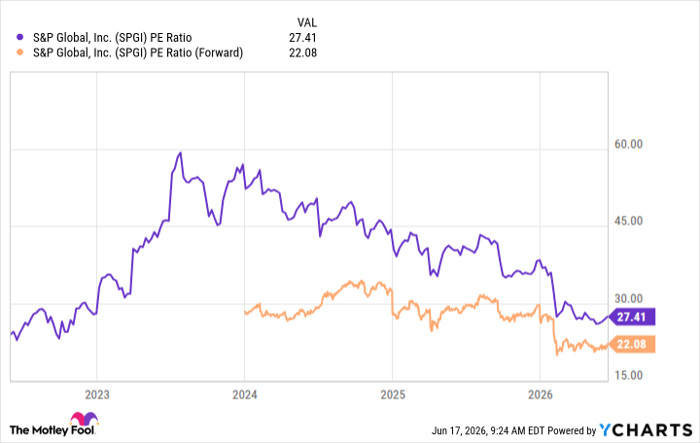
Data by YCharts.
The company has an incredible competitive advantage
S&P Global has several structural advantages that should help it navigate the current market landscape. For one, the company dominates the credit ratings industry, holding a 50% market share. Moody's ranks second, with a 31% market share.
Issuing credit ratings requires expertise and, more importantly, trust among major institutions. This, along with other barriers to entry, makes it difficult for new entrants to break into the space, giving S&P Global a strong competitive advantage.
In addition, the company's proprietary, institutional-grade datasets are protected by intellectual property rights. The company should be a beneficiary of AI, which enables it to integrate advanced analytics to drastically reduce operational costs, accelerate workflow automation, and expand operating margins, which came to a solid 52% during the first quarter.
A high-quality blue chip stock at a good price
Later this year, S&P Global will spin off its mobility division, a move expected to unlock value for both S&P Global and the newly formed business. The new company, Mobility Global, will focus on automotive data and intelligence, making S&P Global a pure-play financial services company.
S&P Global is a high-quality business with robust competitive advantages that have helped it navigate difficult market environments for decades. This is evidenced by the company's 53 years of increasing its annual dividend, making it a coveted Dividend King, a stock that has raised its dividend payouts for 50 years or more.
For investors looking to add quality names to their diversified portfolio, S&P Global is an excellent pick right now.
Should you buy stock in S&P Global right now?
Before you buy stock in S&P Global, consider this:
The Motley Fool Stock Advisor analyst team just identified what they believe are the 10 best stocks for investors to buy now… and S&P Global wasn’t one of them. The 10 stocks that made the cut could produce monster returns in the coming years.
Consider when Netflix made this list on December 17, 2004... if you invested $1,000 at the time of our recommendation, you’d have $417,305!* Or when Nvidia made this list on April 15, 2005... if you invested $1,000 at the time of our recommendation, you’d have $1,293,148!*
Now, it’s worth noting Stock Advisor’s total average return is 936% — a market-crushing outperformance compared to 207% for the S&P 500. Don't miss the latest top 10 list, available with Stock Advisor, and join an investing community built by individual investors for individual investors.
See the 10 stocks »
*Stock Advisor returns as of June 19, 2026.
Courtney Carlsen has positions in S&P Global. The Motley Fool has positions in and recommends S&P Global. The Motley Fool has a disclosure policy.
Recommended Articles


