


Brookfield Is Launching Another Renewable Energy Company. Here's What Investors Need to Know.
Key Points
Investment manager Brookfield Asset Management oversees a handful of industry-focused asset managers of its own.
One of these asset managers, Brookfield Renewable, recently unveiled a deal that illustrates why its business is such a reliably consistent cash cow.
"Capital recycling," or using self-funded projects rather than third-party funding, is a slower but ultimately smarter strategy.
- 10 stocks we like better than Brookfield Renewable ›
Brookfield Asset Management (NYSE: BAM) continues expanding its footprint -- and its revenue-bearing business. Last week, the company announced that its energy arm, Brookfield Renewable (NYSE: BEP) (NYSE: BEPC), is co-launching a joint venture with Mitsubishi HC Capital that will own and operate a portfolio of established power-generating facilities in Europe.
What's Brookfield?
Many investors have probably heard of Brookfield, but might not know exactly what it is. That's largely because there is more than one publicly traded entity within the Brookfield family. Brookfield Renewable, of course, holds energy-producing assets, while Brookfield Infrastructure Partners owns pipelines, utilities, and cell phone towers. Brookfield Business Corp. has interests in everything from mortgage insurance to car rentals to manufacturing. These are all cash cow businesses that generate recurring management fees, which are ultimately distributed as dividends to their shareholders.
Where to invest $1,000 right now? Our analyst team just revealed what they believe are the 10 best stocks to buy right now, when you join Stock Advisor. See the stocks »
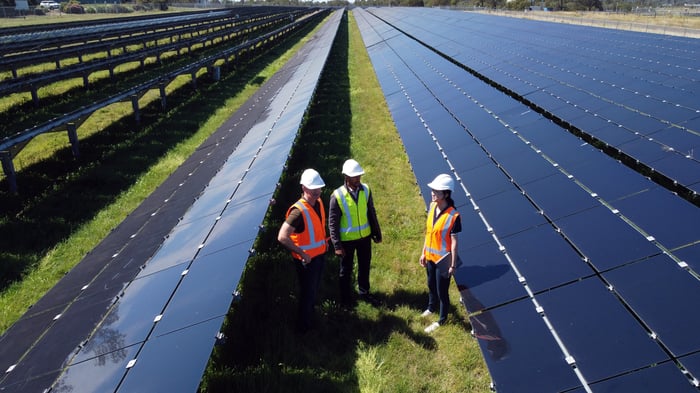
Image source: Getty Images.
Brookfield Asset Management owns the organizations that manage these entities, generating dividend-supporting management fees of its own.
The arm in focus here, however, is the aforementioned Brookfield Renewable, which oversees a portfolio of privately owned stakes in solar power farms, wind energy assets, and hydropower facilities collectively capable of producing 47,300 megawatts' worth of power.
Now add 570 megawatts to that count. That's the potential output of the European wind, solar, and energy storage assets that Brookfield will soon be co-acquiring with Mitsubishi HC Capital. Presumably, this purchase will help Brookfield Renewable achieve its long-term annual dividend growth target of 5% to 9%, contributing to its larger total annual return target of 12% to 15%.
Just more of the same capital recycling
It's actually not noteworthy, simply because it's not particularly unusual -- this is what Brookfield Renewable does. This is the third such joint venture announced just this year. The first one was the co-creation of Northview Energy along with partners British Columbia Investment Management Corp. and Norges Bank Investment Management. Then, in late March, Brookfield and Canadian investment manager La Caisse agreed to wholly acquire renewable energy developer Boralex.
More importantly for interested investors, these examples illustrate why Brookfield Renewable and Brookfield Asset Management are consistently successful and capable of market-beating growth: the company acquires businesses that are already up and running and cash-flow-positive, as well as businesses with potential for lateral expansion.
There's a term for this model, too. In its own words, when describing the purchase of the assets that will become Northview Energy, "we are enhancing our capital recycling strategy by launching private renewable vehicles while continuing to scale platform, minority stake, and asset-level monetizations."
In other words, Brookfield Renewable isn't making things unnecessarily difficult by building expensive projects from scratch -- projects that won't help fund themselves for years -- that require sizable, recurring, and dilutive injections of outside funding.
It's not making things unpredictable for shareholders either. Brookfield wants to co-own and wholly manage its cash-producing businesses so it can produce its targeted dividend growth without being forced to make decisions that ultimately undermine its long-term potential.
You can step into BEPC today while its forward-looking dividend yield stands at 4.3%. Just don't confuse BEPC with BEP, which is a dividend-paying limited partnership version of the same ticker, which means taxation of its income can be a little bit complicated.
Should you buy stock in Brookfield Renewable right now?
Before you buy stock in Brookfield Renewable, consider this:
The Motley Fool Stock Advisor analyst team just identified what they believe are the 10 best stocks for investors to buy now… and Brookfield Renewable wasn’t one of them. The 10 stocks that made the cut could produce monster returns in the coming years.
Consider when Netflix made this list on December 17, 2004... if you invested $1,000 at the time of our recommendation, you’d have $415,040!* Or when Nvidia made this list on April 15, 2005... if you invested $1,000 at the time of our recommendation, you’d have $1,256,076!*
Now, it’s worth noting Stock Advisor’s total average return is 920% — a market-crushing outperformance compared to 207% for the S&P 500. Don't miss the latest top 10 list, available with Stock Advisor, and join an investing community built by individual investors for individual investors.
See the 10 stocks »
*Stock Advisor returns as of June 18, 2026.
James Brumley has no position in any of the stocks mentioned. The Motley Fool has positions in and recommends Brookfield Asset Management. The Motley Fool recommends Brookfield Infrastructure Partners, Brookfield Renewable, and Brookfield Renewable Partners. The Motley Fool has a disclosure policy.
Recommended Articles


