


Finally, A Little Good News for EV Stocks -- Especially This Detroit Automaker
Key Points
U.S. EV sales have jumped to their strongest result since the end of the $7,500 federal EV tax credit.
Moreover, EV average transaction prices have declined for 11 consecutive months.
Incentives to help drive sales are roughly twice the amount for EVs as for new gasoline vehicles.
- 10 stocks we like better than Ford Motor Company ›
If there's one word in the dictionary that Wall Street and investors both dislike, it's the word "uncertainty." Uncertainty in the automotive industry is particularly bad, as the vehicle design and development process can take many months, and it's done in anticipation of markets years down the road.
Last year, the Trump administration injected uncertainty into the automotive industry when it slapped new tariffs on imported vehicles and automotive parts, and ended the valuable $7,500 federal electric vehicle (EV) tax credit. The ensuing drop in EV demand and sales was significant.
Where to invest $1,000 right now? Our analyst team just revealed what they believe are the 10 best stocks to buy right now, when you join Stock Advisor. See the stocks »
However, there's finally a little good news for EV makers such as Tesla (NASDAQ: TSLA), and even more for traditional automakers such as Ford Motor Company (NYSE: F).
EV demand returns!
Even without the federal tax credit helping to offset the high cost of EVs, sales of EVs jumped to their strongest level since the government ended the EV tax credit last fall. Preliminary numbers estimate that more than 85,000 EVs were sold in the U.S. in May, marking a noticeable rebound since the prior year's third-quarter result.
As investors know, the automotive industry has a lot of moving parts, and understanding the driving forces is just as important as the sales data itself. One such insight from May is that, according to Kelley Blue Book data, the industry's average transaction price (ATP) for a new EV fell to $54,532 in May. While that's still roughly $4,500 higher than a comparable new gasoline-powered vehicle, it's still a 4% decline in EV ATPs from the prior year. It also marks the 11th consecutive month of year-over-year declines.
That prices continue to fall as demand rebounds could suggest a couple of things. It could mean that there's still a surplus of inventory for the EV industry to work through. It also suggests that automakers are bringing down vital costs despite a rise in demand that should support pricing. Many continue to consolidate platforms, build scale, and advance battery technology (still the most expensive component of an EV).
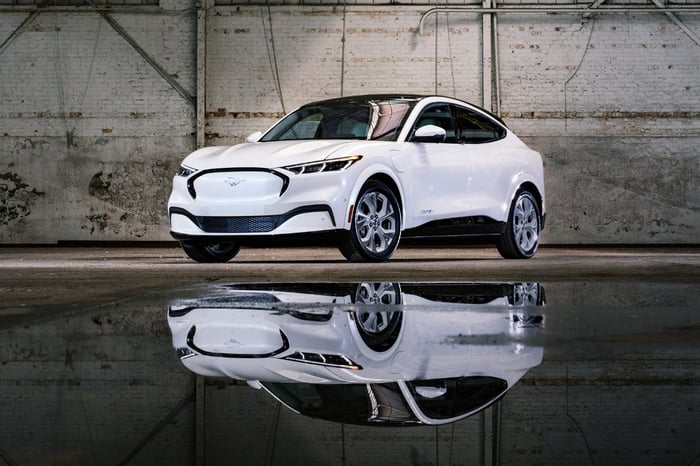
Image source: Ford Motor Company.
Incentives remain elevated
Another factor that investors need to keep an eye on is automotive industry incentives, which, if left unchecked, can hinder margins and profitability. In May, automakers spent roughly 14% of an EV's ATP on incentives to help move product, which equates to roughly $7,600 per vehicle. For context, that's about double the broader industry average, and it hasn't shown signs of easing just yet.
Rising gas prices are also driving interest and consideration of EVs higher, both in the U.S. and overseas. Tesla -- which still accounts for about half of all U.S. EV sales -- put some pressure on prices, as its price cuts contributed to its ATPs declining 3.4% compared to the prior year.
What it all means
The rebound in demand comes at a crucial time for Ford. The company is launching its Universal EV Platform on a new midsize EV truck in 2027 that it expects to be profitable early in its lifetime. Ford's EV sales have lagged as it adjusted its strategy and canceled the current version of its F-150 Lightning. That contributed to Ford's year-to-date 58% decline in EVs (not including hybrids), and its 31% decline in electrified vehicles (including hybrids).
While sales of EVs in the U.S. have lagged growth found in many overseas regions, and have been much slower to ramp up than analysts and automakers had planned, this is a great sign that real demand is returning to the EV industry. Costs continue to decline, and automakers are producing better and more compelling EV products. The future for the EV business is bright, even if it takes a little bit longer to get there due to speed bumps and slower adoption from U.S. consumers.
Should you buy stock in Ford Motor Company right now?
Before you buy stock in Ford Motor Company, consider this:
The Motley Fool Stock Advisor analyst team just identified what they believe are the 10 best stocks for investors to buy now… and Ford Motor Company wasn’t one of them. The 10 stocks that made the cut could produce monster returns in the coming years.
Consider when Netflix made this list on December 17, 2004... if you invested $1,000 at the time of our recommendation, you’d have $415,040!* Or when Nvidia made this list on April 15, 2005... if you invested $1,000 at the time of our recommendation, you’d have $1,256,076!*
Now, it’s worth noting Stock Advisor’s total average return is 923% — a market-crushing outperformance compared to 207% for the S&P 500. Don't miss the latest top 10 list, available with Stock Advisor, and join an investing community built by individual investors for individual investors.
See the 10 stocks »
*Stock Advisor returns as of June 18, 2026.
Daniel Miller has positions in Ford Motor Company. The Motley Fool has positions in and recommends Tesla. The Motley Fool has a disclosure policy.
Recommended Articles


