


9 Words From Fed Chair Kevin Warsh That Have Shaken Wall Street to Its Core
Key Points
Kevin Warsh just led his first Federal Open Market Committee (FOMC) meeting as Fed chair, with policymakers keeping the federal funds target rate unchanged (as expected).
However, the central bank's new head is instituting several changes, including the removal of forward-looking guidance.
Less transparency from America's foremost financial institution can create more questions than it resolves, which is a recipe for disaster for the Dow Jones Industrial Average, S&P 500, and Nasdaq Composite.
- 10 stocks we like better than S&P 500 Index ›
The last five weeks have been eventful on Wall Street, to say the least. We've watched the Dow Jones Industrial Average (DJINDICES: ^DJI), S&P 500 (SNPINDEX: ^GSPC), and Nasdaq Composite (NASDAQINDEX: ^IXIC) explode to new highs, witnessed the largest initial public offering in Wall Street's storied history, and saw an ultra-rare changing of the guard at the Federal Reserve. President Donald Trump's handpicked successor to Jerome Powell, Kevin Warsh, is now leading the charge.
Yesterday, June 17, marked Warsh's first meeting as head of the Federal Open Market Committee (FOMC) -- the 12-person body, including Warsh, responsible for setting the nation's monetary policy. While several aspects of this meeting went according to expectations, one nine-word comment from the new Fed chair has shaken Wall Street to its core.
Where to invest $1,000 right now? Our analyst team just revealed what they believe are the 10 best stocks to buy right now, when you join Stock Advisor. See the stocks »
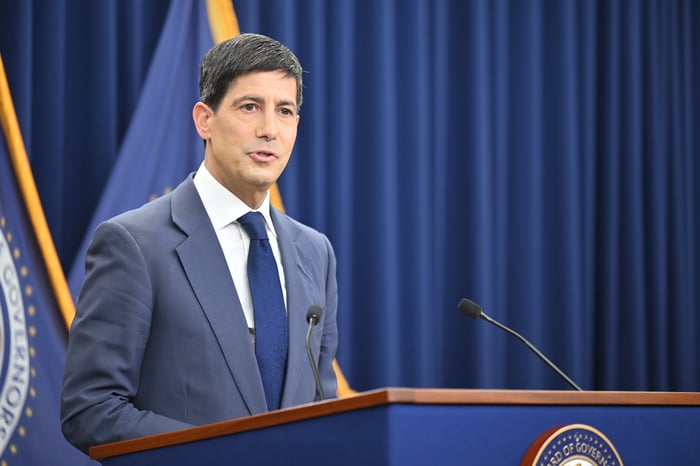
Fed Chair Kevin Warsh delivering remarks. Image source: Official Federal Reserve Photo.
It's a new era for the Federal Reserve
The headline from the June 17 FOMC meeting is that policymakers left the federal funds target rate unchanged... but this doesn't even begin to tell the full story.
The FOMC meeting statement announcing its decision was markedly shorter than during Powell's tenure, with Warsh proclaiming a desire to provide a statement that "just gives you the facts."
Additionally, the latest FOMC statement was missing the easing bias language that had been a staple for more than a year. Powell's final FOMC meeting on April 29 featured four dissents, three of which were opposed to the inclusion of the easing bias statement. While the FOMC didn't signal an official shift to a neutral bias, what wasn't said speaks volumes.
BREAKING: Fed Chair Kevin Warsh announces that the Fed has "dropped" forward guidance.
-- The Kobeissi Letter (@KobeissiLetter) June 17, 2026
"Forward guidance is not the business we should be in," he says.
But it's the new Fed chair's commentary with the press after the FOMC meeting that's stirred Wall Street and investors. In response to a multi-pronged question about price stability, elevated inflation, and the circumstances in which the Fed would take action, Warsh retorted:
Others have, I'd say, different views and think, as a general proposition, forward guidance isn't the business we should be in.
This nine-word phrase, "forward guidance isn't the business we should be in," confirms that Warsh is going to make it considerably tougher for investors to predict what policymakers will do next. Removing the transparency and predictability that have made the central bank a foundational pillar for Wall Street may backfire on a historically expensive stock market.
Case in point: Warsh's first FOMC meeting coincided with the quarterly release of the dot plot (officially, the "Summary of Economic Projections"). The dot plot provides projections of where policymakers expect interest rates to go in the future. Though Warsh didn't offer projections, nine of the other 18 members (not all are voting FOMC members) expect interest rates to rise before the end of 2026.
At the start of the year, the bond market was pricing in 2 Fed rate CUTS.
-- Charlie Bilello (@charliebilello) June 17, 2026
After today's FOMC meeting, it is now pricing in 2 Fed rate HIKES.
That's a 1% swing in expectations.
The 2-Year Treasury yield entered the year at 3.48%. It ended the day at 4.21%. pic.twitter.com/zvVru7ValQ
While Jerome Powell's leadership style was to overshare and prepare financial markets for any shift in FOMC policy, Warsh prefers to leave these forward-looking guides on the back burner, believing they lead to inefficient markets that may respond to whims rather than facts.
Although it's good to see that Warsh and his colleagues plan to tackle America's biggest problem, price stability, the removal of forward-looking guidance can create more questions than it removes. That's not a recipe for success for the Dow Jones Industrial Average, S&P 500, and Nasdaq Composite.
Should you buy stock in S&P 500 Index right now?
Before you buy stock in S&P 500 Index, consider this:
The Motley Fool Stock Advisor analyst team just identified what they believe are the 10 best stocks for investors to buy now… and S&P 500 Index wasn’t one of them. The 10 stocks that made the cut could produce monster returns in the coming years.
Consider when Netflix made this list on December 17, 2004... if you invested $1,000 at the time of our recommendation, you’d have $424,531!* Or when Nvidia made this list on April 15, 2005... if you invested $1,000 at the time of our recommendation, you’d have $1,273,016!*
Now, it’s worth noting Stock Advisor’s total average return is 940% — a market-crushing outperformance compared to 209% for the S&P 500. Don't miss the latest top 10 list, available with Stock Advisor, and join an investing community built by individual investors for individual investors.
See the 10 stocks »
*Stock Advisor returns as of June 18, 2026.
Sean Williams has no position in any of the stocks mentioned. The Motley Fool has no position in any of the stocks mentioned. The Motley Fool has a disclosure policy.
Recommended Articles


