


Gold price continues losing streak as hot inflation pushes back Fed rate-cut expectations
- Gold price remains under pressure as sticky US CPI data suggests interest rates will stay high.
- Surging rental and healthcare costs drive price pressures in the US economy.
- The US Dollar extends its upside amid a risk-off market sentiment, further weighing on Gold.
Gold price (XAU/USD) continues its five-day losing spell on Wednesday as hot United States inflation data suggests the Federal Reserve (Fed) will hold back from cutting interest rates at its monetary policy meeting in May. The opportunity cost of holding non-yielding assets, such as Gold, has risen as the Fed is expected to keep interest rates at their current level for a longer period.
The absence of evidence ensuring the return of the underlying inflation to the 2% target has strengthened the need to maintain a hawkish narrative on interest rates. Fed policymakers are not expected to bring down key rates until they see price pressures easing for a decent period.
The US Consumer Price Index (CPI) grew faster than market expectations due to an uptick in rental and healthcare costs.
Contrary to market action, US Treasury Secretary Janet Yellen said there is progress in the war against persistent inflation despite surging rental prices on Tuesday.
Daily Digest Market Movers: Gold price extends its losing spell for sixth trading session
- Gold price declines toward a two-month low of around $1,975 as stubborn United States inflation data for January has cooled down expectations of rate cuts by the Federal Reserve in the May monetary policy meeting.
- The CME Fedwatch tool now shows that traders see a 38% decline in interest rates by 25 basis points (bps) for the May meeting, which was almost 50% before the release of the US inflation data.
- On Tuesday, the US Bureau of Labor Statistics (BLS) showed that core inflation rose steadily by 3.9%, while the headline inflation grew at a moderate pace of 3.1% against expectations of 2.9%.
- The Fed generally considers core inflation data for preparing monetary policy remarks, and sticky underlying price pressures are sufficient for Fed policymakers to maintain their hawkish rhetoric.
- Now, expectations for a rate cut have shifted to the June monetary policy meeting as stubborn price pressures would allow Fed policymakers to emphasize holding interest rates in the range of 5.25%-5.50% for a longer period.
- The interest rate decision is widely anticipated to remain unchanged for the March monetary policy meeting.
- Meanwhile, the US Dollar Index (DXY) has refreshed a three-week high at 104.90 amid a dismal market mood. The US Dollar attracts higher foreign inflows if the Fed maintains a restrictive stance.
- 10-year US Treasury yields have corrected mildly to 4.29% in the London session on Wednesday but are still almost 3% high this week.
- Going forward, market participants will focus on the monthly US Retail Sales data for January, which will be published on Thursday.
- Investors anticipate that Retail Sales dropped by 0.1% against a 0.6% increase in December. This might weigh on the US Dollar as weak sales at retail stores indicate a decline in household spending.
Technical Analysis: Gold price prints a fresh two-month low below $1,990
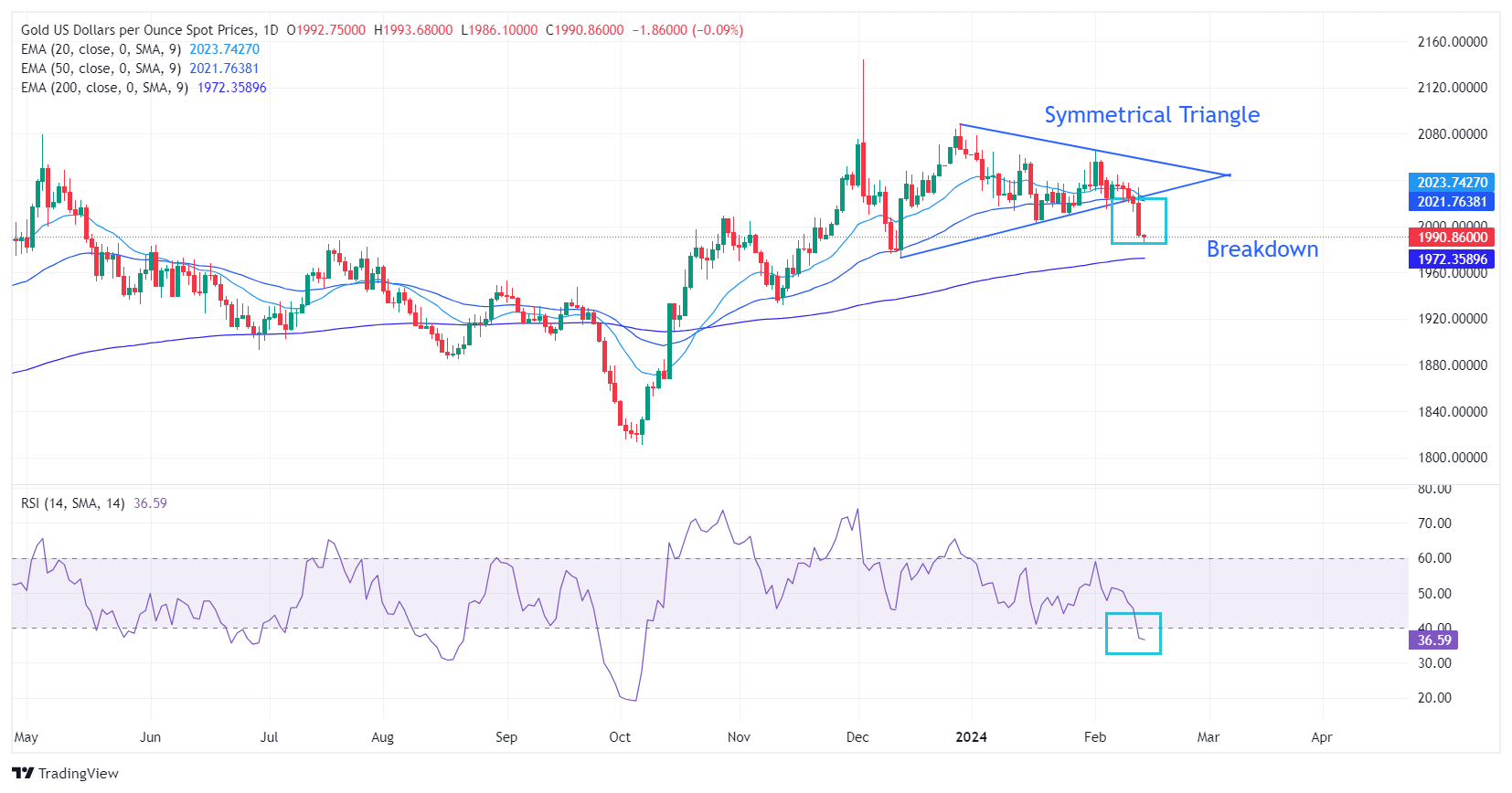
Gold price refreshes a two-month low below $1,990. The precious metal witnesses an intense sell-off after surrendering the psychological support of $2,000. The Yellow Metal is expected to face more downside as a breakdown of the Symmetrical Triangle chart pattern seems confirmed due to wider bearish tick formation on Tuesday.
The short-term appeal has turned bearish as the 20 and 50-day Exponential Moving Averages (EMAs) have turned down. The Gold price is expected to find support near the 200-day EMA, which trades around $1,970.
The 14-period Relative Strength Index (RSI) has slipped below 40.00 for the first time in more than four months. More downside looks likely amid an absence of oversold and divergence signals.
Gold FAQs
Why do people invest in Gold?
Gold has played a key role in human’s history as it has been widely used as a store of value and medium of exchange. Currently, apart from its shine and usage for jewelry, the precious metal is widely seen as a safe-haven asset, meaning that it is considered a good investment during turbulent times. Gold is also widely seen as a hedge against inflation and against depreciating currencies as it doesn’t rely on any specific issuer or government.
Who buys the most Gold?
Central banks are the biggest Gold holders. In their aim to support their currencies in turbulent times, central banks tend to diversify their reserves and buy Gold to improve the perceived strength of the economy and the currency. High Gold reserves can be a source of trust for a country’s solvency. Central banks added 1,136 tonnes of Gold worth around $70 billion to their reserves in 2022, according to data from the World Gold Council. This is the highest yearly purchase since records began. Central banks from emerging economies such as China, India and Turkey are quickly increasing their Gold reserves.
How is Gold correlated with other assets?
Gold has an inverse correlation with the US Dollar and US Treasuries, which are both major reserve and safe-haven assets. When the Dollar depreciates, Gold tends to rise, enabling investors and central banks to diversify their assets in turbulent times. Gold is also inversely correlated with risk assets. A rally in the stock market tends to weaken Gold price, while sell-offs in riskier markets tend to favor the precious metal.
What does the price of Gold depend on?
The price can move due to a wide range of factors. Geopolitical instability or fears of a deep recession can quickly make Gold price escalate due to its safe-haven status. As a yield-less asset, Gold tends to rise with lower interest rates, while higher cost of money usually weighs down on the yellow metal. Still, most moves depend on how the US Dollar (USD) behaves as the asset is priced in dollars (XAU/USD). A strong Dollar tends to keep the price of Gold controlled, whereas a weaker Dollar is likely to push Gold prices up.
Artigos Recomendados


