


Gold price slips as US inflation fuels small Fed rate cut
- Gold retreats from a daily high of $2,529 after US inflation data boosts odds of a 25 bps Fed rate cut.
- Rising US Treasury yields and a stronger US Dollar weigh on the non-yielding metal with the 10-year T-note climbing to 3.655%.
- CME FedWatch Tool shows 71% chance of a 25 bps cut.
Gold fell late in the North American session, down by 0.18%, after hitting a daily peak of $2,529. US inflation data prompted traders to cut longs in the non-yielding metal due to increasing odds that the Federal Reserve (Fed) will kick off its easing cycle with a 25-basis-point (bps) interest rate cut. The XAU/USD trades at $2,511.
Sentiment remains positive after the US Bureau of Labor Statistics revealed August’s Consumer Price Index (CPI). Monthly headline inflation remained unchanged, while the monthly core, which excludes food and energy, ticked up a tenth.
Market participants pushed US Treasury yields higher amid fears that the Fed could be dissuaded from cutting interest rates by 50 basis points (bps) and instead might opt for 25 bps next week.
The US 10-year Treasury rose to 3.655%, up by one and a half bps. The Greenback was bolstered after the news, hitting a daily high of 101.82, according to the US Dollar Index (DXY). At the time of writing, the DXY is virtually unchanged at 101.68.
Investors had trimmed their odds for a 50 bps Fed rate cut, according to the CME FedWatch Tool. The chances are at 29%, while 25 bps lie at 71%.
The Presidential debate between Vice President Kamala Harris and former President Donald Trump was won by Harris, according to a CNN poll.
In the geopolitical space, US Secretary of State Anthony Blinken and the UK’s David Lammy heightened concerns that the US and UK could grant Ukraine the ability to use weapons from Western nations to strike inside Russia.
Daily digest market moves: Gold price drops following US CPI release
- US Bureau of Labor Statistics’ CPI data revealed that headline inflation for August dipped from 2.9% to 2.6% YoY) as expected.
- However, US core CPI, which excludes volatile items and is considered a more accurate inflation gauge, remained unchanged at 3.2% YoY. On a monthly basis, core CPI rose from 0.2% to 0.3%, while headline CPI stood at 0.2% MoM.
- Data from the Chicago Board of Trade suggests the Fed is now expected to cut at least 98 basis points this year, down from 108 basis points a day ago, according to the December 2024 fed funds rate futures contract.
- Last Friday, Fed officials were dovish. New York Fed President John Williams said that cutting rates will help keep the labor market balanced, while Governor Christopher Waller said that “the time has come” to ease policy.
- Chicago Fed President Austan Goolsbee was dovish, saying policymakers have an “overwhelming” consensus to reduce borrowing costs.
- It is worth noting that Fed officials entered their blackout period ahead of the Federal Open Market Committee (FOMC) monetary policy meeting.
- Data from the Chicago Board of Trade indicates that the Fed is anticipated to cut at least 98 bps this year, based on the fed funds rate futures contract for December 2024.
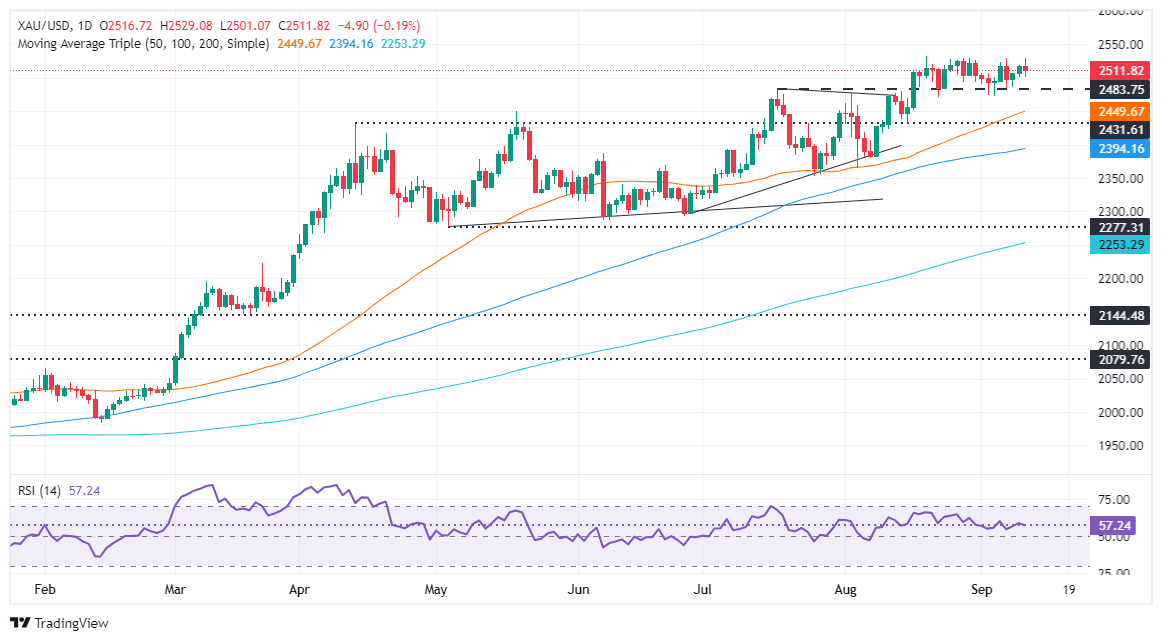
Technical outlook: Gold price clings to $2,500 despite posting losses
Gold price is subdued, consolidated within the $2,500 to $2,531 area. Even though momentum remains bullish, as depicted by the Relative Strength Index (RSI), it is flat above its neutral line, indicating that neither buyers nor sellers are in control.
If XAU/USD clears the all-time high of $2,531, the next resistance would be the $2,550 mark. Once hurdled, the next stop would be the psychological $2,600 figure.
Conversely, if Gold price slides below $2,500, the next support would be the August 22 low at $2,470. On further weakness, the next demand zone would be the confluence of the May 20 high, which turned into support, and the 50-day Simple Moving Average (SMA) between $2,450 and $2,440.
Gold FAQs
Gold has played a key role in human’s history as it has been widely used as a store of value and medium of exchange. Currently, apart from its shine and usage for jewelry, the precious metal is widely seen as a safe-haven asset, meaning that it is considered a good investment during turbulent times. Gold is also widely seen as a hedge against inflation and against depreciating currencies as it doesn’t rely on any specific issuer or government.
Central banks are the biggest Gold holders. In their aim to support their currencies in turbulent times, central banks tend to diversify their reserves and buy Gold to improve the perceived strength of the economy and the currency. High Gold reserves can be a source of trust for a country’s solvency. Central banks added 1,136 tonnes of Gold worth around $70 billion to their reserves in 2022, according to data from the World Gold Council. This is the highest yearly purchase since records began. Central banks from emerging economies such as China, India and Turkey are quickly increasing their Gold reserves.
Gold has an inverse correlation with the US Dollar and US Treasuries, which are both major reserve and safe-haven assets. When the Dollar depreciates, Gold tends to rise, enabling investors and central banks to diversify their assets in turbulent times. Gold is also inversely correlated with risk assets. A rally in the stock market tends to weaken Gold price, while sell-offs in riskier markets tend to favor the precious metal.
The price can move due to a wide range of factors. Geopolitical instability or fears of a deep recession can quickly make Gold price escalate due to its safe-haven status. As a yield-less asset, Gold tends to rise with lower interest rates, while higher cost of money usually weighs down on the yellow metal. Still, most moves depend on how the US Dollar (USD) behaves as the asset is priced in dollars (XAU/USD). A strong Dollar tends to keep the price of Gold controlled, whereas a weaker Dollar is likely to push Gold prices up.
Artigos Recomendados


