




EUR/JPY Price Forecast: Flirt with 169.25-169.30 hurdle; seems poised to appreciate further
- EUR/JPY regains positive traction amid a combination of supporting factors.
- A weaker USD benefits the EUR, while a softer Tokyo CPI undermines the JPY.
- The daily RSI remains close to the overbought zone and might cap the cross.
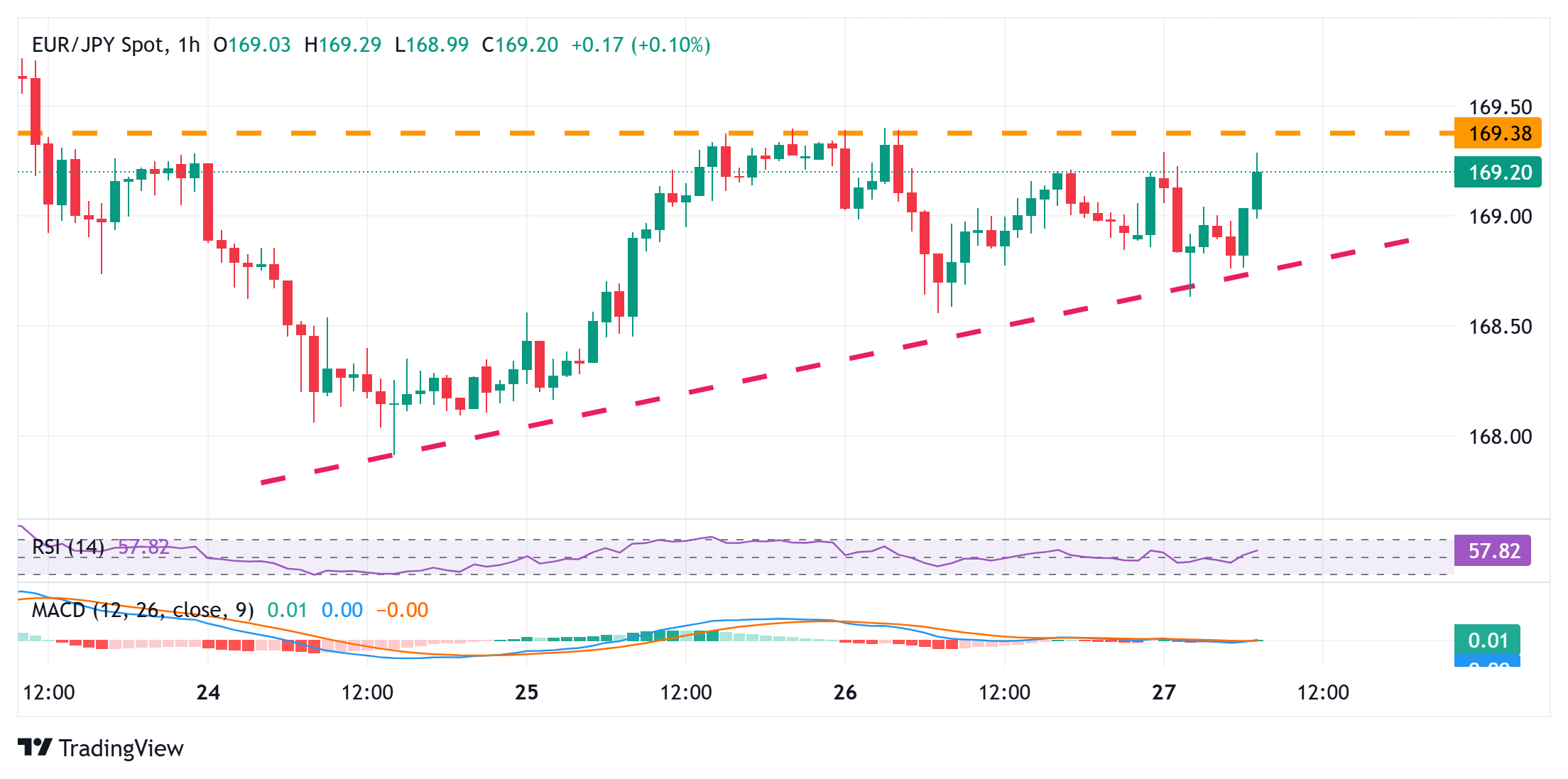
The EUR/JPY cross reverses an intraday dip to the 168.65-168.60 region and climbs to the top end of its daily range during the early part of the European session on Friday. Spot prices currently trade around the 169.25--169.30 supply zone, up nearly 0.20% for the day, and seem poised to appreciate further.
The shared currency continues to benefit from the prevailing US Dollar (USD) selling bias. The Japanese Yen (JPY), on the other hand, attracts some intraday sellers following the release of a softer Tokyo CPI print. A separate report showed that Japan's Retail Sales grew at the slowest pace since February and reaffirmed bets that the Bank of Japan (BoJ) might forgo a rate hike in 2025. This, along with a positive risk tone, undermines the safe-haven JPY and validates the positive outlook for the EUR/JPY cross.
However, the Relative Strength Index (RSI) on the daily chart remains close to overbought territory, which, in turn, might hold back traders from placing fresh bullish bets. Hence, it will be prudent to wait for an extension of a multi-day-old consolidative price move before positioning for any further appreciating move. Nevertheless, the bias seems tilted in favor of the EUR/JPY bulls, suggesting that any corrective might continue to find support near the weekly trend line, near the 168.70-168.65 area.
A convincing break below the latter, however, might prompt some technical selling and pave the way for some meaningful decline. The EUR/JPY cross might then accelerate the slide towards the 168.00 round figure en route to the 167.60-167.55 region before eventually dropping to the lower end of the weekly range, around the 167.00-166.90 area. The latter should act as a key pivotal point, which if broken decisively would negate the constructive outlook and shift the near-term bias in favor of bearish traders.
On the flip side, the 169.70 area, or a nearly one-year high touched on Monday, could offer some resistance. Some follow-through buying, leading to a subsequent strength beyond the 170.00 psychological mark, will be seen as a fresh trigger for bullish. The EUR/JPY cross might then climb further beyond the 170.40 intermediate hurdle, towards reclaiming the 171.00 mark for the first time since June 2024.
EUR/JPY 1-hour chart
Bank of Japan FAQs
The Bank of Japan (BoJ) is the Japanese central bank, which sets monetary policy in the country. Its mandate is to issue banknotes and carry out currency and monetary control to ensure price stability, which means an inflation target of around 2%.
The Bank of Japan embarked in an ultra-loose monetary policy in 2013 in order to stimulate the economy and fuel inflation amid a low-inflationary environment. The bank’s policy is based on Quantitative and Qualitative Easing (QQE), or printing notes to buy assets such as government or corporate bonds to provide liquidity. In 2016, the bank doubled down on its strategy and further loosened policy by first introducing negative interest rates and then directly controlling the yield of its 10-year government bonds. In March 2024, the BoJ lifted interest rates, effectively retreating from the ultra-loose monetary policy stance.
The Bank’s massive stimulus caused the Yen to depreciate against its main currency peers. This process exacerbated in 2022 and 2023 due to an increasing policy divergence between the Bank of Japan and other main central banks, which opted to increase interest rates sharply to fight decades-high levels of inflation. The BoJ’s policy led to a widening differential with other currencies, dragging down the value of the Yen. This trend partly reversed in 2024, when the BoJ decided to abandon its ultra-loose policy stance.
A weaker Yen and the spike in global energy prices led to an increase in Japanese inflation, which exceeded the BoJ’s 2% target. The prospect of rising salaries in the country – a key element fuelling inflation – also contributed to the move.
Artigos Recomendados


