




USD/CAD holds steady despite Canada’s mixed CPI print
- USD/CAD remains within a well-defined range as markets digest Canada’s mixed inflation data.
- The US Dollar remains under pressure, with the focus shifting to Wednesday’s tax bill vote.
- The Loonie pair clings to Fibonacci support, with resistance firming at 1.400.
USD/CAD is trading in a tight range in the early hours of the US session as markets react to Canada’s latest Consumer Price Index (CPI) data and shift focus to Wednesday’s US House of Representatives vote on President Donald Trump’s proposed tax bill.
At the time of writing, USD/CAD is trading in a well-defined range, forming around a key level of Fibonacci support around 1.3944, with both technical and fundamental factors contributing to price action.
Mixed Canadian inflation data and US fiscal policy take the spotlight
Canada’s Consumer Price Index (CPI) data for April, released by Statistics Canada at 12:30 GMT on Tuesday, presented a mixed inflation picture that could influence the Bank of Canada’s (BoC) next policy move.
Headline CPI (YoY) for April rose to 1.7%, slightly above expectations of 1.6%, but sharply lower than March’s 2.3%. On a monthly basis, CPI unexpectedly declined by 0.1%, missing forecasts for a 0.5% increase and slowing from March’s 0.3% rise. Meanwhile, Core CPI (MoM), which excludes food and energy, increased by 0.5%, beating the 0.2% consensus and up from the previous 0.1%. Core CPI (YoY) climbed to 2.5% from 2.2% in March.
The data is critical as it feeds into expectations for the BoC’s rate decision in June as the weaker headline number strengthens the case for a rate cut, while firmer core inflation may limit the scope of policy easing and offer support to the Canadian dollar (CAD).
In the United States (US), attention has shifted to Wednesday’s House vote on President Trump’s “One Big Beautiful Bill,” which seeks to extend the 2017 Tax Cuts and introduce new relief measures.
While potentially supportive of near-term growth, the bill raises concerns over long-term debt sustainability, adding pressure on the US Dollar.
Additionally, remarks from several Fed officials, Barkin, Musalem, Kugler, Bostic, Daly, and Hammack, are being closely monitored for insights into the Fed’s policy stance amid ongoing fiscal and economic uncertainty.
USD/CAD tests Moving Average support, as psychological resistance firming at 1.400
The USD/CAD daily chart shows the pair consolidating just below the key resistance level at 1.39444, which aligns with the 61.8% Fibonacci retracement (Fib) level of the September-February rally.
Price action is currently caught between the 10-day Simple Moving Average (SMA) at 1.3941 and the 200-day SMA at 1.4025, signaling short-term indecision within a broader bearish context.
The Relative Strength Index (RSI) sits at 49.45, reflecting neutral momentum.
For the upside move, a decisive break and close above 1.39444 would signal upside potential, targeting the 200-day MA and the mid-point of the above-mentioned move at 1.41066.
USD/CAD daily chart
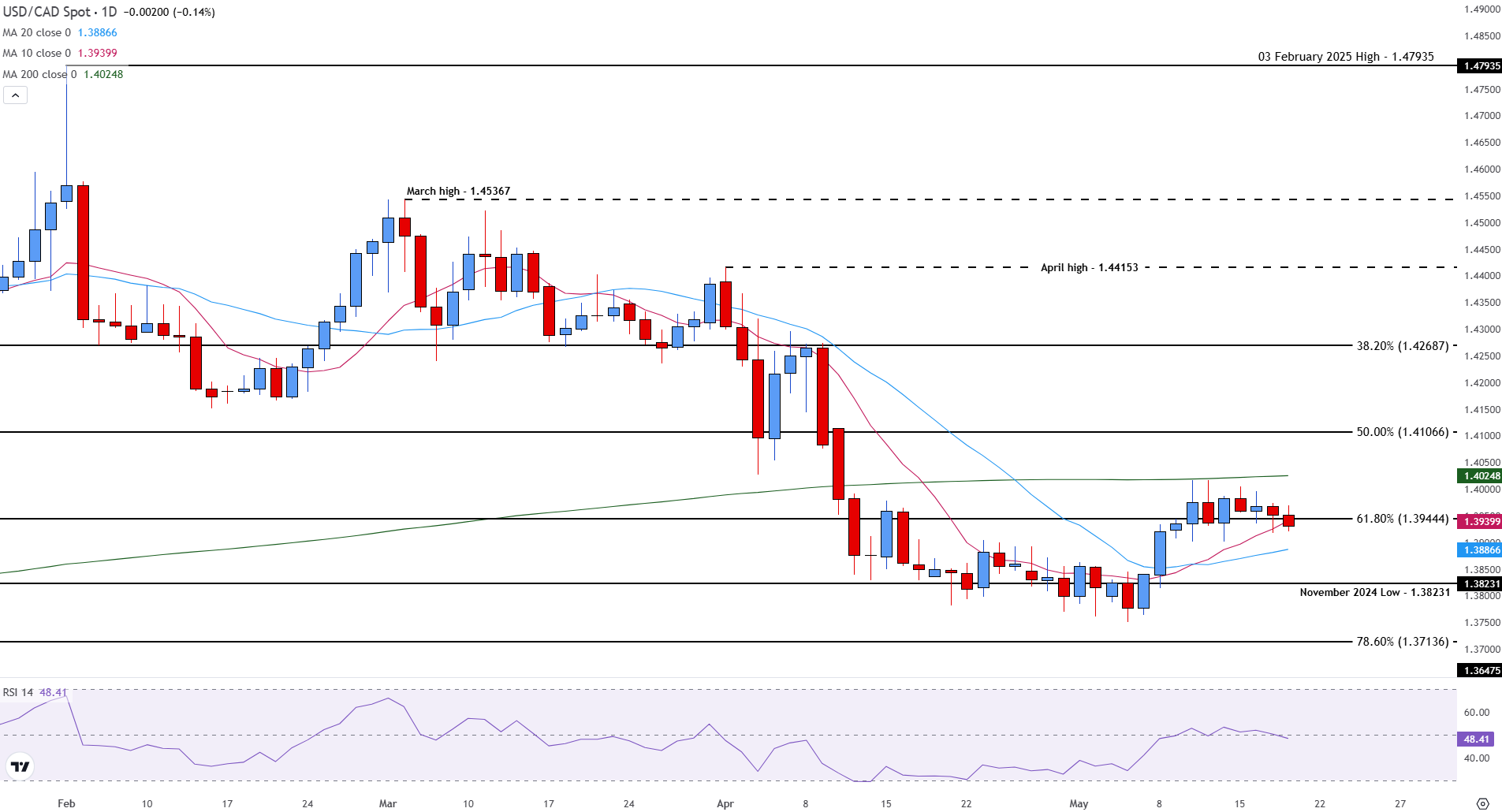
A continuation higher could bring April’s high at 1.44153 into focus, suggesting a possible trend reversal if bullish momentum strengthens.
Meanwhile, failure to clear 1.39444 may trigger a pullback, with immediate support at the November low of 1.3823.
A break below this level would reinforce the downtrend, opening the way to deeper support at the 78.6% Fib level near 1.37136 and potentially 1.36475.
The next directional move hinges on whether bulls can overcome resistance or bears regain control.
Canadian Dollar FAQs
The key factors driving the Canadian Dollar (CAD) are the level of interest rates set by the Bank of Canada (BoC), the price of Oil, Canada’s largest export, the health of its economy, inflation and the Trade Balance, which is the difference between the value of Canada’s exports versus its imports. Other factors include market sentiment – whether investors are taking on more risky assets (risk-on) or seeking safe-havens (risk-off) – with risk-on being CAD-positive. As its largest trading partner, the health of the US economy is also a key factor influencing the Canadian Dollar.
The Bank of Canada (BoC) has a significant influence on the Canadian Dollar by setting the level of interest rates that banks can lend to one another. This influences the level of interest rates for everyone. The main goal of the BoC is to maintain inflation at 1-3% by adjusting interest rates up or down. Relatively higher interest rates tend to be positive for the CAD. The Bank of Canada can also use quantitative easing and tightening to influence credit conditions, with the former CAD-negative and the latter CAD-positive.
The price of Oil is a key factor impacting the value of the Canadian Dollar. Petroleum is Canada’s biggest export, so Oil price tends to have an immediate impact on the CAD value. Generally, if Oil price rises CAD also goes up, as aggregate demand for the currency increases. The opposite is the case if the price of Oil falls. Higher Oil prices also tend to result in a greater likelihood of a positive Trade Balance, which is also supportive of the CAD.
While inflation had always traditionally been thought of as a negative factor for a currency since it lowers the value of money, the opposite has actually been the case in modern times with the relaxation of cross-border capital controls. Higher inflation tends to lead central banks to put up interest rates which attracts more capital inflows from global investors seeking a lucrative place to keep their money. This increases demand for the local currency, which in Canada’s case is the Canadian Dollar.
Macroeconomic data releases gauge the health of the economy and can have an impact on the Canadian Dollar. Indicators such as GDP, Manufacturing and Services PMIs, employment, and consumer sentiment surveys can all influence the direction of the CAD. A strong economy is good for the Canadian Dollar. Not only does it attract more foreign investment but it may encourage the Bank of Canada to put up interest rates, leading to a stronger currency. If economic data is weak, however, the CAD is likely to fall.
Artigos Recomendados


