


The Japanese Yen gets nothing for a strong consumption print
- USD/JPY holds under 160.00 after an early push above the handle failed.
- Japan Retail Trade rose 4% YoY in July against a 3% consensus.
- BoJ September hike pricing sits at 80% to 90% into the G20 meeting.
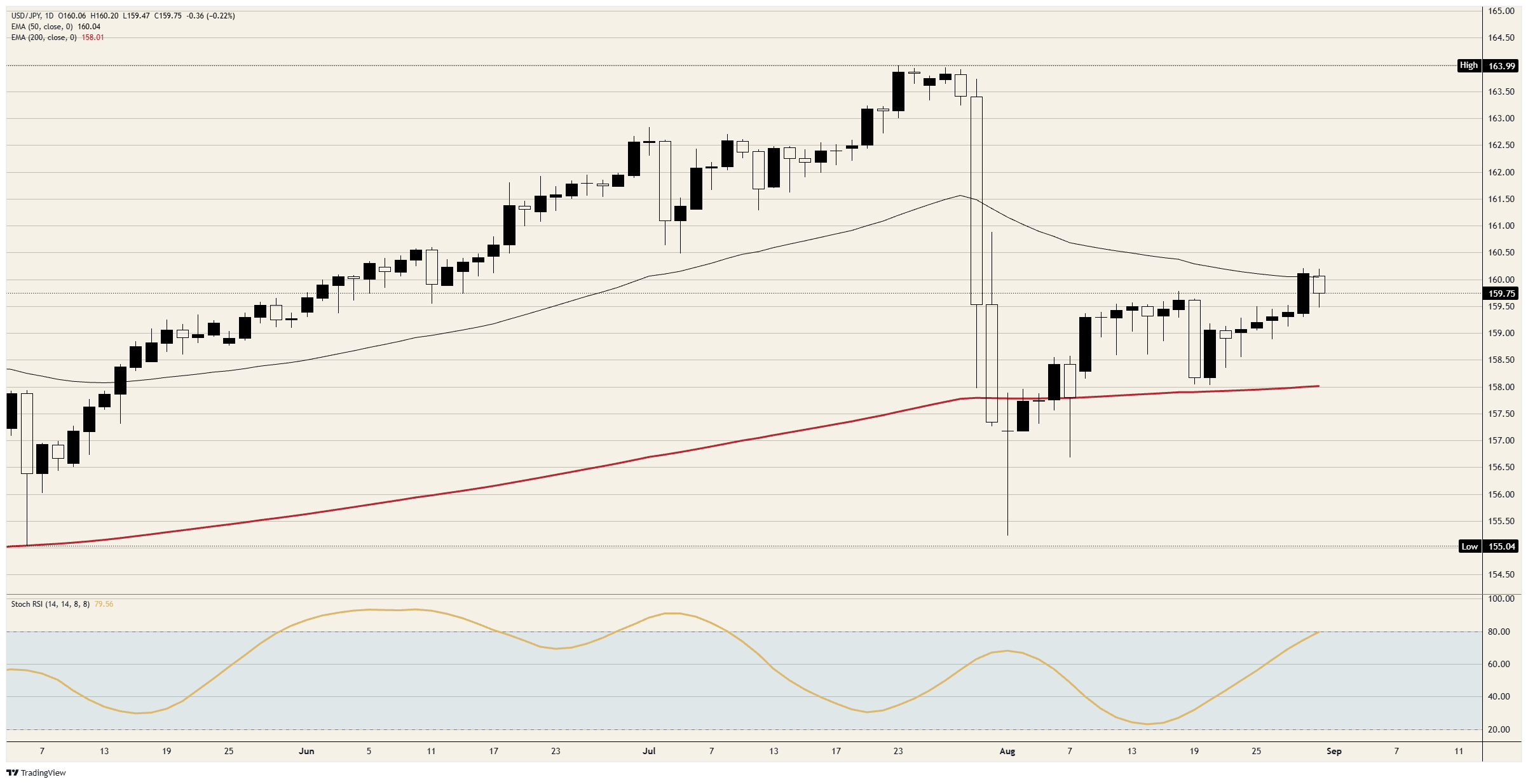
USD/JPY trades a little beneath 160.00 on Monday, down around 0.2% after an early push above the handle was sold back inside the session. The 50-day Exponential Moving Average (EMA) sits directly on 160.00 and has been descending since the late-July intervention, while the 200-day sits on 158.00. The daily Stochastic Relative Strength Index (Stoch RSI) reads near 80, at the top of the range it has held all month.
The best domestic print of the summer bought about a third of a Yen
Japan's July retail figures landed at 23:50 GMT on Sunday and were unambiguous. Retail Trade rose 4% YoY against a 3% consensus and 0.6% prior, the seasonally adjusted monthly series rose 2.4% from a 3.9% contraction, and Large Retailer Sales came in at 1.4% against a 1% decline. That is precisely the domestic demand evidence the Bank of Japan (BoJ) has said it wants before moving again.
The Yen's reward for it was about a third of a Yen and a failed test of a round number. The explanation is not that the data was ignored but that there was nobody left to convert. Pricing for the September 18 decision has been running at 80% to 90% for weeks, and a hike priced that heavily generates no incremental buyer when the evidence for it improves.
The Gulf keeps writing Japan's inflation for it
United States forces struck Iranian rocket launchers on Larak Island on Sunday, the first acknowledged American strike on Iranian positions in a month, and Tehran answered against US bases in Jordan. Crude Oil added more than 2% on the escalation and longer-dated Treasury yields rose with it. Japan imports nearly all of its energy from that region, so a move of that size reaches Japanese consumer prices with very little standing between the two.
The channel has been running all year and it shows in the price data, with underlying inflation grinding back toward target and wholesale prices running well ahead of it. This is the reason a central bank that spent a decade failing to manufacture inflation now has a majority arguing to lean against it. The awkward part is that the same mechanism weakens the currency it is meant to defend, because a larger import bill is a larger standing sale of Yen.
Both legs are hiking now, which is the whole problem
The reason 160.00 keeps being defended from below rather than abandoned sits on the American side. Friday's Jackson Hole keynote from the Federal Reserve chair pushed aggregated futures probabilities for a September 16 increase to near 65%, October to 92%, and left December close to evenly split between one increase and two. A BoJ move to 1.25% against a US target range heading toward 3.75% to 4.00% leaves the differential almost exactly where it started.
That is a different market from the one that existed a week ago, when the Yen was long a tightening cycle nobody else was running. The late-July coordinated intervention took the pair from near 164.00 down to just above 155.00, and four weeks of grinding recovery have carried it all the way back to the handle. Every attempt above 160.00 has been sold, which describes a ceiling rather than a reversal.
Tuesday puts the currency on a formal agenda
The Group of Twenty (G20) finance ministers and central bank governors are meeting in Asheville, North Carolina on Monday and Tuesday, with Japan's finance minister and central bank governor both attending and the Yen an explicit item of discussion. The US Treasury Secretary has publicly encouraged higher Japanese rates as the remedy for a weak currency, which makes any communique language or press remarks a live event risk rather than diplomatic filler.
The scheduled numbers arrive on the same day and they are all American. The Institute for Supply Management (ISM) Manufacturing Purchasing Managers Index (PMI) prints at 14:00 GMT against a 55.2 consensus and 55.6 prior, prices paid against 72 and 71.1, and Job Openings and Labor Turnover Survey (JOLTS) openings against 7.3 million. Private payrolls follow on Wednesday at 47K, and Friday brings Nonfarm Payrolls at a 58K consensus against a 23K contraction, unemployment at 4.1% and average hourly earnings at 0.3% MoM.
Levels
Resistance: 160.00 is the level and the 50-day EMA at the same time, which is why it keeps holding. Through it, 160.50 and 161.00 are the next marks, with the pre-intervention range from 162.00 up to 164.00 above them.
Support: 159.50 is the shelf the grind has been built on, with 159.00 beneath it and the 200-day EMA on 158.00 as the level that would end the recovery rather than interrupt it.
Bias: Bullish. A break above 160.00 is the higher-probability outcome from here, since the differential argument that was supposed to sink the pair has been neutralized by the repricing on the American side. The caveat is momentum: an oscillator near 80 has already spent what it had getting price to the handle, so the break needs Friday's payrolls rather than drift. Invalidation on a daily close beneath 159.00.
USD/JPY daily chart
Japanese Yen FAQs
The Japanese Yen (JPY) is one of the world’s most traded currencies. Its value is broadly determined by the performance of the Japanese economy, but more specifically by the Bank of Japan’s policy, the differential between Japanese and US bond yields, or risk sentiment among traders, among other factors.
One of the Bank of Japan’s mandates is currency control, so its moves are key for the Yen. The BoJ has directly intervened in currency markets sometimes, generally to lower the value of the Yen, although it refrains from doing it often due to political concerns of its main trading partners. The BoJ ultra-loose monetary policy between 2013 and 2024 caused the Yen to depreciate against its main currency peers due to an increasing policy divergence between the Bank of Japan and other main central banks. More recently, the gradually unwinding of this ultra-loose policy has given some support to the Yen.
Over the last decade, the BoJ’s stance of sticking to ultra-loose monetary policy has led to a widening policy divergence with other central banks, particularly with the US Federal Reserve. This supported a widening of the differential between the 10-year US and Japanese bonds, which favored the US Dollar against the Japanese Yen. The BoJ decision in 2024 to gradually abandon the ultra-loose policy, coupled with interest-rate cuts in other major central banks, is narrowing this differential.
The Japanese Yen is often seen as a safe-haven investment. This means that in times of market stress, investors are more likely to put their money in the Japanese currency due to its supposed reliability and stability. Turbulent times are likely to strengthen the Yen’s value against other currencies seen as more risky to invest in.
Artigos Recomendados


