

Canadian Dollar tests five-month highs on Tuesday
- Canadian dollar hits five-month highs, driving USD/CAD to 22-week lows amid broad US Dollar weakness.
- Bank of Canada surprised by economic resilience, despite trade uncertainty and a modest October GDP contraction.
- USMCA review in 2026 looms, keeping longer-term trade risks in focus for CAD.
- USD/CAD deeply oversold, raising near-term pullback or consolidation risk despite bearish momentum.
The Canadian Dollar (CAD) touched its highest bids in five months against the US Dollar (USD) on Tuesday, sending the USD/CAD pair to its lowest levels in 22 weeks. The Greenback is softening across the board heading into the holiday season, sparking a broad-market recovery for other currencies and giving the Loonie a further leg up as bullish CAD momentum extends into the year-end.
The Bank of Canada’s (BoC) latest Meeting Minutes, released on Tuesday, highlighted the BoC’s general surprise at the Canadian economy’s resilience in the face of targeted trade war rhetoric from the Trump administration. Canadian economic data continues to show far more resilience than many policymakers expected earlier in the year, but plenty of trade-headline headwinds remain ahead.
US President Donald Trump’s bespoke ‘USMCA’ trade agreement, which Trump hand-crafted during his first term as a replacement for the long-standing NAFTA trilateral trade arrangement between Canada, the US, and Mexico, is due for its six-year review period in July of 2026. Trump has spent most of his second term expressing frustration at his own self-made trade deal, and is expected to make plenty of hay about achieving a “fair” trade deal, despite USMCA initially being heralded by Trump himself as one of the best trade deals “of all time” when it was first signed.
Daily digest market movers: Canadian Dollar advances amid Greenback softness
- The Canadian Dollar gained ground for a second straight day on Tuesday, climbing 0.44% against the US Dollar and adding to Monday’s 0.34% climb.
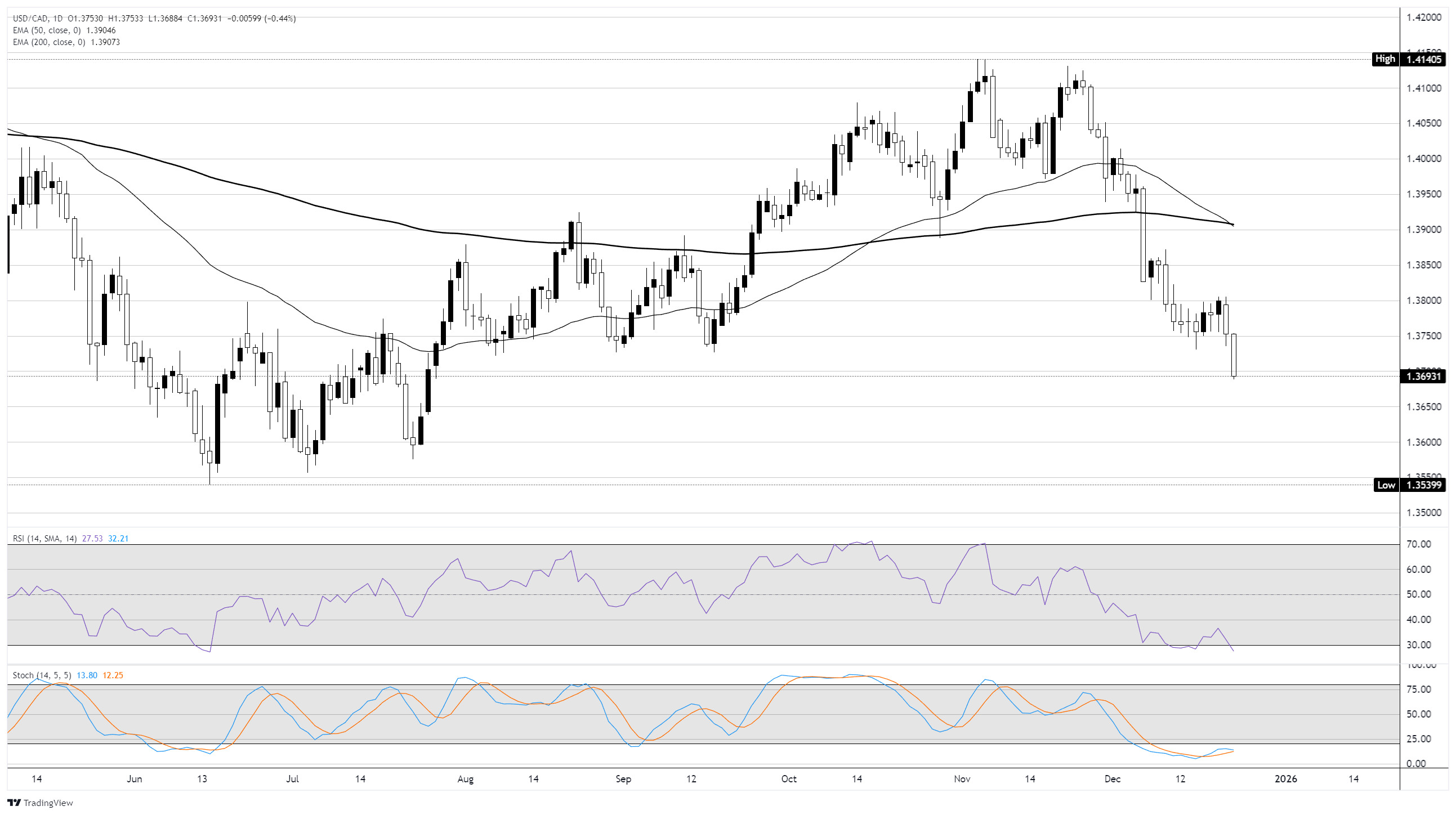
- The USD/CAD pair has fallen to 22-week lows below 1.3700, stretching the Dollar-Loonie pair even deeper into oversold territory.
- Despite clear trade war headwinds looming in 2026, the BoC remains pleasantly surprised that the Canadian economy continues to show resilience where few expected.
- The BoC’s latest comments followed the latest monthly Canadian Gross Domestic Product (GDP), which showed a slight but manageable 0.3% contraction in October.
- Little else remains on the economic data docket for this week, and market dynamics are unlikely to shift course heading into the holidays and the trading week’s early closure beginning on Wednesday.
Canadian Dollar price forecast: Loonie poised to keep taking every inch Greenback markets give up
The USD/CAD daily chart shows a sharp downside extension following a clear breakdown below its 50-day and 200-day moving averages, confirming a shift in short-term momentum in favor of the Canadian Dollar. Price has accelerated lower from the mid-December highs near 1.41 and is now pressing toward the lower end of its recent range, with the latest candles reflecting persistent selling pressure. However, momentum indicators suggest the move may be becoming stretched. The RSI has fallen into the high-20s, well below the 30 threshold typically associated with oversold conditions, while the stochastic oscillator is deeply depressed and beginning to flatten, signaling that downside momentum may be losing intensity.
From an immediate price-action perspective, these oversold signals increase the probability of a near-term pullback or consolidation rather than a straight continuation lower. While the broader trend has clearly weakened, the speed of the recent decline raises the risk of short covering or mean reversion toward nearby resistance zones, such as the broken moving averages or recent minor swing levels. Any rebound would likely be corrective in nature unless momentum indicators meaningfully recover, but the current setup suggests the market may need to pause or retrace before establishing its next directional move.
USD/CAD daily chart
Canadian Dollar FAQs
The key factors driving the Canadian Dollar (CAD) are the level of interest rates set by the Bank of Canada (BoC), the price of Oil, Canada’s largest export, the health of its economy, inflation and the Trade Balance, which is the difference between the value of Canada’s exports versus its imports. Other factors include market sentiment – whether investors are taking on more risky assets (risk-on) or seeking safe-havens (risk-off) – with risk-on being CAD-positive. As its largest trading partner, the health of the US economy is also a key factor influencing the Canadian Dollar.
The Bank of Canada (BoC) has a significant influence on the Canadian Dollar by setting the level of interest rates that banks can lend to one another. This influences the level of interest rates for everyone. The main goal of the BoC is to maintain inflation at 1-3% by adjusting interest rates up or down. Relatively higher interest rates tend to be positive for the CAD. The Bank of Canada can also use quantitative easing and tightening to influence credit conditions, with the former CAD-negative and the latter CAD-positive.
The price of Oil is a key factor impacting the value of the Canadian Dollar. Petroleum is Canada’s biggest export, so Oil price tends to have an immediate impact on the CAD value. Generally, if Oil price rises CAD also goes up, as aggregate demand for the currency increases. The opposite is the case if the price of Oil falls. Higher Oil prices also tend to result in a greater likelihood of a positive Trade Balance, which is also supportive of the CAD.
While inflation had always traditionally been thought of as a negative factor for a currency since it lowers the value of money, the opposite has actually been the case in modern times with the relaxation of cross-border capital controls. Higher inflation tends to lead central banks to put up interest rates which attracts more capital inflows from global investors seeking a lucrative place to keep their money. This increases demand for the local currency, which in Canada’s case is the Canadian Dollar.
Macroeconomic data releases gauge the health of the economy and can have an impact on the Canadian Dollar. Indicators such as GDP, Manufacturing and Services PMIs, employment, and consumer sentiment surveys can all influence the direction of the CAD. A strong economy is good for the Canadian Dollar. Not only does it attract more foreign investment but it may encourage the Bank of Canada to put up interest rates, leading to a stronger currency. If economic data is weak, however, the CAD is likely to fall.
Artigos Recomendados


