


US core PCE inflation set to heat up in October, prompting Federal Reserve rate hikes in 2027
- The core Personal Consumption Expenditures Price Index is expected to rise 0.3% monthly and 3.2% annually in October.
- Headline annual inflation is forecast to accelerate to 3.8% from 3.6% in September.
- EUR/USD remains under pressure below 1.1000 as markets anticipate further Fed interest rate hikes.
The United States (US) Bureau of Economic Analysis (BEA) will publish the Personal Consumption Expenditures (PCE) Price Index data for October on Wednesday at 13:30 GMT. Market participants closely monitor this indicator as it is the Federal Reserve’s (Fed) preferred measure of inflation and plays a key role in shaping monetary policy decisions.
The release marks the last major inflation report ahead of the Fed’s December 9 monetary policy decision. With another interest rate hike widely anticipated, the data could have a greater influence on monetary tightening expectations for early 2027.
PCE inflation: Insights into the Federal Reserve's key inflation metric
Market participants expect the core PCE Price Index, which excludes volatile food and energy prices, to have risen 0.3% MoM in October, matching September’s increase. On a yearly basis, core inflation is forecast to accelerate to 3.2% from 3.1% in the previous month.
Meanwhile, the headline PCE Price Index is expected to increase 0.3% on a monthly basis, following a 0.5% rise in September, while the annual reading is seen climbing to 3.8% from 3.6%. Despite the expected moderation in monthly price pressures, annual inflation is expected to move further away from the central bank’s 2% target.
Recent US economic data has already strengthened the case for further monetary tightening. The Consumer Price Index (CPI) rose 0.4% MoM in October, exceeding market expectations of 0.3%, while the core reading increased 0.3% for the third consecutive month. Meanwhile, the US economy added 165K jobs in October, highlighting the resilience of the labor market.
The PCE inflation report carries additional significance this month, as missing October 2025 data due to last year’s US government shutdown prevented the publication of the main annual CPI inflation readings for October.
Economists at the Royal Bank of Canada (RBC) anticipate a slightly stronger acceleration in annual core PCE inflation to 3.3%. However, the bank notes that declining producer prices in certain categories, particularly airfares and medical care services, should help contain the increase. RBC also questions whether US households can continue to absorb higher energy costs. While consumer spending remains resilient, the growing reliance on consumer credit and the low personal saving rate could become increasingly problematic in an environment of higher interest rates.
It is worth recalling that the Fed raised interest rates by 25 basis points (bps) in September before keeping its target range unchanged at 3.75%-4.00% at its October meeting. However, two policymakers voted in favor of another hike. The Minutes of the October meeting, released on November 18, also revealed broad support for further monetary tightening.
According to the CME FedWatch Tool, markets are currently pricing in approximately a 97% chance of a 25 bps interest rate hike in December, while the odds of another increase in January stand at around 60%.
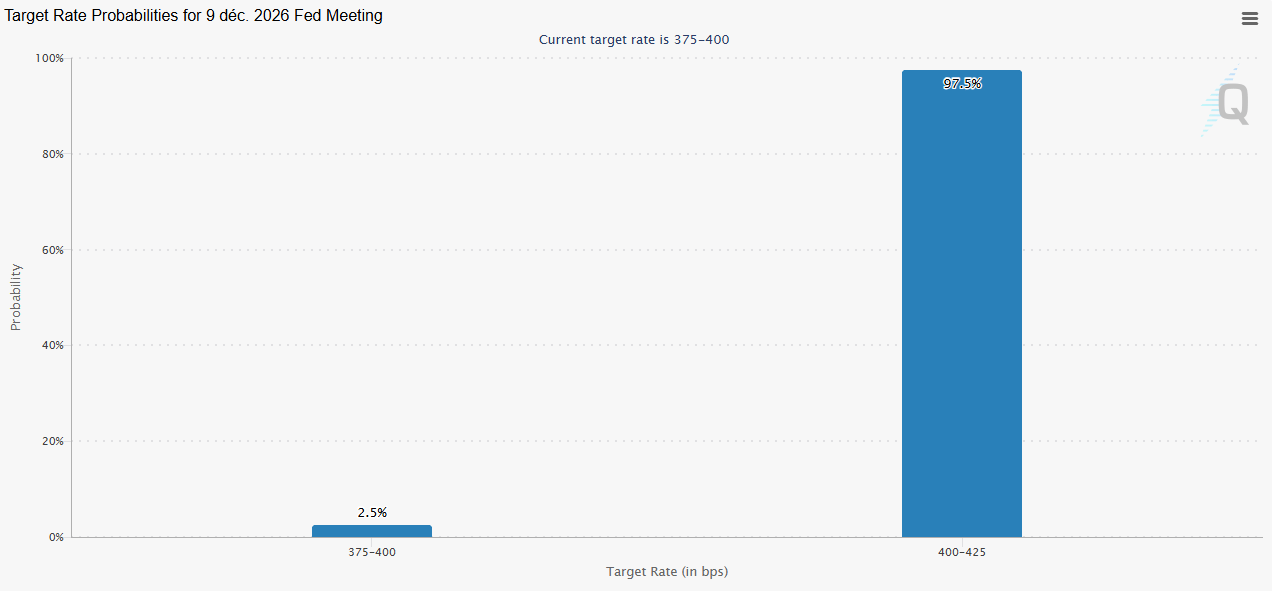
Against this backdrop, a PCE inflation reading in line with expectations should reinforce bets on a December rate hike but could have a limited impact on financial markets. The main significance of Wednesday’s release lies in its potential to reshape monetary policy expectations beyond the final Fed meeting of the year.
How will the Personal Consumption Expenditures Price Index affect EUR/USD?
The US Dollar (USD) has benefited from expectations of further monetary tightening by the Fed, which have contributed to pushing EUR/USD below the psychological 1.1000 mark in recent trading days. However, much of the monetary policy support for the Greenback appears to be already priced in. A significant further appreciation of the US Dollar may therefore require a hawkish repricing of the Fed’s monetary policy outlook for 2027.
A monthly core PCE reading above the expected 0.3% could strengthen bets on another interest rate hike in January, and potentially put a third increase back on the table in March, lifting US Treasury yields and the US Dollar at the expense of the Euro (EUR). Conversely, a softer-than-expected reading could prompt investors to scale back expectations of further monetary tightening beyond December, allowing EUR/USD to recover some ground. However, a single lower inflation report is unlikely to significantly undermine the prospects of a rate hike in December.
Market participants will also need to assess the simultaneous release of an updated estimate of third-quarter US Gross Domestic Product (GDP) and weekly Initial Jobless Claims. Additionally, thinner liquidity ahead of Thursday’s Thanksgiving holiday could amplify EUR/USD movements in the event of a significant surprise in the data.
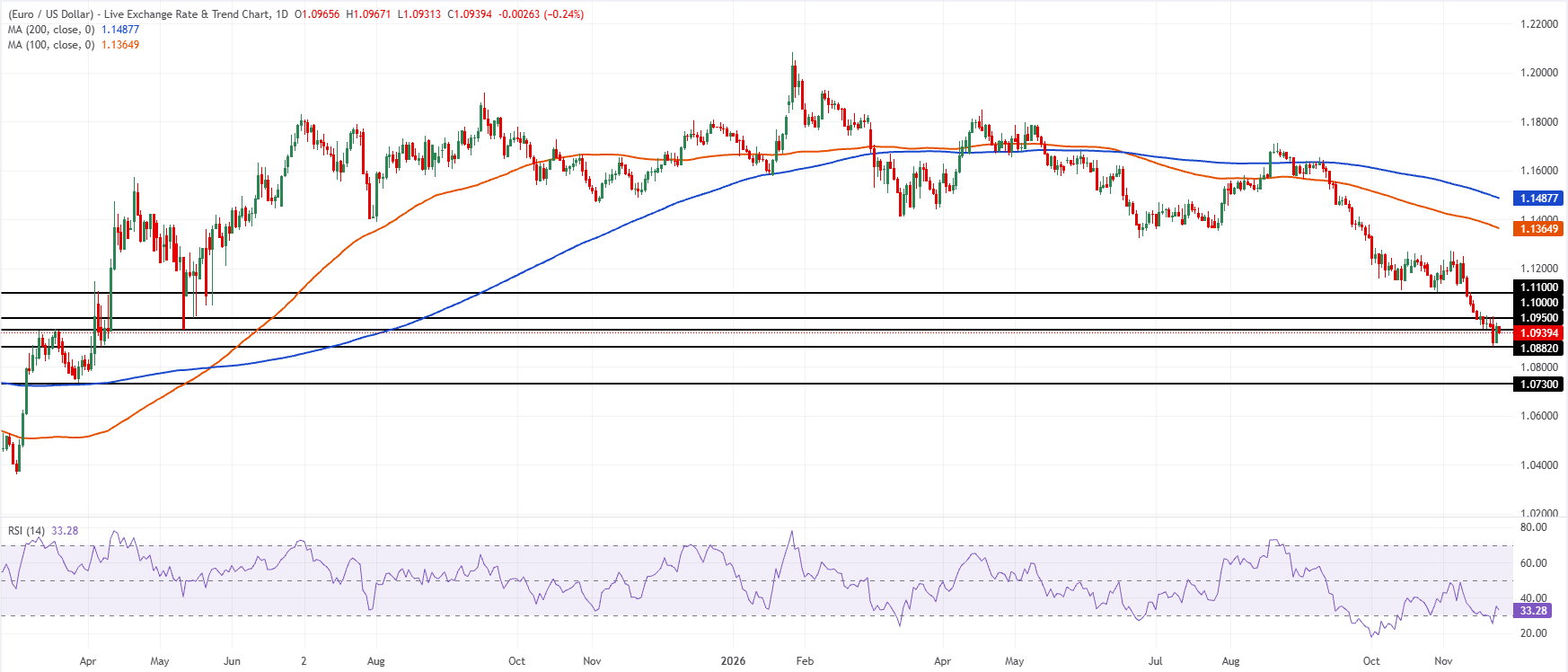
Technically, EUR/USD remains in a clear downtrend on the daily chart. The pair trades well below its 100-day and 200-day Simple Moving Averages (SMAs), currently at 1.1365 and 1.1488, respectively, with both pointing lower. The daily Relative Strength Index (RSI) stands around 33, confirming the prevailing bearish momentum while remaining slightly above oversold territory.
Should inflation data exceed expectations, EUR/USD could retest its recent yearly low at 1.0882. A break below this support would open the door to a deeper decline toward the 1.0730 area.
Conversely, softer-than-expected inflation could allow EUR/USD to break above immediate resistance at 1.0950 before targeting the psychological 1.1000 level. A sustained move above this threshold could pave the way for a further recovery toward 1.1100, although the broader bearish trend would remain intact.
Economic Indicator
Personal Consumption Expenditures - Price Index (MoM)
The Personal Consumption Expenditures (PCE), released by the US Bureau of Economic Analysis on a monthly basis, measures the changes in the prices of goods and services purchased by consumers in the United States (US).. The MoM figure compares prices in the reference month to the previous month. Price changes may cause consumers to switch from buying one good to another and the PCE Deflator can account for such substitutions. This makes it the preferred measure of inflation for the Federal Reserve. Generally speaking, a high reading is bullish for the US Dollar (USD), while a low reading is bearish.
Read more.Next release: Wed Nov 25, 2026 13:30
Frequency: Monthly
Consensus: 0.3%
Previous: 0.5%
Source: US Bureau of Economic Analysis
Inflation FAQs
Inflation measures the rise in the price of a representative basket of goods and services. Headline inflation is usually expressed as a percentage change on a month-on-month (MoM) and year-on-year (YoY) basis. Core inflation excludes more volatile elements such as food and fuel which can fluctuate because of geopolitical and seasonal factors. Core inflation is the figure economists focus on and is the level targeted by central banks, which are mandated to keep inflation at a manageable level, usually around 2%.
The Consumer Price Index (CPI) measures the change in prices of a basket of goods and services over a period of time. It is usually expressed as a percentage change on a month-on-month (MoM) and year-on-year (YoY) basis. Core CPI is the figure targeted by central banks as it excludes volatile food and fuel inputs. When Core CPI rises above 2% it usually results in higher interest rates and vice versa when it falls below 2%. Since higher interest rates are positive for a currency, higher inflation usually results in a stronger currency. The opposite is true when inflation falls.
Although it may seem counter-intuitive, high inflation in a country pushes up the value of its currency and vice versa for lower inflation. This is because the central bank will normally raise interest rates to combat the higher inflation, which attract more global capital inflows from investors looking for a lucrative place to park their money.
Formerly, Gold was the asset investors turned to in times of high inflation because it preserved its value, and whilst investors will often still buy Gold for its safe-haven properties in times of extreme market turmoil, this is not the case most of the time. This is because when inflation is high, central banks will put up interest rates to combat it. Higher interest rates are negative for Gold because they increase the opportunity-cost of holding Gold vis-a-vis an interest-bearing asset or placing the money in a cash deposit account. On the flipside, lower inflation tends to be positive for Gold as it brings interest rates down, making the bright metal a more viable investment alternative.
추천 기사


