


UoM Consumer Sentiment Index expected to remain depressed near historical lows in June
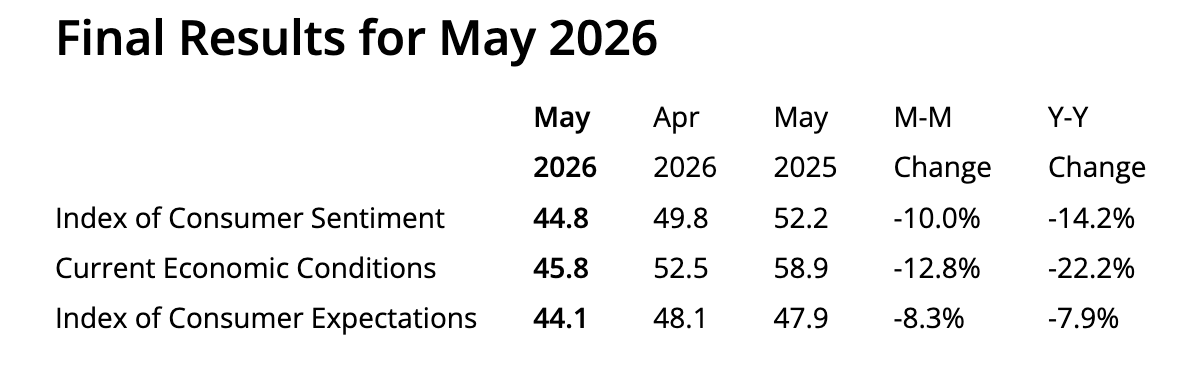
- The Preliminary Michigan Consumer Sentiment Index is seen ticking up to 46 in June from 44.8 in May.
- Consumer confidence is expected to have remained near historic lows as higher prices pinch purchasing power.
- UoM Consumer Sentiment reading is likely to add concerns about the economic consequences of inflation.
The University of Michigan (UoM) will release the preliminary estimate of June’s Consumer Sentiment Index on Friday. The report, measuring consumers’ feelings about personal finances, business conditions, and purchasing plans, is expected to show that consumers’ confidence remains depressed, at levels only beaten by May’s all-time low.
Economic confidence among US consumers is expected to have edged up to 46.0 in June, as measured by the UoM Consumer Sentiment Index, only marginally above May’s record low of 44.8. These figures show the lowest confidence levels since records began in 1952, and a more pessimistic view than during the 1970s Oil crisis, the 2008 recession, or the COVID pandemic.
Hopes for a brighter future are also poor. The UoM Consumer Expectations Index is also foreseen as consolidating near historic lows, despite an uptick to 44.3 from May’s 44.1 reading.
Consumption is a key contributor to US economic activity, accounting for about 70% of the country’s Gross Domestic Product (GDP). In that sense, the Michigan Consumer Sentiment Index is considered a reliable forward-looking indicator of US economic trends, and its release tends to have a significant impact on the US Dollar (USD)
What to expect from June’s UoM Consumer Sentiment Index report?
June’s release is expected to provide further evidence that US consumers are struggling amid the higher cost of living. The war in Iran and the subsequent blockade of the Strait of Hormuz have boosted energy prices, pushing costs higher through a wide range of products and services.
If preliminary UoM Consumer Sentiment Index figures align with market consensus, they are likely to shift the focus to the economic consequences of out-of-control inflation and might dampen some of the enthusiasm triggered by the bright Nonfarm Payrolls (NFP) report and the strong services and manufacturing activity data released last week.
May’s survey already highlighted an increasing concern about the inflationary impact on personal finances, an issue that is unlikely to have improved during the last weeks: “The cost of living continues to be a first-order concern, with 57% of consumers spontaneously mentioning that high prices were eroding their personal finances, up from 50% last month.”, said Joanne Hsu, director of the University of Michigan’s Surveys of consumers.
US Consumer Price Index (CPI) figures, released on Wednesday, endorse the view that US consumers are getting squeezed by inflation. Data from May revealed that prices accelerated to a 4.2% year-on-year pace, their highest level since April 2023, with energy prices jumping by a whopping 23.5% in the 12 months previous to May.
When will the UoM Consumer Sentiment Index be released, and how could it affect the US Dollar?
The University of Michigan will release its Consumer Sentiment Index, together with the Consumer Inflation Expectations survey, on Friday at 14:00 GMT. The market consensus hints at a minor improvement from the previous reading, yet at levels reflecting a deeply negative sentiment. The risk is skewed to the downside for the US Dollar.
The Greenback has shown a solid bullish trend since early May, as investors seek safe assets amid uncertainty in the Middle East conflict. Beyond that, strong US data, namely a significant improvement in the labour market, has boosted hopes that the Federal Reserve (Fed) will be forced to raise interest rates before the end of the year, providing additional support to the USD.
The US Dollar Index (DXY), which measures the value of the USD against a basket of peers, has rallied more than 2% as tensions escalated in the Middle East, casting clouds over the US-Iran peace process.
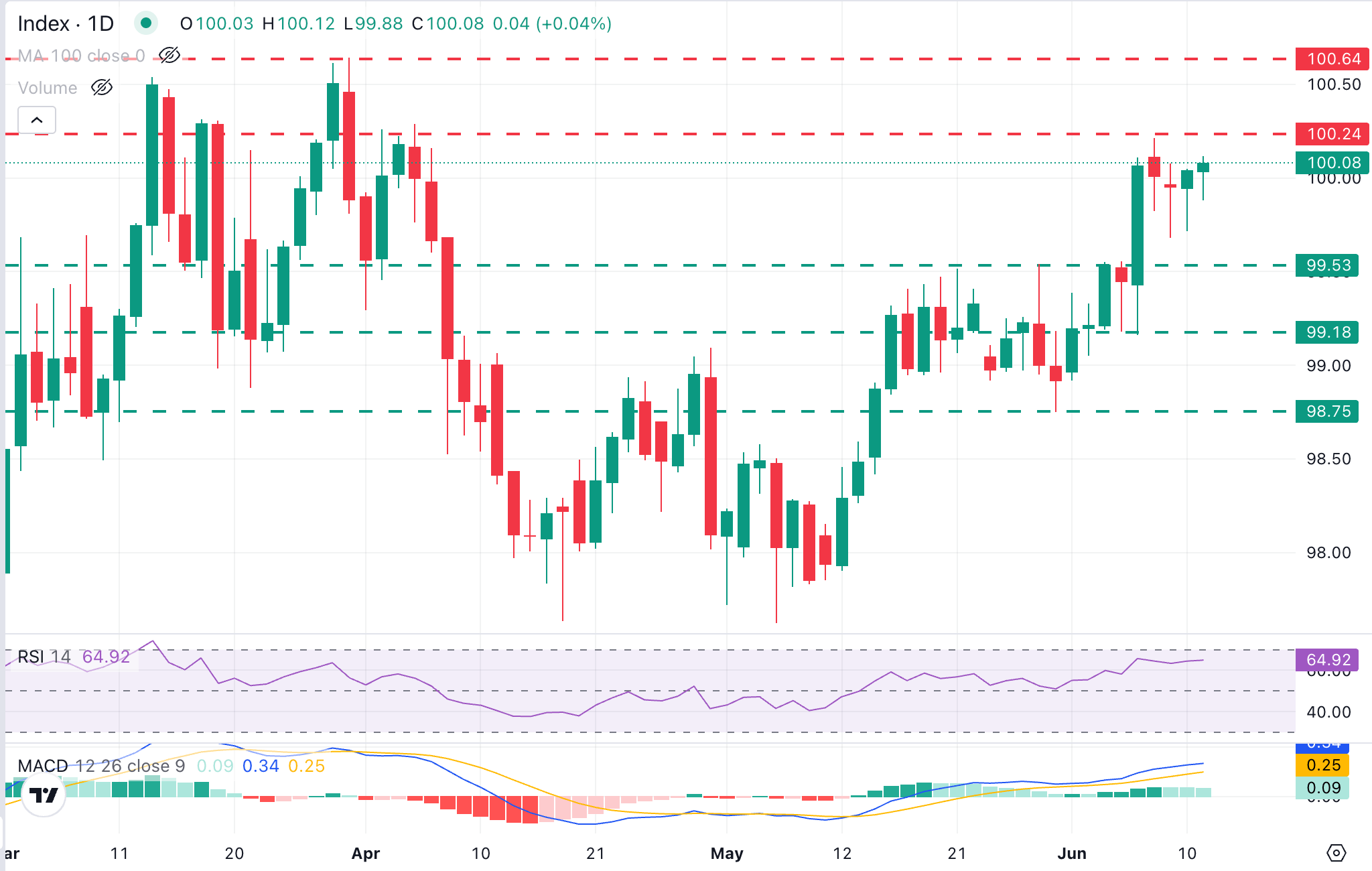
Guillermo Alcala, FX Analyst at FXStreet, sees limited chances of a significant US Dollar reversal until the situation in the Middle East improves. ”The USD is likely to weaken if consumer confidence figures meet market expectations. Dips, however, are likely to find buyers with risk appetite subdued amid Iran’s conflict. Previous highs at the 99.50 area or the June 4 and 5 lows near 99.15 are expected to hold bearish attempts.”
On the upside, Alcalá sees resistance at the 100.30 and 100.65 areas as the main hurdles for bulls: “Upside attempts are likely to be tested ahead of the April 6 high near 100.30, which, so far, is closing the path to the year-to-date high, in the 100.65 area.”
Inflation FAQs
Inflation measures the rise in the price of a representative basket of goods and services. Headline inflation is usually expressed as a percentage change on a month-on-month (MoM) and year-on-year (YoY) basis. Core inflation excludes more volatile elements such as food and fuel which can fluctuate because of geopolitical and seasonal factors. Core inflation is the figure economists focus on and is the level targeted by central banks, which are mandated to keep inflation at a manageable level, usually around 2%.
The Consumer Price Index (CPI) measures the change in prices of a basket of goods and services over a period of time. It is usually expressed as a percentage change on a month-on-month (MoM) and year-on-year (YoY) basis. Core CPI is the figure targeted by central banks as it excludes volatile food and fuel inputs. When Core CPI rises above 2% it usually results in higher interest rates and vice versa when it falls below 2%. Since higher interest rates are positive for a currency, higher inflation usually results in a stronger currency. The opposite is true when inflation falls.
Although it may seem counter-intuitive, high inflation in a country pushes up the value of its currency and vice versa for lower inflation. This is because the central bank will normally raise interest rates to combat the higher inflation, which attract more global capital inflows from investors looking for a lucrative place to park their money.
Formerly, Gold was the asset investors turned to in times of high inflation because it preserved its value, and whilst investors will often still buy Gold for its safe-haven properties in times of extreme market turmoil, this is not the case most of the time. This is because when inflation is high, central banks will put up interest rates to combat it. Higher interest rates are negative for Gold because they increase the opportunity-cost of holding Gold vis-a-vis an interest-bearing asset or placing the money in a cash deposit account. On the flipside, lower inflation tends to be positive for Gold as it brings interest rates down, making the bright metal a more viable investment alternative.
Economic Indicator
Michigan Consumer Sentiment Index
The Michigan Consumer Sentiment Index, released on a monthly basis by the University of Michigan, is a survey gauging sentiment among consumers in the United States. The questions cover three broad areas: personal finances, business conditions and buying conditions. The data shows a picture of whether or not consumers are willing to spend money, a key factor as consumer spending is a major driver of the US economy. The University of Michigan survey has proven to be an accurate indicator of the future course of the US economy. The survey publishes a preliminary, mid-month reading and a final print at the end of the month. Generally, a high reading is bullish for the US Dollar (USD), while a low reading is bearish.
Read more.Next release: Fri Jun 12, 2026 14:00 (Prel)
Frequency: Monthly
Consensus: 46
Previous: 44.8
Source: University of Michigan
Consumer exuberance can translate into greater spending and faster economic growth, implying a stronger labor market and a potential pick-up in inflation, helping turn the Fed hawkish. This survey’s popularity among analysts (mentioned more frequently than CB Consumer Confidence) is justified because the data here includes interviews conducted up to a day or two before the official release, making it a timely measure of consumer mood, but foremost because it gauges consumer attitudes on financial and income situations. Actual figures beating consensus tend to be USD bullish.
추천 기사


