


Dow Jones Industrial Average sits out the disinflation party
- DJIA trades near 52,356, down 0.29%, defending the 52,000 handle while a negative June inflation print lifts the rest of the tape.
- Goldman Sachs pops 8% on an earnings beat, International Business Machines craters 25% on a profit warning, and price-weighted arithmetic nets the index out to roughly nothing.
- July hike odds collapse to 17% after the print, yet the Fed Chair testifies hawkish as Crude Oil re-prices a reinstated Strait of Hormuz blockade.
The June Consumer Price Index (CPI) fell 0.4% on the month against consensus for a 0.1% decline, following May's 0.5% increase, and the annual rate dropped to 3.5% from 4.2%, well under the 3.8% forecast. Core prices were flat MoM and eased to 2.6% YoY versus 2.8% expected. June's slide in energy costs, the dividend of last month's ceasefire, did most of the work.
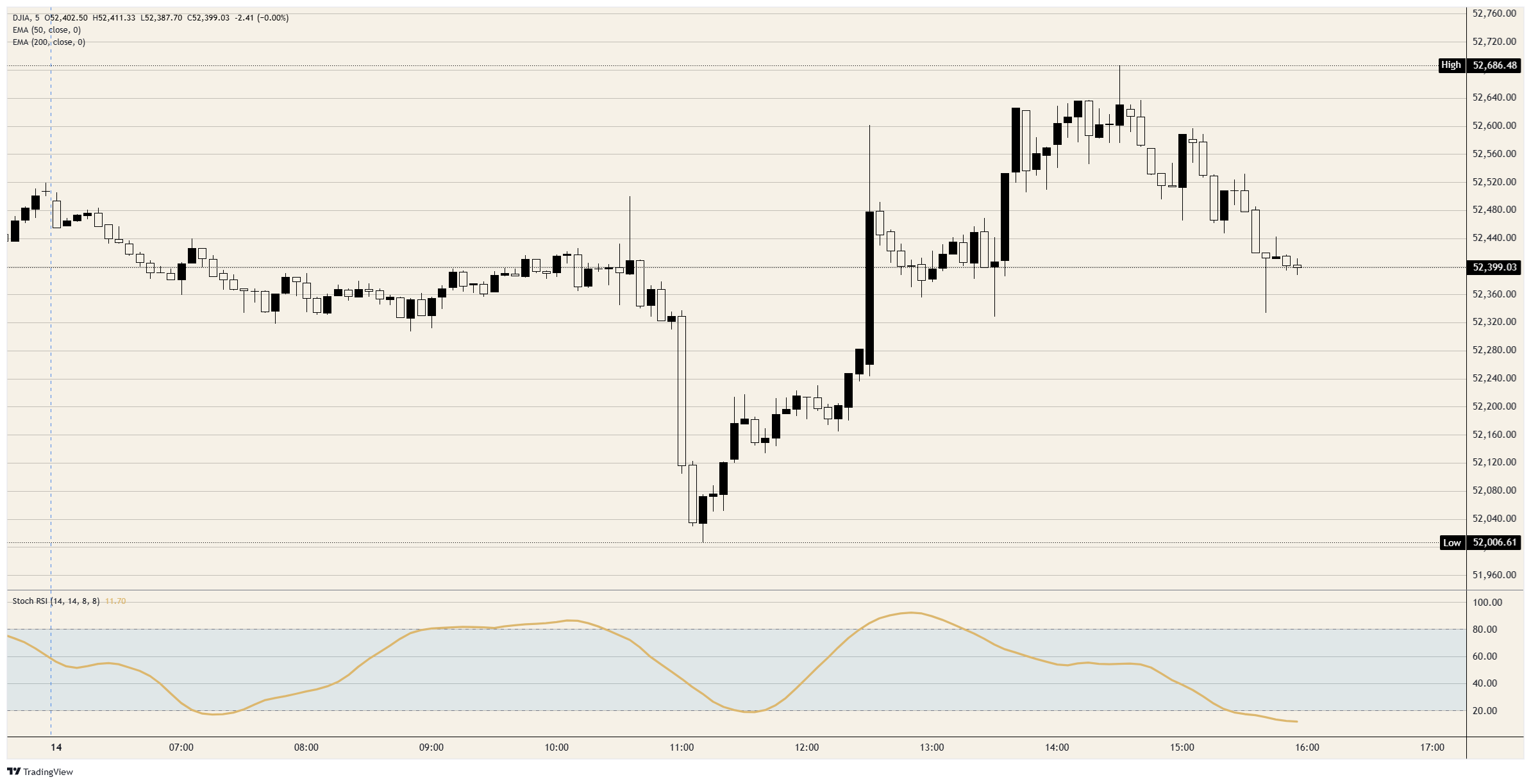
The broader market took the gift at face value, with the S&P 500 up 0.5% and the Nasdaq Composite adding 1% on a semiconductor rebound. The Dow Jones Industrial Average trades at 52,356, down 0.29% on the session, after probing 52,006 in early dealing. The blue-chip average received the friendliest inflation report in months and promptly went nowhere, and the explanation sits inside its own membership.
Price-weighted arithmetic cuts both ways
Goldman Sachs (GS) popped 8% after posting an earnings beat, and because it ranks among the highest-priced shares in the average, that single move is worth several hundred Dow points on its own. International Business Machines (IBM) collapsed 25% after warning that second-quarter profit fell short of expectations on soft demand across its software and infrastructure businesses.
The Dow is not a market so much as a sum of thirty share prices, and today the sum is a wash; one legacy technology profit warning cancels a blowout bank quarter. The semiconductor rally powering the Nasdaq, with Lam Research (LRCX) up 4% and Micron (MU) adding more than 2%, accrues almost entirely elsewhere, leaving IBM as the index's loudest technology story of the day.
A hawkish Chair meets a friendly print
Rate futures tell the story of a market that removed July and kept September. Odds of a hike at this month's meeting dropped to 17% from 42% the day prior, while September pricing still assigns a 63% chance that the target rate sits at least a quarter point higher by the autumn. The print bought the Federal Reserve room; it did not buy a pivot.
The Fed Chair delivers his first semiannual testimony before the House committee across hearings at 12:30 and 14:00 GMT, restating a commitment to the 2% target while refusing anything resembling forward guidance. One buy-side chief investment officer notes that nearly every communication of the Chair's short tenure has leaned hawkish, and that today's relief more plausibly keeps the committee on hold than opens a path lower. A run of Fed speakers follows through 18:55 GMT, and the Senate round comes Wednesday.
The barrel votes against the print
President Donald Trump said Monday the United States would reinstate its naval blockade on Iranian shipping through the Strait of Hormuz, with the cordon resuming late Tuesday, after a week of renewed strikes and Iranian attacks on commercial vessels left last month's peace framework in tatters. West Texas Intermediate (WTI) Crude Oil topped $80 per barrel earlier and trades above $78, up 1%, while Brent Crude Oil adds 2% above $85, a one-month high.
The tension between the print and the tape is not subtle: the disinflation the June report recorded came almost entirely from energy prices that fell while the ceasefire held, and the ceasefire no longer holds. Should the blockade and the tanker attacks persist through July, the next CPI report reads very differently, which is precisely the scenario September pricing refuses to let go of.
The data does not let up
Wednesday brings June's Producer Price Index (PPI) at 12:30 GMT, where the core YoY rate is seen accelerating to 5.2% from 4.9%; pipeline pressure moving the wrong way would undercut today's consumer-level relief before it is a day old. The Chair sits before the Senate committee at 14:00 GMT and the Beige Book lands at 18:00 GMT.
Thursday's June Retail Sales at 12:30 GMT carry a 0.2% headline consensus with the control group seen at 0.5%, and Friday's preliminary July Michigan sentiment survey at 14:00 GMT is expected at 51, alongside year-ahead inflation expectations last printed at 4.6%. A hot PPI and sticky expectations set against a rebuilding Crude Oil premium would harden the September hike case no matter how soft today's print looked.
Levels to watch
Resistance: The session high at 52,686 caps the first bounce attempt, ahead of the 53,000 handle; beyond that, last week's cycle high at 53,333 is the level that turns this pullback back into a trend.
Support: The 52,000 handle absorbed the early probe at 52,006, and below it the 50-day Exponential Moving Average (EMA) at 51,227, untested since mid-June, guards the 51,000 handle.
Bias: Lower; the daily Stochastic Relative Strength Index is rolling over from overbought near 74 while the index prints a lower high beneath 53,333. A drift toward the 50-day EMA at 51,227 is favoured while price holds below 52,686, and only a daily close above 53,333 resets the uptrend.
Dow Jones 5-minute chart
Dow Jones FAQs
The Dow Jones Industrial Average, one of the oldest stock market indices in the world, is compiled of the 30 most traded stocks in the US. The index is price-weighted rather than weighted by capitalization. It is calculated by summing the prices of the constituent stocks and dividing them by a factor, currently 0.152. The index was founded by Charles Dow, who also founded the Wall Street Journal. In later years it has been criticized for not being broadly representative enough because it only tracks 30 conglomerates, unlike broader indices such as the S&P 500.
Many different factors drive the Dow Jones Industrial Average (DJIA). The aggregate performance of the component companies revealed in quarterly company earnings reports is the main one. US and global macroeconomic data also contributes as it impacts on investor sentiment. The level of interest rates, set by the Federal Reserve (Fed), also influences the DJIA as it affects the cost of credit, on which many corporations are heavily reliant. Therefore, inflation can be a major driver as well as other metrics which impact the Fed decisions.
Dow Theory is a method for identifying the primary trend of the stock market developed by Charles Dow. A key step is to compare the direction of the Dow Jones Industrial Average (DJIA) and the Dow Jones Transportation Average (DJTA) and only follow trends where both are moving in the same direction. Volume is a confirmatory criteria. The theory uses elements of peak and trough analysis. Dow’s theory posits three trend phases: accumulation, when smart money starts buying or selling; public participation, when the wider public joins in; and distribution, when the smart money exits.
There are a number of ways to trade the DJIA. One is to use ETFs which allow investors to trade the DJIA as a single security, rather than having to buy shares in all 30 constituent companies. A leading example is the SPDR Dow Jones Industrial Average ETF (DIA). DJIA futures contracts enable traders to speculate on the future value of the index and Options provide the right, but not the obligation, to buy or sell the index at a predetermined price in the future. Mutual funds enable investors to buy a share of a diversified portfolio of DJIA stocks thus providing exposure to the overall index.
추천 기사


