


Dow Jones Industrial Average edges higher on NFP beat as Iran reply awaited
- DJIA futures recover toward 49,800 as April Nonfarm Payrolls smashes consensus, clawing back some of Thursday's slide.
- US-Iran ceasefire negotiations stay in focus, with Tehran's response expected today though defiant rhetoric and an overnight strike on the UAE cast doubt on a swift breakthrough.
- University of Michigan Consumer Sentiment slumps to a recession-era 48.2 in the May preliminary print, even as 1-year and 5-year inflation expectations cool.
- Next week's April Consumer Price Index, due Tuesday, looms as the dominant catalyst with consensus pencilling in a second straight YoY uptick.
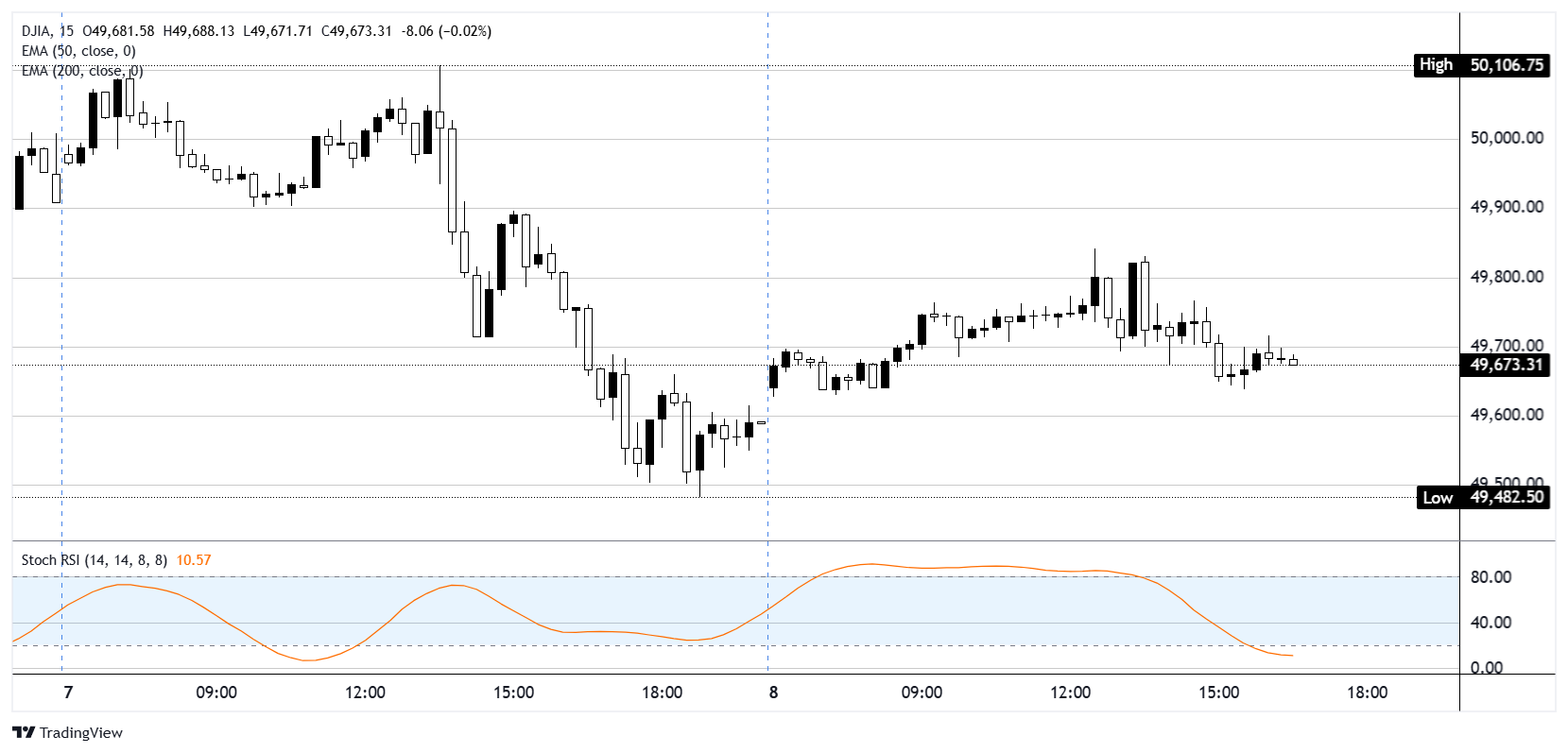
Dow Jones Industrial Average (DJIA) futures clawed back ground on Friday, May 8, after Thursday's late-session selloff dragged the cash index toward 49,500. Overnight dealing through Asia and Europe held a tight range just above 49,600, with traders reluctant to commit ahead of the US jobs report. The 12:30 GMT release sparked a rally toward 49,800 before profit-taking trimmed gains. Cash DJIA was last trading above 49,700, the S&P 500 up around 0.4%, and Nasdaq Composite advancing 0.6%. The small-cap Russell 2000 told a different story, sliding more than 1.5% and underscoring the megacap concentration that has driven the post-April rebound.
Jobs print runs hot, but wages tell a softer story
April Nonfarm Payrolls (NFP) came in at 115K, blowing past the 62K consensus and easing the soft-landing-into-recession concerns that had been building. The Unemployment Rate held steady at 4.3%, matching expectations. The hot headline was tempered, though, by a cooler wages picture. Average Hourly Earnings rose 0.2% MoM against a 0.3% consensus and 3.6% YoY versus 3.8% expected. Labor Force Participation also slipped to 61.8% from 61.9%. It is a mildly Federal Reserve (Fed)-friendly mix, hiring solid enough to push back on hard-landing fears without rekindling wage-driven inflation pressure.
Michigan sentiment plunges to recession-era lows
The University of Michigan (UoM) preliminary May survey told a much darker story. The Consumer Sentiment Index plunged to 48.2 against a 49.5 consensus, sitting at levels usually associated with active recessions. Inflation expectations did soften, with the 1-year measure dropping to 4.5% from 4.7% and the 5-year easing to 3.4% from 3.5%. Still, the combined picture, hot hiring alongside collapsing consumer sentiment and 4.5% near-term inflation expectations, paints the kind of stagflationary backdrop traders have flagged repeatedly through the Iran war. The cooling inflation expectations marginally take pressure off the Fed but do little to ease the consumer-side concerns.
Tehran's response in focus, scepticism builds by the hour
All eyes on Iran today. Secretary of State Marco Rubio told reporters in Rome the US expects Iran's response to its latest peace proposal at some point Friday, but he acknowledged Tehran's system "is still highly fractured and a bit dysfunctional," which may be slowing the reply. The mood music is hardly constructive. Iranian Foreign Minister Abbas Araghchi posted that "Iranians never bow to pressure," accusing Washington of opting for "reckless military adventure" every time a diplomatic solution is on the table, comments made after Thursday's US strikes on Iranian military sites at Bandar Abbas and Qeshm. Overnight, UAE air defenses intercepted two Iranian ballistic missiles and three drones, with three moderate injuries reported. Beneath the headlines, the structural gap remains wide. Iran's 14-point proposal defers nuclear talks until after the war ends and the blockade is lifted, while Washington insists Iran first surrender its 400-plus-kilogram stockpile of highly enriched uranium. Markets are pricing some optimism into the reply, but a quick deal is far from baked in.
Single-stock action: AI plays lift, retail and travel drag
Akamai (AKAM) topped the leaderboard with shares surging 28.5% after the content delivery firm posted mixed first-quarter results but raised its full-year outlook. Rackspace Technology (RXT) jumped 12.5% after announcing a memorandum of understanding with Advanced Micro Devices (AMD) to build enterprise AI cloud services for regulated and sovereign workloads. AMD itself climbed 1.7%. BorgWarner (BWA) gained 5.1% on a Q1 beat and new turbocharger awards from a major European original equipment manufacturer. On the downside, Expedia (EXPE) tumbled 6.7% after issuing soft forward guidance despite an earnings beat, and Nike (NKE) shed 1.1% after Wells Fargo downgraded the name to equalweight from overweight, citing a longer-than-expected international turnaround.
Looking ahead: April CPI is next week's main event
Tuesday's April Consumer Price Index (CPI) release is the dominant macro catalyst on the docket. Consensus has headline CPI YoY ticking up to 3.4% from 3.3%, a second straight monthly acceleration after March's print jumped from 2.4% to 3.3% on the back of the Iran-driven oil shock. Headline MoM is forecast at 0.6%, cooling from March's blistering 0.9%. The sharper watch is core: Core CPI MoM is pencilled in at 0.4%, double the 0.2% in March, and Core CPI YoY at 2.6%. With Brent still elevated and Strait of Hormuz traffic constrained, the balance of risks leans to the upside. Producer Price Index (PPI) follows Wednesday, then Retail Sales on Thursday.
Fed pricing: still locked into hold mode
Front-end rate markets are barely flinching. CME FedWatch shows roughly a 95% probability the Fed holds at the June 17 Federal Open Market Committee (FOMC) meeting, with only a thin minority betting on a 25-basis-point cut. The March dot plot pencilled in just one cut for the remainder of 2026, and today's combination of a hot NFP, soft wages, and weak sentiment is unlikely to shift that calculus on its own. Tuesday's CPI is the only print between now and June capable of meaningfully repricing the front end, particularly if core surprises to the upside.
Dow Jones 15-minute chart
Futures FAQs
The futures market is an exchange-based auction in which participants buy and sell contracts of an underlying asset at a predetermined future date and price. The set price is agreed upon today and is derived from the underlying asset. Futures contracts can be based on a wide range of assets, with commodities among the most popular, although currencies and indices are other common underlying assets. Futures prices depend on their underlying asset and act as a mechanism for firms, institutions, and large-position traders to manage risks through hedging.
Futures can be traded in different ways. The most common ways are via a regulated exchange or via Contracts For Difference (CFDs). In the former, liquidity is high and pricing is more transparent, with the broker serving only as an intermediary between you and the market. Still, it generally requires more capital. The largest futures exchanges are the Chicago Mercantile Exchange (CME) and the New York Mercantile Exchange (NYME). As for CFDs, these require less capital and thus trading is more flexible, but at the cost of less transparency.
The E-mini S&P 500 index, Crude Oil (Brent, WTI), Natural Gas, Gold, Silver, Copper, and soft commodities such as grains are among the most actively traded contracts. These offer strong liquidity and are closely followed by traders worldwide. Futures market volume consistently exceeds spot market volume, often significantly. This dominance is driven by leverage, hedging, and higher liquidity on exchanges.
Yes. Future gauges, particularly equity index futures such as those of the S&P 500 or the Nasdaq, are widely considered key gauges of market sentiment because they reflect investors’ expectations for the next session’s opening price. When equity futures drop, it is a sign of risk-aversion, signaling bearish market sentiment. On the contrary, rising equity futures suggest markets are risk on.
As a futures contract approaches its maturity date, the futures price converges upon the spot price, becoming almost identical at expiration. However, prices can diverge significantly before the contract ends. A market is in contango when future prices are higher than spot prices, while the mirror image is called backwardation (when current prices are higher than future prices). For commodities, the normal state of the market is contango because holding the asset over time incurs costs such as storage or insurance fees. When markets turn from contango to backwardation – or vice versa – it signals a shift in the trend: a change from contango to backwardation is taken as a bullish sign, while going from backwardation to contango is generally considered bearish.
추천 기사


