


Has Bitcoin really escaped the macro forces it was built to fight?
Over 17 years ago, Satoshi Nakamoto designed Bitcoin (BTC) on the back of a global financial crisis as an alternative to the global monetary system outside the control of central banks, governments and traditional intermediaries. This raises a key question: has Bitcoin really become independent of the macroeconomic forces it was built to challenge?
Nearly two decades after its creation, Bitcoin's price remains sensitive to the same variables that drive traditional risk assets — interest rates, US Treasury yields, inflation expectations, the US Dollar (USD) and global liquidity.
Within the first few days of October, the top crypto dropped from above $86,000 toward $81,000 after a halt in US-Iran negotiations and a hawkish stance in the Federal Reserve (Fed) September meeting Minutes. The move coincided with a jump in Oil prices and Treasury yields. Brent crude rose above $103 while the 10-year Treasury yield climbed to a multi-decade high above 5.3%, with the correlation particularly pronounced on Thursday.
Shortly after, US President Donald Trump announced that the US will not attack Iran "at any time prior" to the US midterm elections on November 3, easing some near-term geopolitical concerns. BTC briefly recovered after the announcement, rising toward $83,000.
Zooming out to August, Bitcoin has gained over 30% despite a 60 basis points increase in yields. While that appears contradictory on the surface, those gains have partly been driven by an intervention from the US Department of the Treasury, which doubled its bond buyback operation to at least $4 billion for 10-year to 30-year debt.
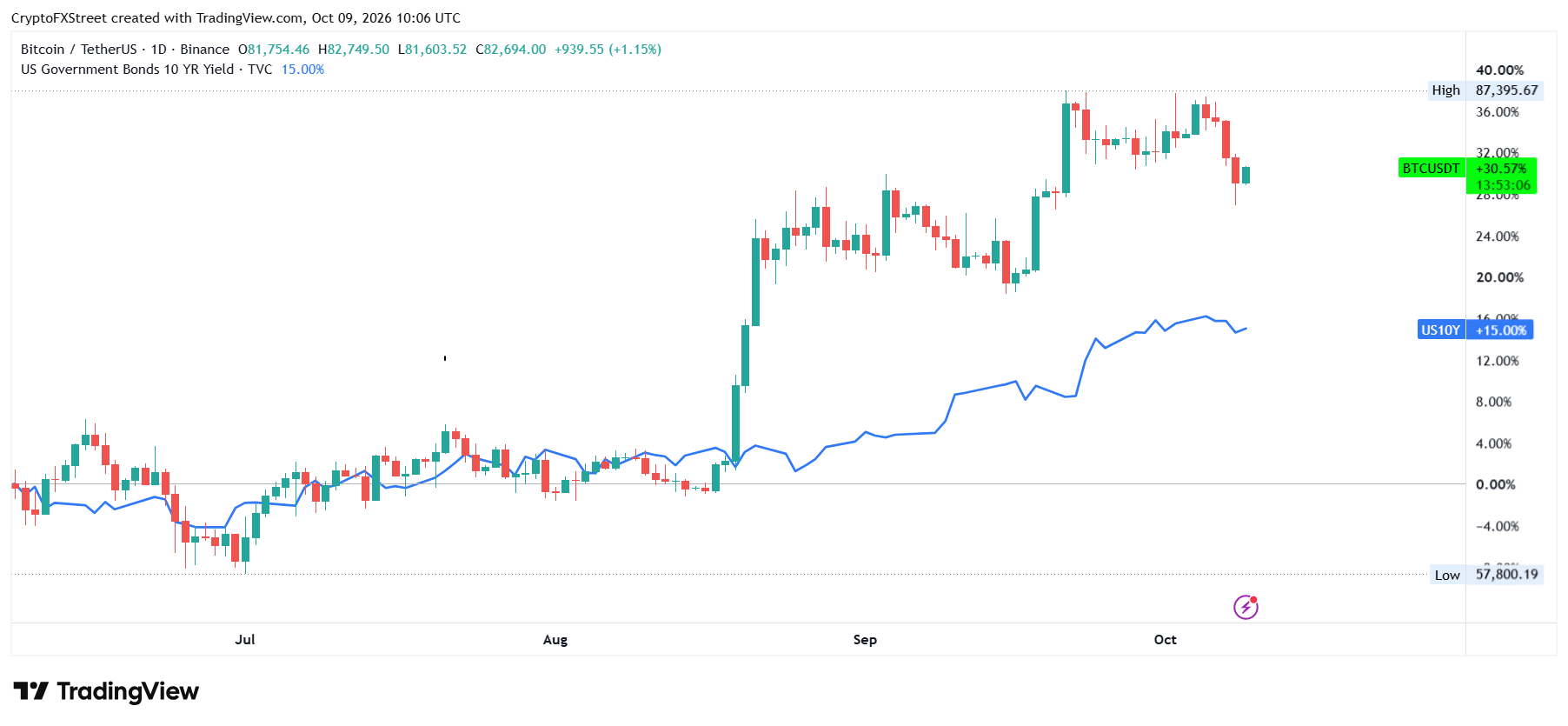
But what does this tell us about Bitcoin's relationship with the broader macro environment?
How US Treasury yields and Oil prices affect Bitcoin
The relationship between Bitcoin, US Treasury yields and Oil prices isn’t a direct one.
Rising Oil prices increase the cost of energy, transportation and production, potentially keeping inflation elevated. This makes it more difficult for the Federal Reserve to ease monetary policy, especially when inflation remains above its target.
Consequently, markets may begin pricing in higher interest rates, pushing Treasury yields higher as investors demand greater compensation for inflation risks and for holding longer-dated government debt.
Unlike bonds, Bitcoin does not generate a conventional cash yield. As Treasury yields rise, investors have access to higher returns from relatively safer assets, increasing the opportunity cost of holding the leading crypto. Higher yields can also make speculative assets less attractive as investors require larger returns before committing capital to riskier investments.
However, the direction of yields alone does not tell the whole story. Rising yields driven by stronger economic growth may have a different effect from those driven by inflationary pressures, fiscal concerns or higher term premiums.
The current environment is particularly challenging because rising Oil prices are feeding inflation concerns while higher yields tighten financial conditions. The Fed's September meeting Minutes also identified Oil prices as a major contributor to the increase in near-term inflation compensation.
Institutional adoption has tied Bitcoin closer to TradFi
Don't get me wrong. Institutional adoption has been one of Bitcoin's biggest developments in recent years. However, the same integration that brings more capital into the market also exposes Bitcoin to traditional portfolio-allocation decisions.
Spot Bitcoin exchange-traded funds (ETFs), CME futures and corporate Bitcoin treasuries have created additional channels through which institutional capital enters and exits the market.
When yields rise and equities come under pressure, institutional investors may rebalance their portfolios, reduce leverage or increase their cash allocations, and Bitcoin exposure can become part of those adjustments.
Recent ETF flows illustrate this pressure. US spot BTC ETFs recorded over $731 million in net outflows over the past two days, with their seven-day flows turning negative, per SoSoValue data.
CME futures add another layer to this relationship. Institutional traders use these contracts to hedge exposure, manage leverage and implement basis trades. CME premiums have compressed over the past two weeks as Bitcoin rally slowed. This shows that when financing costs rise, or the economics of these trades deteriorate, positions may be reduced, adding pressure to the market.
The important distinction is that rising yields do not automatically trigger Bitcoin selling. Rather, they can create the conditions in which portfolio rebalancing, hedging and reduced risk appetite reinforce one another.
Bitcoin's relationship with equities during periods of market stress also provides further evidence.
Wintermute's October 5 market update noted that BTC's correlation with the S&P 500 was rising again. The firm argued that during high-correlation regimes, Bitcoin behaves like a high-beta version of the S&P 500, with a tendency to fall alongside equities without participating equally in subsequent rallies.
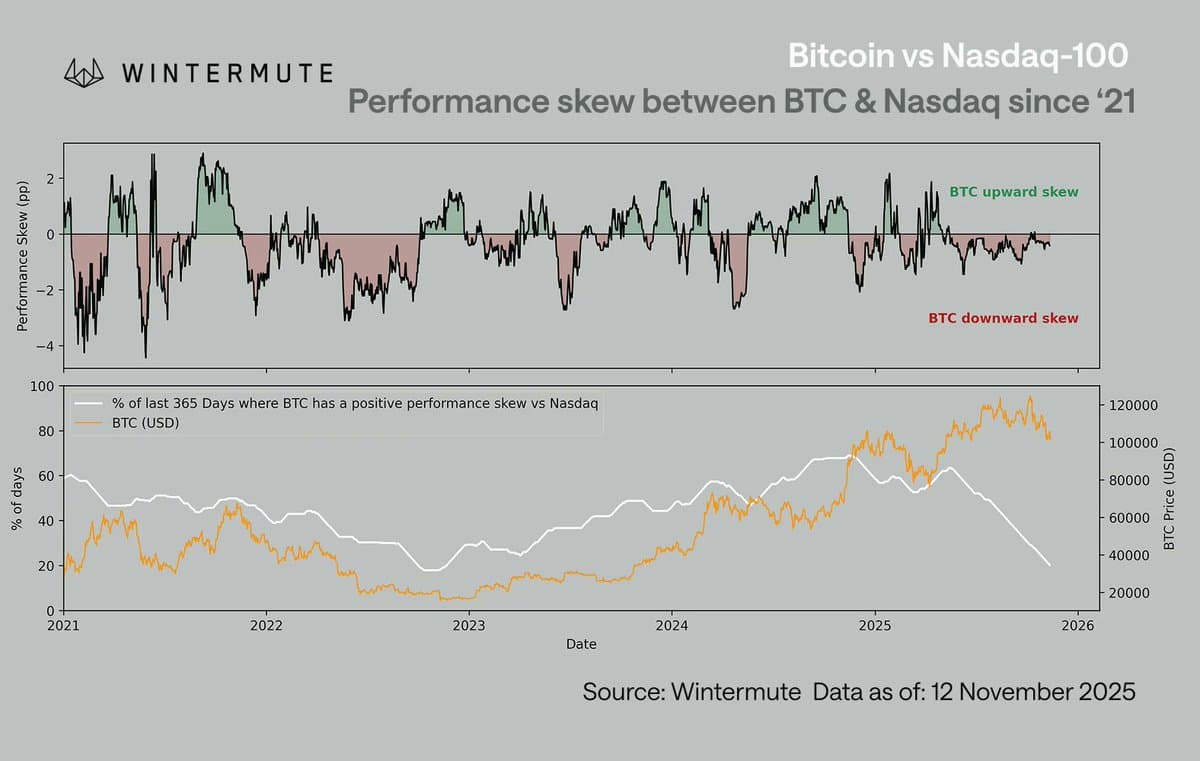
The move shows that Bitcoin's price is increasingly influenced by investors who also hold technology stocks and other growth assets.
Hence, Bitcoin's scarcity does not prevent it from being sold during a broad risk-off event.
Has Bitcoin outgrown macro?
Arthur Hayes, co-founder of the closed crypto exchange BitMEX, has argued that rising Treasury yields could eventually benefit Bitcoin if they expose fiscal stress and force policymakers to expand money creation. Under this thesis, rising borrowing costs make government debt more expensive to service, increasing pressure for monetary intervention that could ultimately weaken fiat currencies. Such a move bodes well for risk assets like Bitcoin that are priced in US Dollars.
However, the timing and transmission mechanism matter. When yields rise because investors anticipate fiscal stress and eventual monetary expansion, Bitcoin's scarcity narrative can become more attractive.
But when inflation is driven by an Oil shock and central banks respond by maintaining restrictive financial conditions, the immediate effect on Bitcoin can be the opposite. As liquidity tightens, the US Dollar may strengthen and Bitcoin can fall alongside technology stocks.
The distinction is between inflation that eventually prompts monetary expansion and inflation that initially forces tighter monetary policy. Bitcoin may benefit from the former while struggling under the latter.
This also helps explain why BTC can rally despite rising yields, as seen in August, without necessarily proving it has become independent of macroeconomic conditions, since Treasury buybacks and other liquidity-related developments can offset some of the pressure from higher yields.
The data suggests that the fundamentals of Bitcoin drive demand, but the macro picture shapes the environment in which that demand operates.
What should investors watch next?
For now, the key variables remain US Treasury yields, Oil prices, the US Dollar and the Fed outlook.
Long- and short-term Treasury yields help indicate the opportunity cost of holding Bitcoin, Brent crude will help determine whether energy-driven inflation remains a concern, while the US Dollar and the Fed outlook will help show whether financial conditions are tightening further.
BTC ETF flows are another key factor. A sustained recovery in inflows could indicate that institutional demand is absorbing macro-related selling pressure. Conversely, persistent outflows would suggest that investors remain cautious.
Until Bitcoin’s marginal demand becomes less sensitive to traditional financial conditions, rising yields, geopolitical Oil-driven inflation and shifts in global liquidity will continue to influence its price.
Bitcoin may offer an alternative to the monetary system, but that system has remained a key influence in determining what investors are willing to pay for it.
추천 기사


