


Dollar Index stalls under its high as the Fed's hawks repeat themselves
- DXY stalls below Monday's 18-month high near 102.50 as Fed officials repeat their hike case.
- Futures price about 20% odds of an October Fed hike and about 70% for December.
- US core CPI forecast at 0.2% MoM on October 14, headline at 0.6%.
Four sessions after its highest level since April 2025, the Dollar Index hasn't got back to it. The index trades near 102.25 and has made a lower high in each session since Wednesday. Fed officials spent the week arguing for another rate hike, and the 10-year Treasury yield reached its highest since 2002 on Monday, yet neither has taken the index higher. The US Consumer Price Index (CPI) on October 14 is the first release with a real chance to change that.
The two-year yield fell while the Fed made the case for a hike
Fed Governor Waller said on Thursday that more hikes are needed but don't have to come at back-to-back meetings, and St. Louis Fed President Musalem said rates should rise over the next six to nine months. Minutes of the September 15-16 meeting, released on Wednesday, showed most officials expect another hike by year-end. That matches the median projection of 4.1% for the end of 2026, which implies one more quarter-point hike from the current 3.75%-4.00%.
Futures put the odds of a hike near 20% for October 28 and near 70% for December 9, so the market took Governor Waller at his word on back-to-back meetings. The Dollar Index climbed with the two-year Treasury yield through September, and the two-year is the yield most tied to the Fed's next move. It fell from 4.84% on Monday to 4.75% on Thursday, while the 10-year has slipped back toward 5.25%.
Consumers rated conditions the worst on record and the index barely moved
Friday's preliminary University of Michigan (UoM) survey put consumer sentiment at 46.3, short of the 47.6 forecast and above only May's reading in the survey's history. Its gauge of current conditions set a record low, while households raised their year-ahead inflation expectations to 4.7% and their five-year expectations to 3.5%. That's the measure Governor Waller said he's watching for signs that higher prices are becoming expected ones.
Most of Friday's rise in the index came earlier, when Canada reported 68.3K job losses and USD/CAD rose to an 18-month high. The Loonie is 9.1% of the index, and Canada's report still moved it more than the US survey did. The Euro is 57.6%, and EUR/USD near 1.1200 is still above the 1.1150 area it held on Monday and Tuesday, so the index's largest component isn't giving it much either.
CPI is forecast to hand each side of the Fed a number
CPI is due Wednesday, October 14, at 12:30 GMT, with headline prices forecast to rise 0.6% MoM in September and the annual rate to reach 3.6% from 3.4%. Prices excluding food and energy are forecast to rise 0.2% after 0.3%, for 2.5% YoY. In the September minutes, some officials described the hike as insurance against persistent inflation and others as a way to stop energy costs spreading into other prices. A 0.2% core would be a month in which nobody had to make a claim.
A core reading of 0.3% or more could revive bets on an October hike and give the index a reason to clear 102.50. A 0.2% may leave December priced and October not, which is the setup that has held the index in its range since Monday. The Fed's Beige Book, its survey of regional business conditions, follows at 18:00 GMT the same day.
Producer Price Index (PPI) figures and retail sales come on Thursday, with sales forecast to rise 0.3% after 1.2% in August. A number well above that could firm up December, and a miss could add to the soft spending plans in Friday's survey. Fed Chair Warsh speaks the same day at 15:30 GMT, among the last scheduled remarks before officials stop speaking publicly on October 17 ahead of the October 27-28 meeting.
Bank of Canada (BoC) Governor Macklem speaks on Wednesday and Friday after two straight monthly job losses, and the Loonie's share of the index carries his tone into it. Monday opens with the US bond market shut for Columbus Day and Japan on holiday as well.
Levels and bias
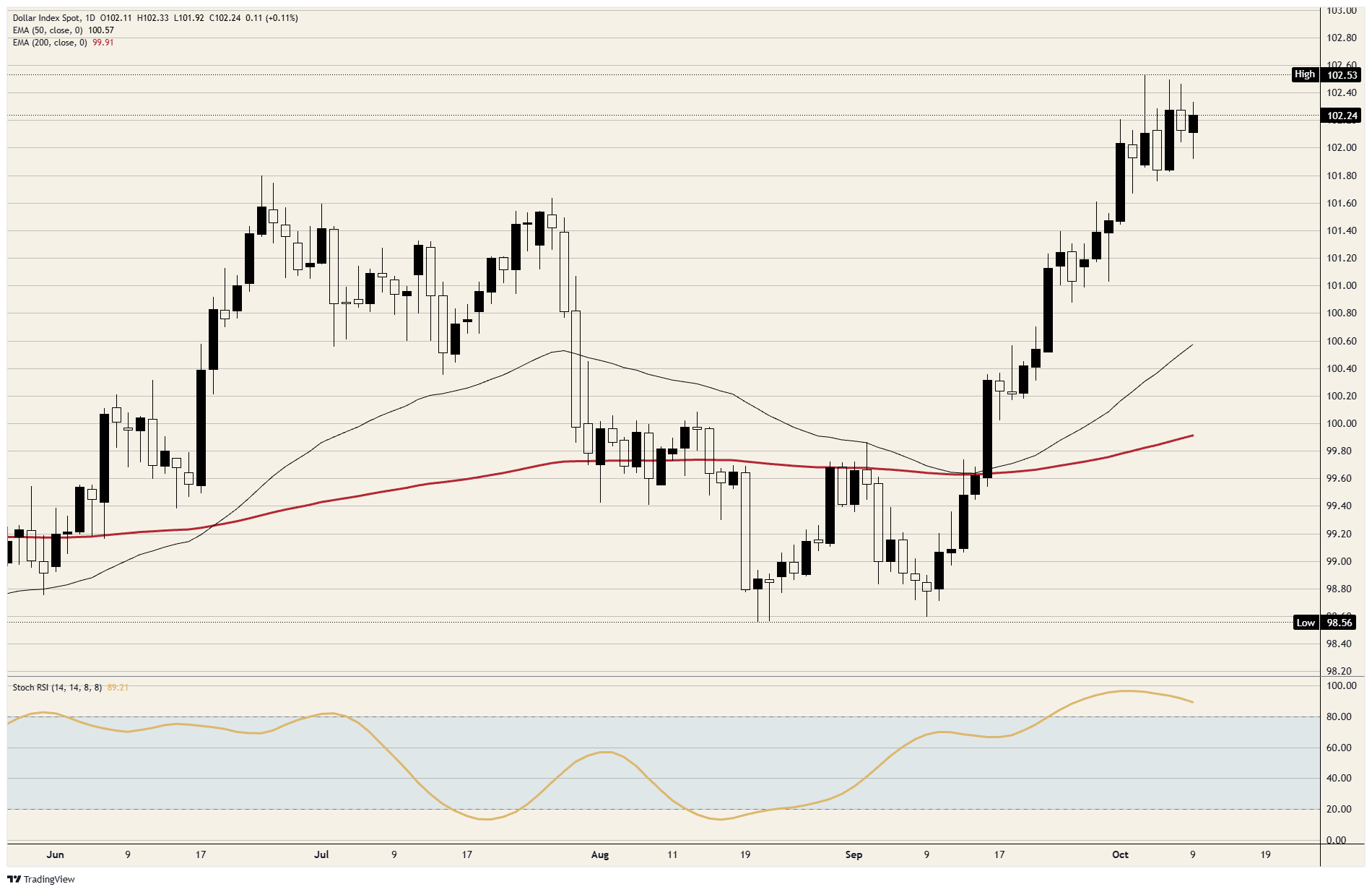
Resistance: 102.50 stopped the index on Monday, Wednesday and Thursday, and Monday's high just above it is the highest since April 2025. Friday's high near 102.30 is the second lower high in a row, and 103.00 is the next round level above.
Support: 102.00 gave way briefly on Friday before buyers took the index back above it. Tuesday's low near 101.75 is the floor of the week, and 101.50 is where the late-September range topped out.
Bias: The lean stays short while 102.50 caps, with Tuesday's low near 101.75 the first objective and 101.50 the second. The daily Stochastic Relative Strength Index (Stoch RSI) is near 89 and has turned lower from the top of its range. A daily close above 102.50 ends the short and puts 103.00 in play.
DXY daily chart
US Dollar FAQs
The US Dollar (USD) is the official currency of the United States of America, and the ‘de facto’ currency of a significant number of other countries where it is found in circulation alongside local notes. It is the most heavily traded currency in the world, accounting for over 88% of all global foreign exchange turnover, or an average of $6.6 trillion in transactions per day, according to data from 2022. Following the second world war, the USD took over from the British Pound as the world’s reserve currency. For most of its history, the US Dollar was backed by Gold, until the Bretton Woods Agreement in 1971 when the Gold Standard went away.
The most important single factor impacting on the value of the US Dollar is monetary policy, which is shaped by the Federal Reserve (Fed). The Fed has two mandates: to achieve price stability (control inflation) and foster full employment. Its primary tool to achieve these two goals is by adjusting interest rates. When prices are rising too quickly and inflation is above the Fed’s 2% target, the Fed will raise rates, which helps the USD value. When inflation falls below 2% or the Unemployment Rate is too high, the Fed may lower interest rates, which weighs on the Greenback.
In extreme situations, the Federal Reserve can also print more Dollars and enact quantitative easing (QE). QE is the process by which the Fed substantially increases the flow of credit in a stuck financial system. It is a non-standard policy measure used when credit has dried up because banks will not lend to each other (out of the fear of counterparty default). It is a last resort when simply lowering interest rates is unlikely to achieve the necessary result. It was the Fed’s weapon of choice to combat the credit crunch that occurred during the Great Financial Crisis in 2008. It involves the Fed printing more Dollars and using them to buy US government bonds predominantly from financial institutions. QE usually leads to a weaker US Dollar.
Quantitative tightening (QT) is the reverse process whereby the Federal Reserve stops buying bonds from financial institutions and does not reinvest the principal from the bonds it holds maturing in new purchases. It is usually positive for the US Dollar.
추천 기사


