


Crude Oil drops on Trump's Russian diesel plan
- WTI touches $90.00 and gives back most of its rally on Trump's diesel post.
- Treasury licenses Russian diesel imports as Trump says 300K tons ship now.
After a call with Russian President Putin, President Trump said Russia will immediately supply more than 300K tons of diesel to the US and global markets. He put the next shipments at 500K tons in November and 1 million tons after that. The first 300K tons come to about 2.2 million barrels, a little more than half a day of US demand for distillate fuels, which are mostly diesel.
Treasury's Office of Foreign Assets Control (OFAC) issued General License 135 the same day, allowing the sale and import of Russian diesel, including into the US, until April 7, 2027. It's the second diesel move President Trump has pushed in a week, after EU countries agreed on October 2 to a French proposal to release diesel stockpiles at his request.
New York diesel futures are near $4.67 a gallon after dropping again on the post, and have given back most of Thursday's rise. That's close to $196 a barrel against WTI near $90.50, a margin of more than $100 on the diesel US refiners make. Russian cargoes compete with that diesel, and a smaller margin gives refiners less reason to pay up for WTI.
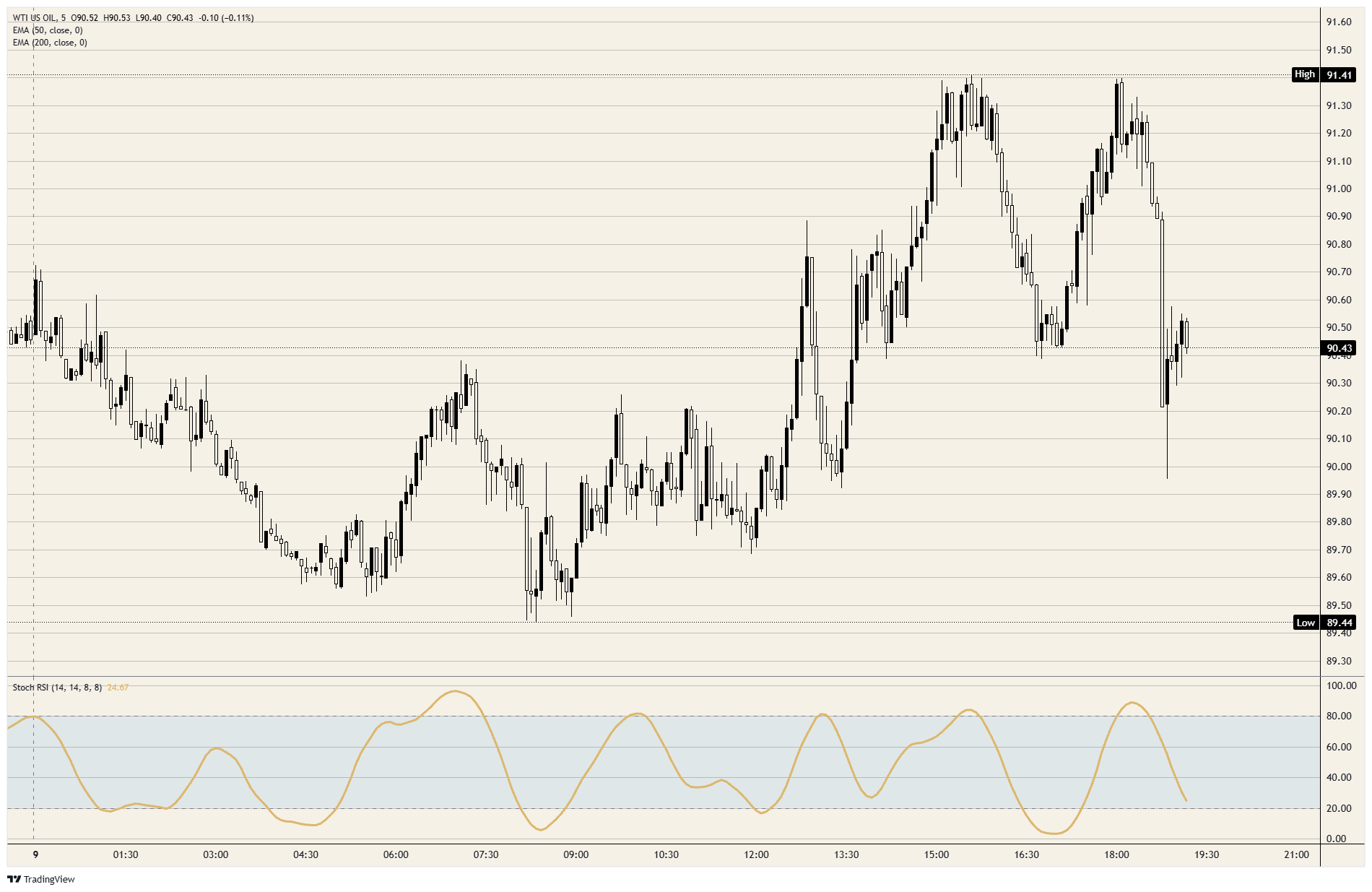
Spot WTI fell from near $91.00 to just under $90.00 in the two five-minute bars after the post, giving back about three-quarters of its climb from the session low just under $89.50. The drop came from the second of two highs that both stopped short of $91.50.
On the charts
WTI has recovered to near $90.50 since then and is in the middle of the session's range between $89.50 and $91.50. Intraday momentum went from overbought to near oversold in the drop and is still falling.
WTI 5-minute chart
WTI Oil FAQs
WTI Oil is a type of Crude Oil sold on international markets. The WTI stands for West Texas Intermediate, one of three major types including Brent and Dubai Crude. WTI is also referred to as “light” and “sweet” because of its relatively low gravity and sulfur content respectively. It is considered a high quality Oil that is easily refined. It is sourced in the United States and distributed via the Cushing hub, which is considered “The Pipeline Crossroads of the World”. It is a benchmark for the Oil market and WTI price is frequently quoted in the media.
Like all assets, supply and demand are the key drivers of WTI Oil price. As such, global growth can be a driver of increased demand and vice versa for weak global growth. Political instability, wars, and sanctions can disrupt supply and impact prices. The decisions of OPEC, a group of major Oil-producing countries, is another key driver of price. The value of the US Dollar influences the price of WTI Crude Oil, since Oil is predominantly traded in US Dollars, thus a weaker US Dollar can make Oil more affordable and vice versa.
The weekly Oil inventory reports published by the American Petroleum Institute (API) and the Energy Information Agency (EIA) impact the price of WTI Oil. Changes in inventories reflect fluctuating supply and demand. If the data shows a drop in inventories it can indicate increased demand, pushing up Oil price. Higher inventories can reflect increased supply, pushing down prices. API’s report is published every Tuesday and EIA’s the day after. Their results are usually similar, falling within 1% of each other 75% of the time. The EIA data is considered more reliable, since it is a government agency.
OPEC (Organization of the Petroleum Exporting Countries) is a group of 12 Oil-producing nations who collectively decide production quotas for member countries at twice-yearly meetings. Their decisions often impact WTI Oil prices. When OPEC decides to lower quotas, it can tighten supply, pushing up Oil prices. When OPEC increases production, it has the opposite effect. OPEC+ refers to an expanded group that includes ten extra non-OPEC members, the most notable of which is Russia.
추천 기사


