


Bitcoin’s 4-year cycle looks self-fulfilling, but RWA may define what's next – ARK Invest
- Bitcoin's 4-year cycle shapes bull and bear market narratives not only through halvings, but also through sentiment and investor behavior.
- ARK Invest’s Lorenzo Valente foresees the merging of the digital asset economy and traditional finance as the next growth frontier.
- RWA tokenization and related infrastructure expand the blockchain technology’s use cases beyond native tokens.
Over the years, investors have leveraged the Bitcoin (BTC) 4-year cycle, buying at bear-market bottoms and taking profits at bull-market tops. Meanwhile, larger narratives in 2026 point to a continued shift toward institutionalization, real-world asset (RWA) tokenization, and regulation, according to ARK Invest’s Director of Digital Asset Research, Lorenzo Valente.
Speaking to FXStreet at the European Blockchain Conference in Barcelona, Valente said that while it is difficult to pinpoint key catalysts for Bitcoin and cryptocurrencies in general, investors appear to be preparing for the cycle’s inflection point in November, potentially validating the pattern as “a self-fulfilling prophecy.” Valente believes the Bitcoin 4-year cycle is influenced not only by halving dynamics but also by investor behavioral patterns, monetary policy and the regulatory landscape.
“I think November will see the four-year cycle, and it seems to be a self-fulfilling prophecy,” Valente said, adding, “many people may be preparing for that. Therefore, I don’t want to downplay it.”
The rise of RWA tokenization and institutionalization
Tokenized assets on public blockchains, RWA grew to $38 billion in the third quarter of 2026 through to late August, up from $20.6 billion a year earlier, according to a report by InvestaX. The growth outlook included the user base, which had surpassed 2.5 million in the same quarter. Meanwhile, RWA.io values the larger RWA market at roughly $345 billion, underpinning the growth in real assets executing on the blockchain.
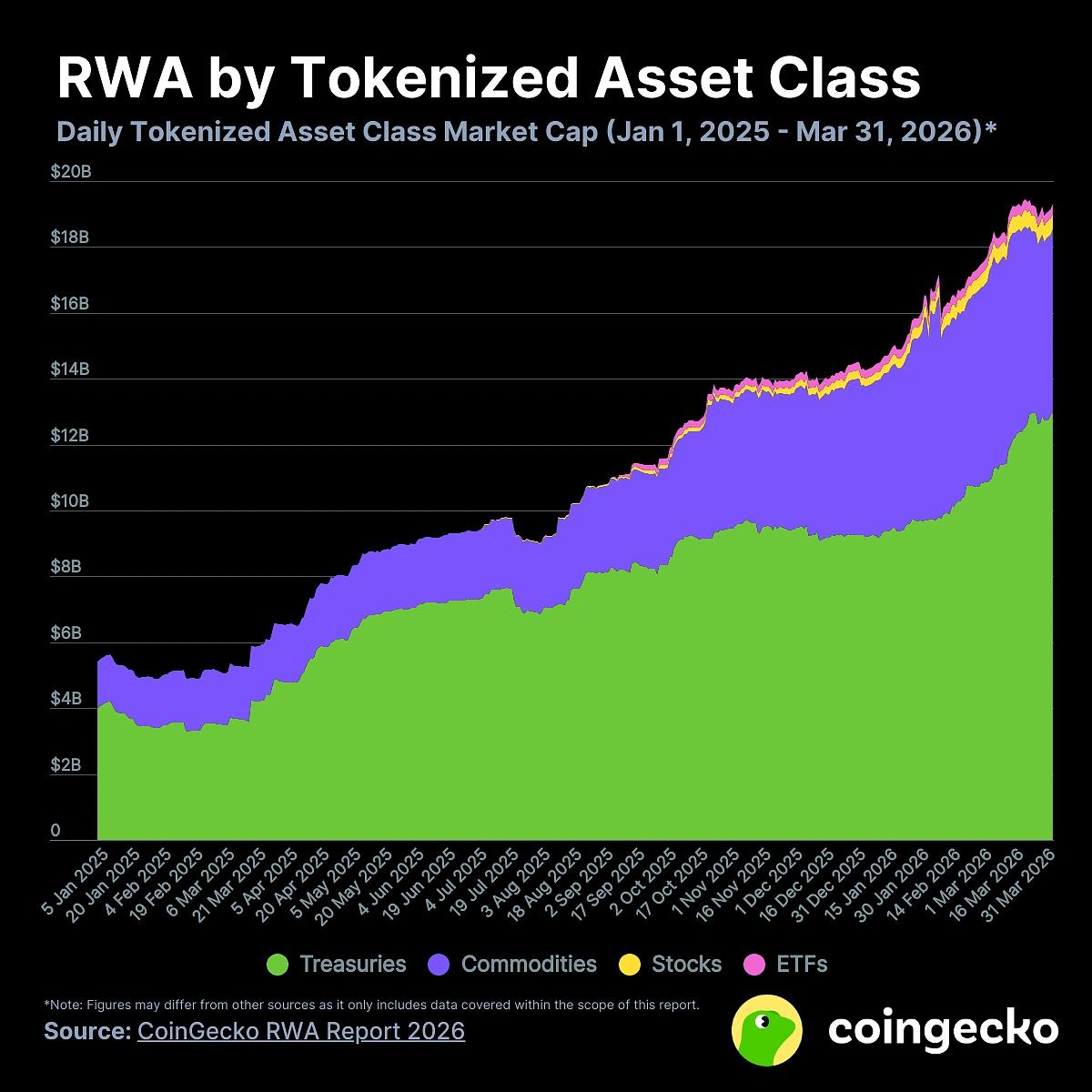
A report by CoinGecko corroborates InvestaX valuations, indicating that the RWA sector more than tripled, reaching $19.3 billion by Q1 2026. Tokenized commodities grew to $5.5 billion from $1.4 billion in the same period, driven by Gold-backed tokens. Moreover, tokenized perpetual volume jumped to $525 billion by the end of Q1 2026, up from $313 billion in all of 2025.
Building on this, Valente said the future of cryptocurrencies lies in institutionalization, with newer products and asset classes primarily serving key users, retailers and traders. Emerging markets rely on trader adoption. Institutions get involved after retailers and traders have validated an asset class.
Regulation played a critical role because it communicates to investors and the broader institutional community that the market is mature and stable. Although the CLARITY Act failed to advance in the United States (US) Senate, agencies including the Securities and Exchange Commission (SEC) and the Commodity Futures Trading Commission (CFTC) are stepping up to formulate industry guidelines within their current authority. Meanwhile, Europe is implementing the Markets in Crypto Assets Regulation (MiCA), a comprehensive regulatory framework for the entire economic bloc.
“You need institutions, don’t you? You need these players, so I think the industry has changed a lot,” Valente said, adding, “for us [Ark Invest], it is clear that the infrastructure has become more mature. There’s more regulation.”
On the CLARITY Act not passing, Valente argued the failure was largely anticipated, which was reflected in Bitcoin falling roughly 2% to 3% before continuing its breakout above $87,000. Bitcoin has since moderated and is broadly consolidating between $82,000 and $85,000.
Valente said RWA tokenization and related infrastructure are fundamental to growth and cash flow. With crypto market capitalization currently lagging traditional markets, there is substantial room for growth in RWA tokenization valuation and for blockchain technology to expand to support assets beyond native tokens.
“Cryptocurrencies in general are a network infrastructure and technology, so if they are useful, we think they will be used much more widely than just tokens, right? This will continue, but I think the main growth in the future definitely lies in RWA and tokenization in general,” Valente explained.
When asked which cryptocurrency projects could be the ultimate winners of the crypto market’s next growth phase, Valente appeared to be very selective. Nonetheless, he highlighted Hyperliquid (HYPE), saying the network has demonstrated strong product-market fit, especially among professional traders. On Zcash (ZEC), which recently hit a new record high, the ARK Invest researcher said the project faces challenges because it is less programmable than networks such as Ethereum (ETH) and Solana (SOL), which offer users more with smart contracts.
Looking ahead
The cryptocurrency industry appears to be at an inflection point, with governments globally moving quickly to formulate regulations and institutions adopting RWA and tokenization as the next growth frontier. On the future of the crypto industry, Valente said the market needs more fund managers, banks and brokers to stimulate growth, especially after the October drawdown left many traders and retailers with heavy losses.
Valente said, “If you were to ask me where the next big offering, product, or cash flow would come from, it would be RWA, tokenization, and safe deposit boxes [vaults].”
Bitcoin, altcoins, stablecoins FAQs
Bitcoin is the largest cryptocurrency by market capitalization, a virtual currency designed to serve as money. This form of payment cannot be controlled by any one person, group, or entity, which eliminates the need for third-party participation during financial transactions.
Altcoins are any cryptocurrency apart from Bitcoin, but some also regard Ethereum as a non-altcoin because it is from these two cryptocurrencies that forking happens. If this is true, then Litecoin is the first altcoin, forked from the Bitcoin protocol and, therefore, an “improved” version of it.
Stablecoins are cryptocurrencies designed to have a stable price, with their value backed by a reserve of the asset it represents. To achieve this, the value of any one stablecoin is pegged to a commodity or financial instrument, such as the US Dollar (USD), with its supply regulated by an algorithm or demand. The main goal of stablecoins is to provide an on/off-ramp for investors willing to trade and invest in cryptocurrencies. Stablecoins also allow investors to store value since cryptocurrencies, in general, are subject to volatility.
Bitcoin dominance is the ratio of Bitcoin's market capitalization to the total market capitalization of all cryptocurrencies combined. It provides a clear picture of Bitcoin’s interest among investors. A high BTC dominance typically happens before and during a bull run, in which investors resort to investing in relatively stable and high market capitalization cryptocurrency like Bitcoin. A drop in BTC dominance usually means that investors are moving their capital and/or profits to altcoins in a quest for higher returns, which usually triggers an explosion of altcoin rallies.
추천 기사


