


Gold climbs as US-Iran peace progress, falling Oil curb rate-hike bets
- Gold climbs over 2.5% on Monday after the US and Iran announce an agreement on a framework deal to end the war.
- Falling Oil prices ease inflation concerns and reduce expectations of higher interest rates, supporting the non-yielding metal.
- Technically, XAU/USD trades below its 20-day SMA, but the RSI has recovered from oversold levels, suggesting selling pressure is easing.
Gold (XAU/USD) starts the week on a positive note, rising more than 2.5% after the United States (US) and Iran reached a framework agreement to end the war in the Middle East. At the time of writing, XAU/USD trades around $4,344, extending its recovery from a nearly seven-month low of $4,023 touched last week.
A memorandum of understanding (MoU) is expected to be signed in Switzerland on Friday. US President Donald Trump said in a Truth Social post on Sunday that "the deal with the Islamic Republic of Iran is now complete" and announced the immediate removal of the US naval blockade of Iranian ports, while Iran would reopen the Strait of Hormuz.
The deal has improved market mood and eased fears of further disruptions to global energy supplies, pushing the US Dollar (USD) and Oil prices lower. West Texas Intermediate (WTI) Crude Oil falls to its lowest level in nearly three months, trading around $79 per barrel at the time of writing.
The precious metal, traditionally viewed as a hedge against inflation and geopolitical uncertainty, has behaved more like an interest rate-sensitive asset since the outbreak of the US-Iran war, as soaring Oil prices fueled inflation concerns and reinforced expectations that the major central banks, including the Federal Reserve (Fed), would keep interest rates higher for longer.
As a result, Gold lost nearly 20% of its value during the war as markets started to price in the possibility of a Fed rate hike later this year. A higher interest-rate environment increases the opportunity cost of holding non-yielding assets.
With Washington and Tehran now moving toward a peace agreement and the Strait of Hormuz set to reopen, the decline in Oil prices is easing inflation concerns, leading traders to scale back rate-hike bets and helping the metal recover.
However, further gains in Gold could be limited as the final agreement between Washington and Tehran has yet to be formally signed. Meanwhile, the Fed is unlikely to signal a return to monetary policy easing anytime soon. US inflation has more than doubled from the central bank's 2% target since the outbreak of the war, suggesting borrowing costs could remain elevated in the coming months even if energy prices continue to decline.
Traders now turn their attention to the Fed's monetary policy announcement on Wednesday. While the central bank is widely expected to keep interest rates unchanged, investors will closely watch the updated economic projections and comments from newly appointed Chair Kevin Warsh for clues on the future path of monetary policy.
Technical analysis: RSI rebounds from oversold territory
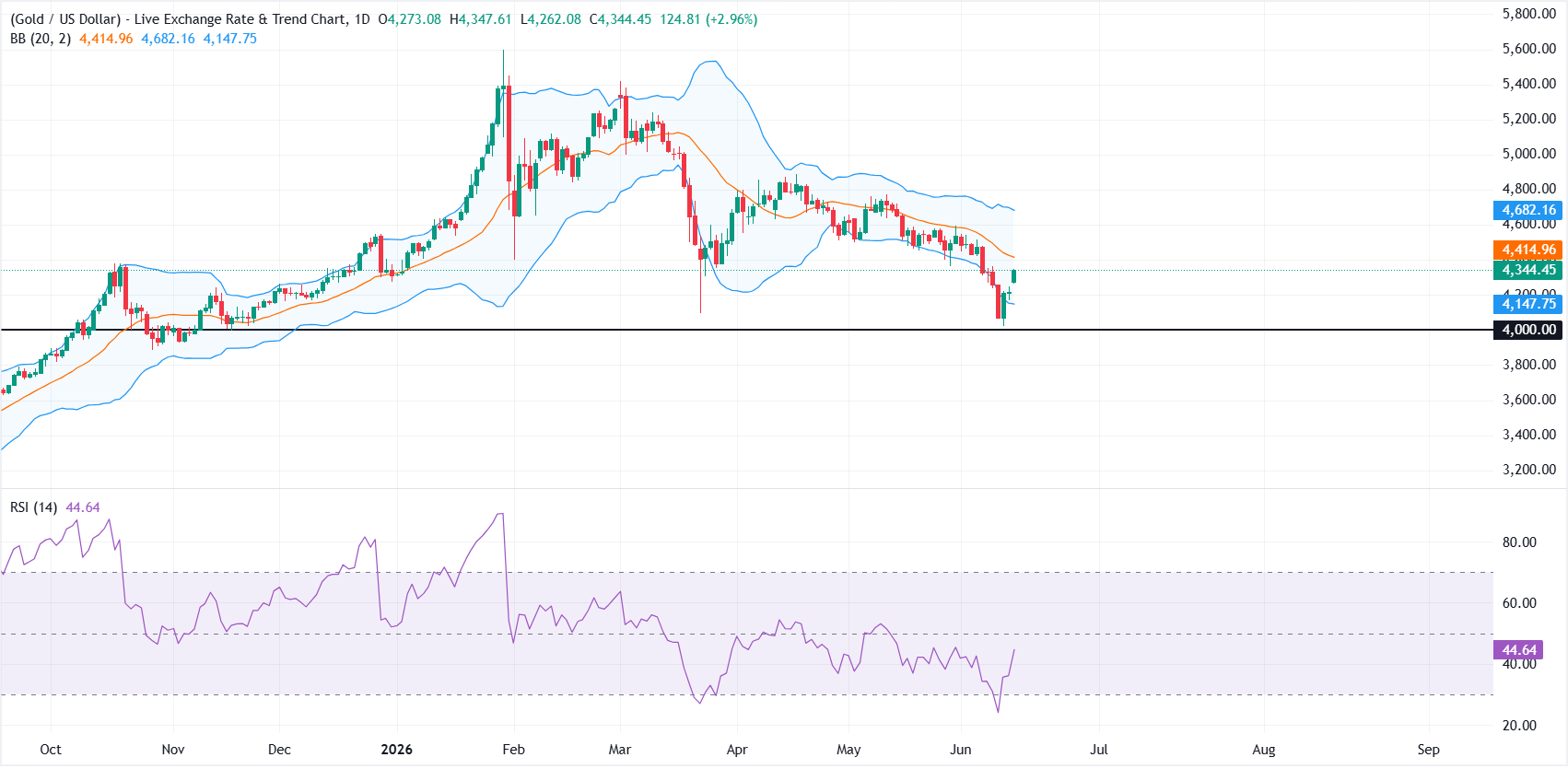
In the daily chart, XAU/USD remains under short-term pressure, holding below the Bollinger Band mid-line 20-day Simple Moving Average near $4,414, keeping the immediate bias tilted lower.
The Relative Strength Index (RSI) has recovered from oversold territory and is currently near 44, indicating that selling pressure has eased. However, the indicator remains below the 50 mark, suggesting the broader trend has yet to turn decisively bullish.
On the topside, initial resistance is located at the Bollinger midline (20-day SMA) around $4,414, with the upper Bollinger band near $4,682 acting as the next cap if buyers manage to extend a rebound.
On the downside, first support emerges at the lower Bollinger Band near $4,147, ahead of a more strategic horizontal floor around $4,000, which is likely to attract stronger buying interest.
(The technical analysis of this story was written with the help of an AI tool.)
Fed FAQs
Monetary policy in the US is shaped by the Federal Reserve (Fed). The Fed has two mandates: to achieve price stability and foster full employment. Its primary tool to achieve these goals is by adjusting interest rates. When prices are rising too quickly and inflation is above the Fed’s 2% target, it raises interest rates, increasing borrowing costs throughout the economy. This results in a stronger US Dollar (USD) as it makes the US a more attractive place for international investors to park their money. When inflation falls below 2% or the Unemployment Rate is too high, the Fed may lower interest rates to encourage borrowing, which weighs on the Greenback.
The Federal Reserve (Fed) holds eight policy meetings a year, where the Federal Open Market Committee (FOMC) assesses economic conditions and makes monetary policy decisions. The FOMC is attended by twelve Fed officials – the seven members of the Board of Governors, the president of the Federal Reserve Bank of New York, and four of the remaining eleven regional Reserve Bank presidents, who serve one-year terms on a rotating basis.
In extreme situations, the Federal Reserve may resort to a policy named Quantitative Easing (QE). QE is the process by which the Fed substantially increases the flow of credit in a stuck financial system. It is a non-standard policy measure used during crises or when inflation is extremely low. It was the Fed’s weapon of choice during the Great Financial Crisis in 2008. It involves the Fed printing more Dollars and using them to buy high grade bonds from financial institutions. QE usually weakens the US Dollar.
Quantitative tightening (QT) is the reverse process of QE, whereby the Federal Reserve stops buying bonds from financial institutions and does not reinvest the principal from the bonds it holds maturing, to purchase new bonds. It is usually positive for the value of the US Dollar.
추천 기사


