


Australian Dollar sets for its third straight negative weekly closing against US Dollar
- Australian Dollar is on track for a third consecutive negative weekly close against the US Dollar.
- The RBA’s monetary tightening cycle appears to has come to an end.
- Hawkish Fed undertone has strengthened the US Dollar.
The Australian Dollar (AUD) finds a brief support against the US Dollar (USD) after hitting a fresh Year-Till-Date (YTD) low near 0.6646 on Friday. In the European trade, the Aussie pair is 0.18% higher at around 0.6670.
Australian Dollar Price This week
The table below shows the percentage change of Australian Dollar (AUD) against listed major currencies this week. Australian Dollar was the weakest against the Japanese Yen.
| USD | EUR | GBP | JPY | CAD | AUD | NZD | CHF | |
|---|---|---|---|---|---|---|---|---|
| USD | 0.57% | 0.87% | -0.48% | 0.47% | 1.71% | 0.60% | 0.45% | |
| EUR | -0.57% | 0.28% | -1.06% | -0.15% | 1.12% | -0.01% | -0.17% | |
| GBP | -0.87% | -0.28% | -1.31% | -0.42% | 0.84% | -0.29% | -0.44% | |
| JPY | 0.48% | 1.06% | 1.31% | 0.83% | 2.17% | 0.99% | 0.94% | |
| CAD | -0.47% | 0.15% | 0.42% | -0.83% | 1.36% | 0.16% | -0.02% | |
| AUD | -1.71% | -1.12% | -0.84% | -2.17% | -1.36% | -1.11% | -1.27% | |
| NZD | -0.60% | 0.00% | 0.29% | -0.99% | -0.16% | 1.11% | -0.16% | |
| CHF | -0.45% | 0.17% | 0.44% | -0.94% | 0.02% | 1.27% | 0.16% |
The heat map shows percentage changes of major currencies against each other. The base currency is picked from the left column, while the quote currency is picked from the top row. For example, if you pick the Australian Dollar from the left column and move along the horizontal line to the US Dollar, the percentage change displayed in the box will represent AUD (base)/USD (quote).
The AUD/USD pair is set for its third straight negative weekly close as the Australian Dollar underperformed this week due to a substantial deterioration of hawkis Reserve Bank of Australia (RBA) expectations. So far this year, the RBA has delivered five quarter-to-a-percent interest rate hikes, pushing the Official Cash Rate (OCR) to 4.85%.
What has eroded hawkish RBA bets?
Analysts at Commerzbank highlight that “yesterday’s Australian labour market data disappointed significantly.” Instead of the “expected increase of 25,000 jobs, employment fell sharply by 43,500,” with the October release “follow[ing] an already weak September.” At the same time, “the unemployment rate rose to 4.9%, its highest level since late 2021,” underlining that “the Australian labour market therefore continues to cool, likely reflecting in particular the impact of higher interest rates and the associated weakness in demand.”
Against this backdrop, Commerzbank argues that “this suggests that the RBA’s rate-hiking cycle likely came to an end with its latest meeting, which is also what markets are pricing in,” noting that “we, too, had recently expected no further rate hikes.” However, they point out that “markets are now pricing in around 1.5 rate cuts by the end of 2027, which we still consider premature based on the latest labour market data alone.” While “clearly, the risks of a more pronounced economic slowdown have increased,” the bank stresses that “the incoming data will first have to confirm that this trend is continuing.”
Looking ahead, Commerzbank sees event risk concentrated in upcoming releases: “The next labour market data will therefore be key to determining whether markets’ rate-cut bets are justified, while inflation data will remain in focus as well. The October figures are due next week.” In their view, “if inflation comes in as expected or even slightly lower, this would likely lend further support to rate-cut expectations. The Aussie could then lose some more ground, although quite a bit is already priced in given current rate-cut expectations.” Conversely, “if inflation instead surprises to the upside, the AUD could benefit as markets would likely scale back some of their rate-cut expectations.”
Meanwhile, the US Dollar’s strength due to hawkish Federal Reserve (Fed) expectations has also weighed on the Aussie pair. As of writing, the US Dollar Index (DXY), which gauges the Greenback’s value against six major currencies, holds onto recent rally near 104.00.
Strategists at ING said in a note that markets now “quite settled on pricing 25bp hikes in December, January and next summer.”
AUD/USD Technical Analysis
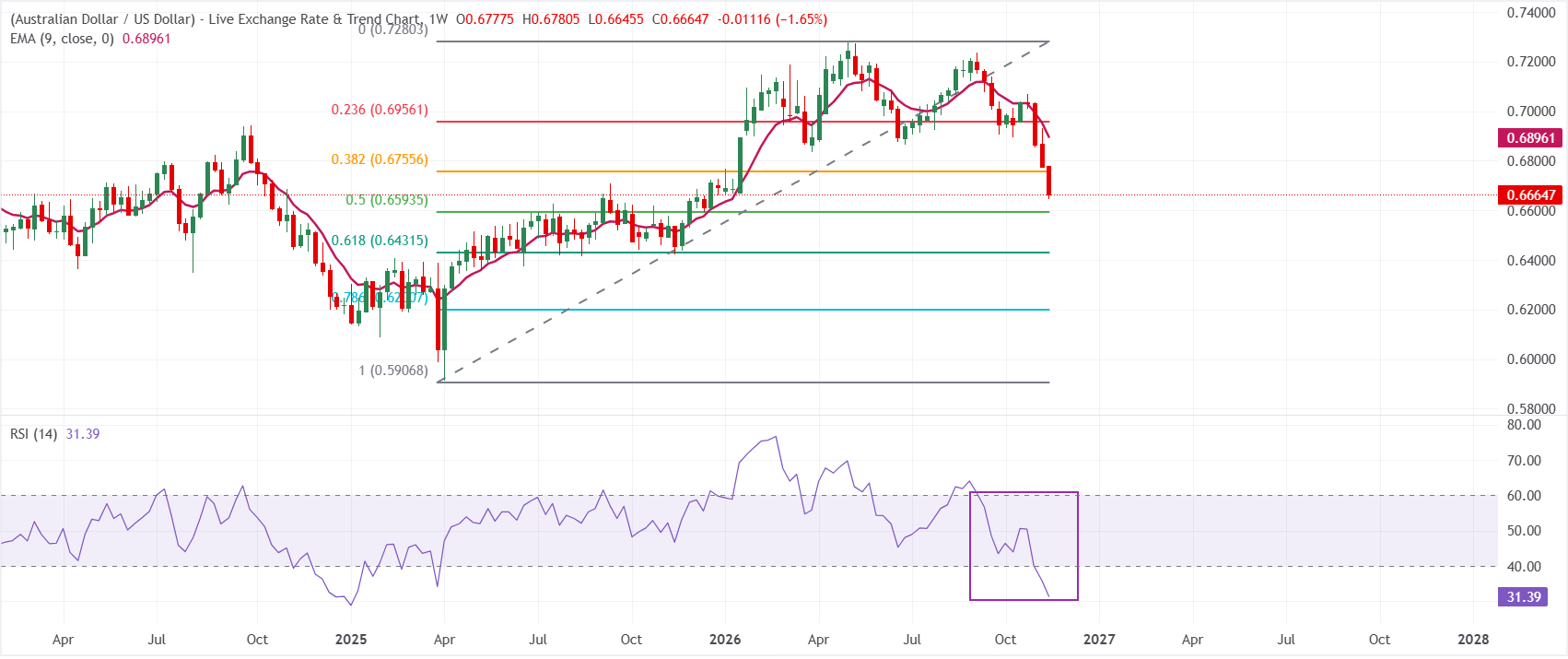
In the weekly chart, AUD/USD trades at 0.6665 with a bearish near-term bias as it holds below the 23.6% Fibonacci retracement at 0.6956 and the 38.2% retracement at 0.6756. The pair has slipped away from these overhead fib levels after failing to sustain prior gains, while the nine-week exponential moving average (EMA) at 0.6896 now sits well above spot, reinforcing the notion of a market trading beneath its short-term trend gauge. Weekly Relative Strength Index (RSI) has retreated toward the low-30s, approaching oversold territory and hinting that while bears remain in control, the downside momentum could start to moderate if selling persists without fresh lows.
On the downside, initial support emerges at the 50% retracement around 0.6594, ahead of a deeper Fibonacci floor at 0.6431, with the 78.6% retracement near 0.6201 marking a more distant bearish target if pressure accelerates. On the topside, bulls would first need to overcome the 38.2% retracement at 0.6756 to ease immediate downside risks, with a break above there exposing the more significant 23.6% retracement at 0.6956, where the descending EMA cluster overhead would be expected to offer an additional layer of resistance.
(The technical analysis of this story was written with the help of an AI tool. Know more.)
Economic Indicator
Employment Change s.a.
The Employment Change released by the Australian Bureau of Statistics is a measure of the change in the number of employed people in Australia. The statistic is adjusted to remove the influence of seasonal trends. Generally speaking, a rise in Employment Change has positive implications for consumer spending, stimulates economic growth, and is bullish for the Australian Dollar (AUD). A low reading, on the other hand, is seen as bearish.
Read more.Last release: Thu Nov 19, 2026 00:30
Frequency: Monthly
Actual: -43.5K
Consensus: 25K
Previous: -39.3K
Source: Australian Bureau of Statistics
추천 기사


