


US Dollar Index Price Forecast: Ongoing rally could extend towards 104.60
- The US Dollar Index corrects mildly after hitting a fresh 19-month high near 104.00
- ING sees the USD Index extending the rally to near 104.60 amid hawkish Fed bets.
- Commerzback cautions of US Dollar’s corrections amid AI trade unwinding.
The US Dollar (USD) corrects marginally after a sharp run-up in the past few weeks. As of writing, the USD Index, which gauges the Greenback’s value against six major currencies, is 0.1% down to near 103.81 from its fresh 19-month high of around 104.00 posted the previous day.
US Dollar Price This week
The table below shows the percentage change of US Dollar (USD) against listed major currencies this week. US Dollar was the strongest against the Australian Dollar.
| USD | EUR | GBP | JPY | CAD | AUD | NZD | CHF | |
|---|---|---|---|---|---|---|---|---|
| USD | 0.47% | 0.82% | -0.35% | 0.47% | 1.65% | 0.60% | 0.39% | |
| EUR | -0.47% | 0.33% | -0.79% | -0.02% | 1.16% | 0.09% | -0.12% | |
| GBP | -0.82% | -0.33% | -1.09% | -0.36% | 0.85% | -0.25% | -0.45% | |
| JPY | 0.35% | 0.79% | 1.09% | 0.68% | 1.94% | 0.82% | 0.72% | |
| CAD | -0.47% | 0.02% | 0.36% | -0.68% | 1.29% | 0.14% | -0.09% | |
| AUD | -1.65% | -1.16% | -0.85% | -1.94% | -1.29% | -1.06% | -1.28% | |
| NZD | -0.60% | -0.09% | 0.25% | -0.82% | -0.14% | 1.06% | -0.21% | |
| CHF | -0.39% | 0.12% | 0.45% | -0.72% | 0.09% | 1.28% | 0.21% |
The heat map shows percentage changes of major currencies against each other. The base currency is picked from the left column, while the quote currency is picked from the top row. For example, if you pick the US Dollar from the left column and move along the horizontal line to the Japanese Yen, the percentage change displayed in the box will represent USD (base)/JPY (quote).
The outlook of the US Dollar remains strong as traders are confident of near-term interest rate hikes by the Federal Reserve (Fed) amid continuously rising inflationary pressures.
Dollar support holds as FOMC path firms
Strategists at ING note that the latest FOMC minutes showed only a “couple” of Fed officials backing a faster pace of tightening at the October meeting, with markets now “quite settled on pricing 25bp hikes in December, January and next summer.”
Against that backdrop, ING argues “there are good reasons for the dollar to be at current levels,” adding that “DXY advancing to the 104.60 area remains our bias for now.”
Contrary to ING, Commerzback cautions of correction risk in the US Dollar amid slowing flows into Artificial Intelligence (AI) stocks.
Dollar support from AI flows faces correction risk
Analysts at Commerzbank caution that the Dollar’s recent support from AI-related capital inflows is not without vulnerability, warning that “if growing doubts about the sustainability of the AI boom were to trigger a sharper correction in US equity markets, a reversal of these capital flows could also hit the dollar hard.” At the same time, they temper this risk assessment by stressing that “we consider an abrupt end to the AI build-out unlikely,” suggesting that while the currency remains exposed to any sharp reassessment of the AI theme, a sudden collapse in that narrative is not their base case.
US Dollar Index Technical Analysis
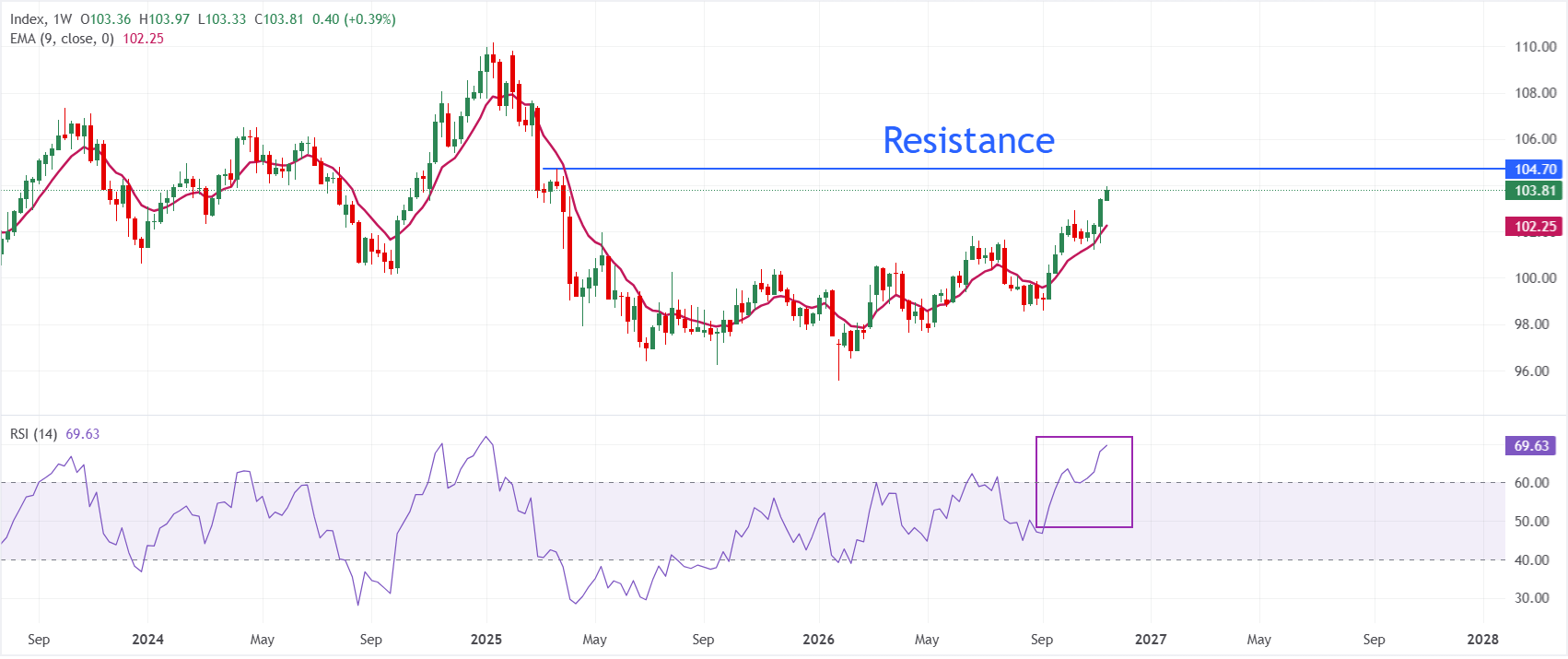
In the weekly chart, Dollar Index Spot trades at 103.81. The near-term bias is bullish as price holds above the nine-period exponential moving average (EMA) at 102.25, keeping the recent advance well supported. The Relative Strength Index (RSI) at 69.63 flirts with overbought territory, suggesting upside momentum is strong but increasingly stretched.
On the downside, initial support is seen at the nine-week EMA around 102.25, where a pullback could attract dip-buying interest while it holds. A weekly close below this moving average would hint at fading bullish pressure, while sustained trade above it leaves the broader uptrend intact, even if momentum cools from current elevated RSI levels.
On the upside, the major hurdle for the index appears at 104.70, which is similar to ING's forecast.
(The technical analysis of this story was written with the help of an AI tool. Know more.)
US Dollar FAQs
The US Dollar (USD) is the official currency of the United States of America, and the ‘de facto’ currency of a significant number of other countries where it is found in circulation alongside local notes. It is the most heavily traded currency in the world, accounting for over 88% of all global foreign exchange turnover, or an average of $6.6 trillion in transactions per day, according to data from 2022. Following the second world war, the USD took over from the British Pound as the world’s reserve currency. For most of its history, the US Dollar was backed by Gold, until the Bretton Woods Agreement in 1971 when the Gold Standard went away.
The most important single factor impacting on the value of the US Dollar is monetary policy, which is shaped by the Federal Reserve (Fed). The Fed has two mandates: to achieve price stability (control inflation) and foster full employment. Its primary tool to achieve these two goals is by adjusting interest rates. When prices are rising too quickly and inflation is above the Fed’s 2% target, the Fed will raise rates, which helps the USD value. When inflation falls below 2% or the Unemployment Rate is too high, the Fed may lower interest rates, which weighs on the Greenback.
In extreme situations, the Federal Reserve can also print more Dollars and enact quantitative easing (QE). QE is the process by which the Fed substantially increases the flow of credit in a stuck financial system. It is a non-standard policy measure used when credit has dried up because banks will not lend to each other (out of the fear of counterparty default). It is a last resort when simply lowering interest rates is unlikely to achieve the necessary result. It was the Fed’s weapon of choice to combat the credit crunch that occurred during the Great Financial Crisis in 2008. It involves the Fed printing more Dollars and using them to buy US government bonds predominantly from financial institutions. QE usually leads to a weaker US Dollar.
Quantitative tightening (QT) is the reverse process whereby the Federal Reserve stops buying bonds from financial institutions and does not reinvest the principal from the bonds it holds maturing in new purchases. It is usually positive for the US Dollar.
추천 기사


