


Japanese Yen outperforms as BoJ’s policy takes centre stage
- The Japanese Yen gains against its peers ahead of the BoJ’s monetary policy announcement.
- The BoJ is widely anticipated to raise interest rates on Friday.
- 16 of 18 Fed members see at least two interest rate hikes this year.
The Japanese Yen (JPY) trades higher against its major currency peers on Thursday. The USD/JPY pair is down 0.35% to near 155.75 ahead of the Bank of Japan’s (BoJ) monetary policy outcome on Friday.
Japanese Yen Price Today
The table below shows the percentage change of Japanese Yen (JPY) against listed major currencies today. Japanese Yen was the strongest against the US Dollar.
| USD | EUR | GBP | JPY | CAD | AUD | NZD | CHF | |
|---|---|---|---|---|---|---|---|---|
| USD | -0.08% | -0.07% | -0.42% | 0.03% | -0.38% | -0.37% | -0.24% | |
| EUR | 0.08% | 0.01% | -0.32% | 0.12% | -0.30% | -0.26% | -0.14% | |
| GBP | 0.07% | -0.01% | -0.31% | 0.11% | -0.31% | -0.27% | -0.13% | |
| JPY | 0.42% | 0.32% | 0.31% | 0.40% | 0.04% | 0.02% | 0.16% | |
| CAD | -0.03% | -0.12% | -0.11% | -0.40% | -0.39% | -0.38% | -0.23% | |
| AUD | 0.38% | 0.30% | 0.31% | -0.04% | 0.39% | 0.03% | 0.13% | |
| NZD | 0.37% | 0.26% | 0.27% | -0.02% | 0.38% | -0.03% | 0.17% | |
| CHF | 0.24% | 0.14% | 0.13% | -0.16% | 0.23% | -0.13% | -0.17% |
The heat map shows percentage changes of major currencies against each other. The base currency is picked from the left column, while the quote currency is picked from the top row. For example, if you pick the Japanese Yen from the left column and move along the horizontal line to the US Dollar, the percentage change displayed in the box will represent JPY (base)/USD (quote).
Market experts are confident that the BoJ will hike interest rates by 25 basis points (bps) to 1.25% and calling the central bank’s communication on the rate outlook to be key trigger for Yen’s next move.
BoJ hike seen as done deal as focus turns to policy tone
DBS Group Research economist Eugene Leow argues that the market now treats the Bank of Japan’s upcoming move as largely decided, noting that “the BoJ’s hike looks like a foregone conclusion with the debate now shifting towards the tone of the central bank.”
“With the rate increase itself widely anticipated”, Leow suggests investors are increasingly focused on how hawkish or cautious the BoJ’s communication will be, and what that implies for the trajectory of policy into year-end.
On Friday, investors will also focus on the National Consumer Price Index (CPI) data for August, which will be published before the policy announcement.
On the US Dollar front, traders have become increasingly confident that the Fed will deliver one more interest rate hike this year. The Fed hiked its interest rates by 25 bps to 3.75%-4.00% on Wednesday and signaled that one more hike is around the corner.
The Fed’s dot plot showed that 12 of 18 policymakers supported two and four voted for three interest rate hikes this year. While two supported the one interest rate hike announced is sufficient.
USD/JPY Technical Analysis
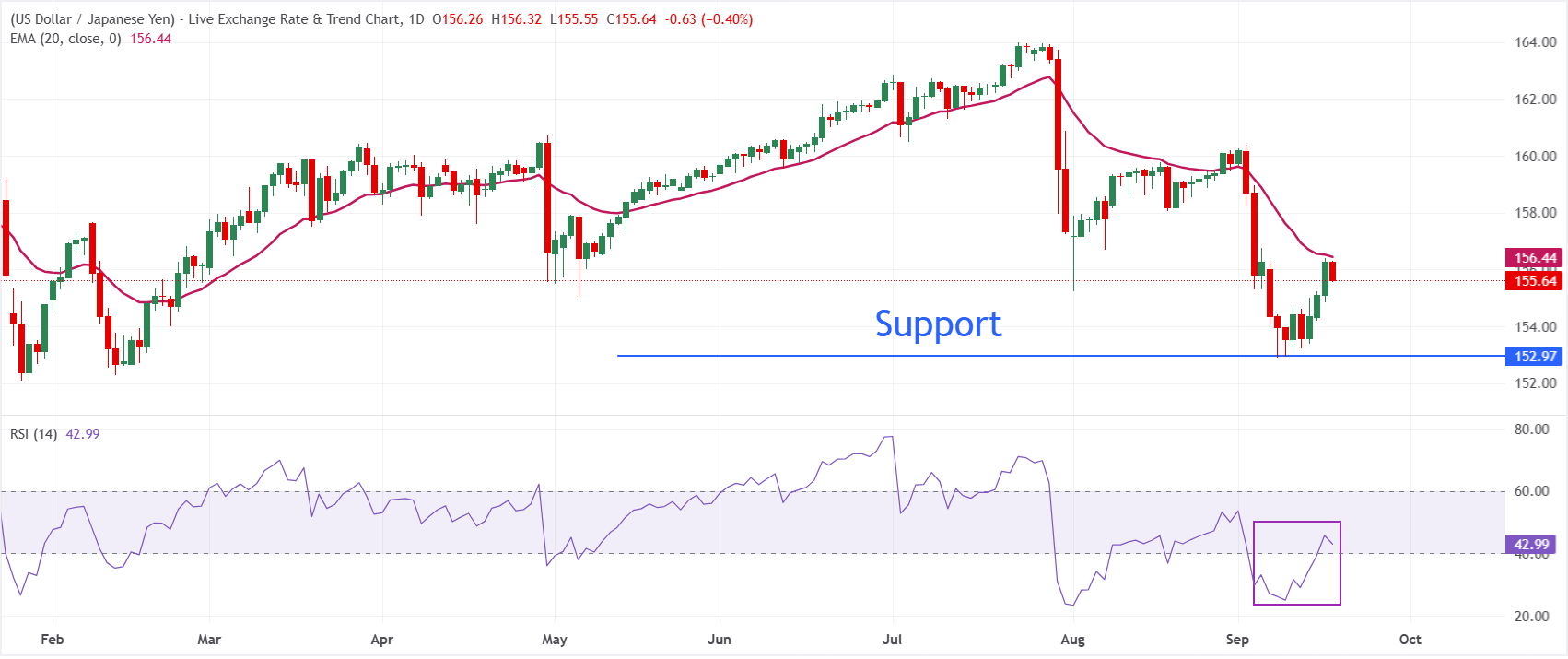
In the daily chart, USD/JPY trades at 155.63, retaining a bearish near-term bias as it holds beneath the 20-day Exponential Moving Average (EMA) at 156.44. The pair’s inability to reclaim this short-term EMA suggests rallies remain capped for now, while the Relative Strength Index (RSI) around 43 hints at stabilizing but still modest downside pressure rather than outright oversold conditions.
On the topside, initial resistance is defined by the 20-day EMA at 156.44, which acts as the first barrier that bulls would need to clear to alleviate immediate selling pressure and open the way for a more sustained recovery. With no nearby structural supports highlighted by the current dataset, traders may continue to treat intraday rebounds toward the EMA as potential selling opportunities until the price decisively closes back above this level.
(The technical analysis of this story was written with the help of an AI tool. Know more.)
Central banks FAQs
Central Banks have a key mandate which is making sure that there is price stability in a country or region. Economies are constantly facing inflation or deflation when prices for certain goods and services are fluctuating. Constant rising prices for the same goods means inflation, constant lowered prices for the same goods means deflation. It is the task of the central bank to keep the demand in line by tweaking its policy rate. For the biggest central banks like the US Federal Reserve (Fed), the European Central Bank (ECB) or the Bank of England (BoE), the mandate is to keep inflation close to 2%.
A central bank has one important tool at its disposal to get inflation higher or lower, and that is by tweaking its benchmark policy rate, commonly known as interest rate. On pre-communicated moments, the central bank will issue a statement with its policy rate and provide additional reasoning on why it is either remaining or changing (cutting or hiking) it. Local banks will adjust their savings and lending rates accordingly, which in turn will make it either harder or easier for people to earn on their savings or for companies to take out loans and make investments in their businesses. When the central bank hikes interest rates substantially, this is called monetary tightening. When it is cutting its benchmark rate, it is called monetary easing.
A central bank is often politically independent. Members of the central bank policy board are passing through a series of panels and hearings before being appointed to a policy board seat. Each member in that board often has a certain conviction on how the central bank should control inflation and the subsequent monetary policy. Members that want a very loose monetary policy, with low rates and cheap lending, to boost the economy substantially while being content to see inflation slightly above 2%, are called ‘doves’. Members that rather want to see higher rates to reward savings and want to keep a lit on inflation at all time are called ‘hawks’ and will not rest until inflation is at or just below 2%.
Normally, there is a chairman or president who leads each meeting, needs to create a consensus between the hawks or doves and has his or her final say when it would come down to a vote split to avoid a 50-50 tie on whether the current policy should be adjusted. The chairman will deliver speeches which often can be followed live, where the current monetary stance and outlook is being communicated. A central bank will try to push forward its monetary policy without triggering violent swings in rates, equities, or its currency. All members of the central bank will channel their stance toward the markets in advance of a policy meeting event. A few days before a policy meeting takes place until the new policy has been communicated, members are forbidden to talk publicly. This is called the blackout period.
추천 기사


