


The Japanese Yen finally rallies on something Tokyo did not pay for
- USD/JPY trades just under 156.00 after a 3.7-Yen drop through the 200-day EMA.
- A Bank of Japan hike is fully priced for the September 18 decision.
- Tokyo's top currency official calls the move unsatisfying and stays on alert.
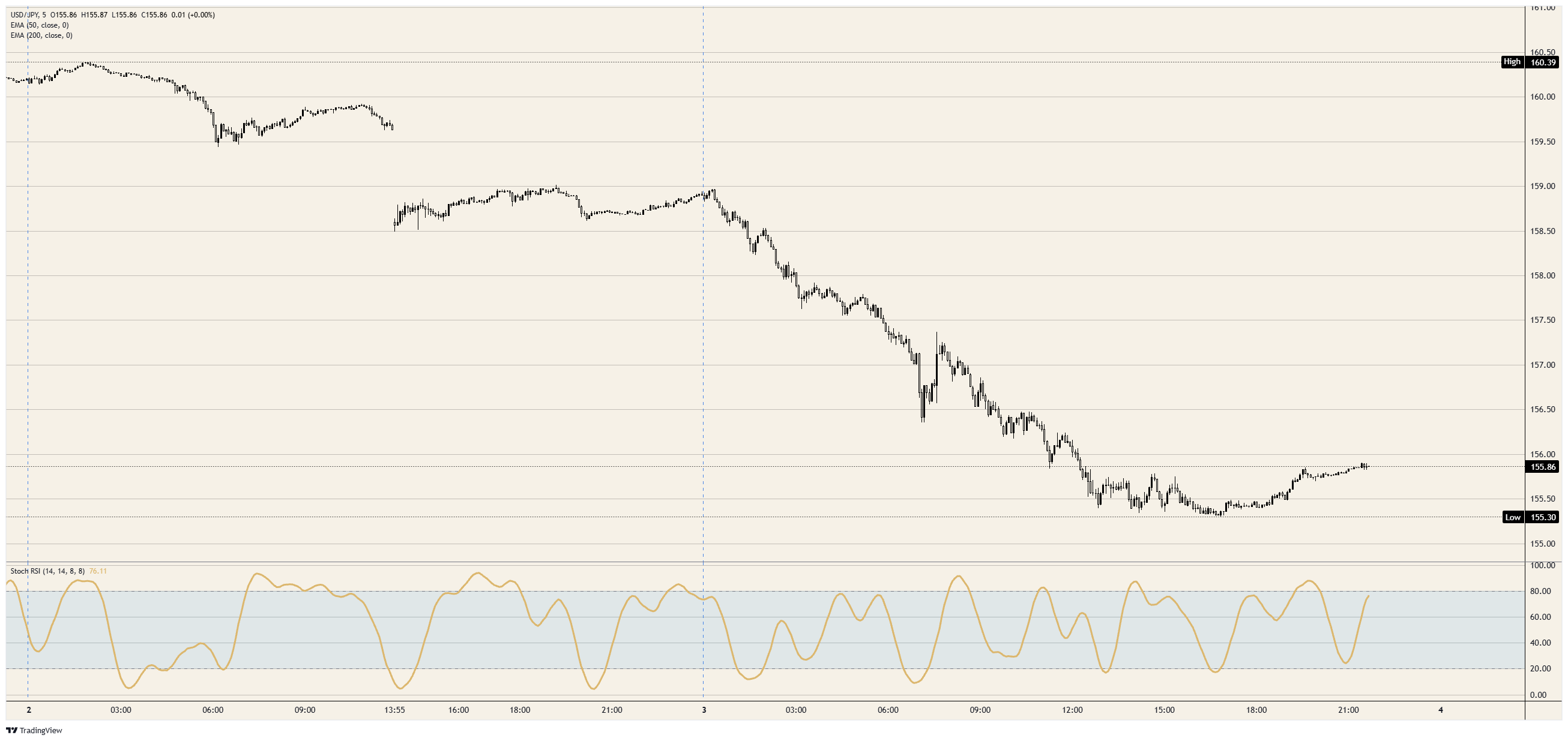
The Yen has produced in two sessions what the largest intervention on record could not, and it did so without a single reported purchase. USD/JPY trades just under 156.00 after a session that ran from a high just under 159.00 to a low just under 155.50, a 3.7-Yen decline that passed through the 200-day Exponential Moving Average (EMA) near 158.00 without pausing and now sits within a few dozen pips of the 155.00 area where the joint July operation bottomed. The move has been almost linear since Wednesday's Asian high just above 160.00, which is the signature of a repricing rather than an ambush.
Both ends of the gap moved at once
The trade that carried USD/JPY from the intervention low back above 160.00 rested on a policy gap of more than two and a half percentage points and the assumption that neither end would move. This week both did. A hawkish Bank of Japan board member spent Wednesday arguing for nimble hikes and leaving the door open to outsized or back-to-back moves, the Governor said upside price risks now deserve more weight, and a quarter-point increase at the September 17-18 meeting is fully priced, with wire reporting pointing to a faster pace afterward than the twice-a-year rhythm the market had assumed.
Twelve hours later a Fed governor said he would be inclined to support holding rates at the September 15-16 meeting if the inflation data behave, and September hike odds fell to around 50% from above 60%. The policy rate in Tokyo is 1% and the target range in Washington is 3.50% to 3.75%, so the arithmetic of the gap barely changed. What changed was the direction of travel at both ends, and a leveraged carry position is priced on direction long before it is priced on the level.
Free is cheaper than $98 billion
Japan spent a record ¥15.4 trillion, roughly $98 billion, buying its own currency between July 30 and August 26 according to the finance ministry's own tally, with an American leg on top, and USD/JPY had given all of it back by Wednesday morning. Thursday's decline cost nothing and covered more ground in a day than most of that money did. Tokyo's top currency official responded by describing the move as neither satisfying nor reassuring and the ministry as still on heightened alert, which is a remarkable thing to say about a four-Yen rally in your favour and tells you the level Tokyo actually wants is lower still.
The uncomfortable part for anyone long Yen is the shape. The decline arrived on nothing but two central banks moving in opposite directions, which means it can reverse just as cheaply if either one stops. A Fed hike on September 16 or a Bank of Japan pause on September 18 undoes the week, and the market is currently pricing the opposite of both.
Payrolls, then the two meetings that set the carry
Friday's nonfarm payrolls at 12:30 GMT carry a 56K consensus after 23K jobs were lost in July, with unemployment seen at 4.1% and average hourly earnings at 0.3% on the month and 3% YoY. A strong print restores the Fed hike and the Dollar with it, and it does so with the pair three Yen below where the carry trade was rebuilt, which is where short covering turns into a squeeze. Japan then supplies a Monday night run: labour cash earnings at 23:30 GMT after 3.4% YoY and the second estimate of second-quarter growth at 23:50 GMT, seen unrevised at 0.3% on the quarter and 1.1% annualized with the deflator at 2.6%, alongside the current account after a ¥92.3 billion deficit.
The prints that decide the Dollar leg come next week with the Producer Price Index (PPI) on September 10 and the Consumer Price Index (CPI) on September 11, and then the two meetings land back to back, Washington on September 16 and Tokyo on September 18, with a three-day Japanese holiday immediately after the second one that the market has already flagged as an intervention window. A currency that just rallied for free is about to find out what it is worth when somebody has to pay.
Levels and bias
Resistance: The 156.00 handle is the first hurdle, then 157.00 and the 200-day EMA near 158.00, which now reads as a ceiling rather than a floor. Beyond it, 158.50 is the shelf that held on Wednesday and failed on Thursday, and the 50-day EMA just under 160.00 caps any full retracement.
Support: The session low just under 155.50 is the first reference, and the August intervention low just above 155.00 is the level that decides whether this is a retest or a new leg. A daily close beneath 155.00 puts the pair into territory it has not seen since the spring, with 154.00 the next round figure and nothing technical between the two.
Bias: Bearish. Thursday took the 200-day EMA and the 158.50 shelf in one session, which inverts the summer map, and the daily Stochastic Relative Strength Index (Stoch RSI) near 87 has not yet begun to register the drop, so it has the whole range to fall. Rallies into 157.00 are for selling while both central banks are priced to narrow the gap within a fortnight. Only a daily close back above 158.50 restores the carry trade's claim on the tape.
USD/JPY 5-minute chart
Japanese Yen FAQs
The Japanese Yen (JPY) is one of the world’s most traded currencies. Its value is broadly determined by the performance of the Japanese economy, but more specifically by the Bank of Japan’s policy, the differential between Japanese and US bond yields, or risk sentiment among traders, among other factors.
One of the Bank of Japan’s mandates is currency control, so its moves are key for the Yen. The BoJ has directly intervened in currency markets sometimes, generally to lower the value of the Yen, although it refrains from doing it often due to political concerns of its main trading partners. The BoJ ultra-loose monetary policy between 2013 and 2024 caused the Yen to depreciate against its main currency peers due to an increasing policy divergence between the Bank of Japan and other main central banks. More recently, the gradually unwinding of this ultra-loose policy has given some support to the Yen.
Over the last decade, the BoJ’s stance of sticking to ultra-loose monetary policy has led to a widening policy divergence with other central banks, particularly with the US Federal Reserve. This supported a widening of the differential between the 10-year US and Japanese bonds, which favored the US Dollar against the Japanese Yen. The BoJ decision in 2024 to gradually abandon the ultra-loose policy, coupled with interest-rate cuts in other major central banks, is narrowing this differential.
The Japanese Yen is often seen as a safe-haven investment. This means that in times of market stress, investors are more likely to put their money in the Japanese currency due to its supposed reliability and stability. Turbulent times are likely to strengthen the Yen’s value against other currencies seen as more risky to invest in.
추천 기사


