


New Zealand's Kiwi gets most of Wednesday back without earning it
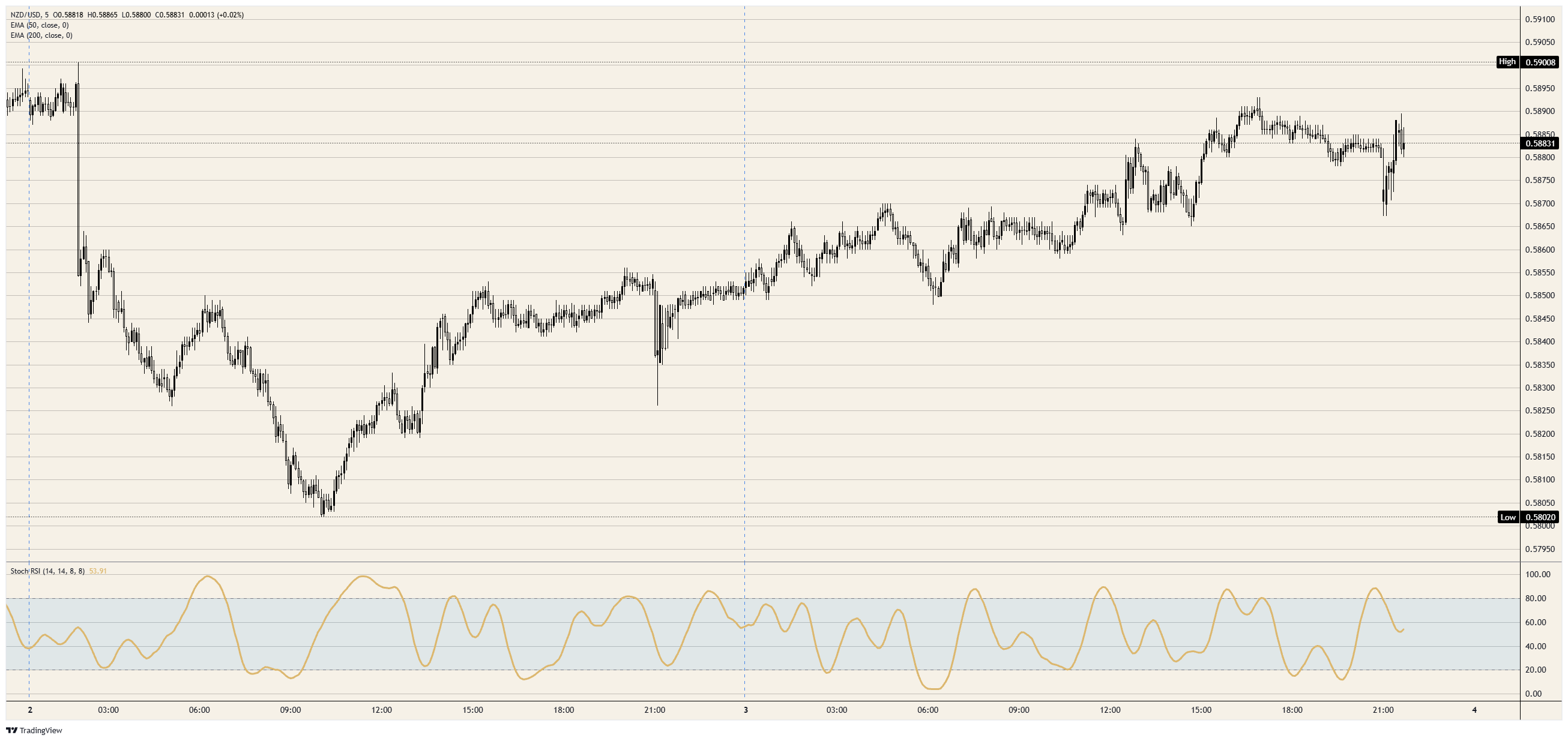
- NZD/USD trades just under 0.5900, back above both long-run EMAs near 0.5850.
- The RBNZ lifted the OCR to 2.75% Wednesday and meets next on October 28.
- Four of seven committee members see inflation risks to the upside.
The New Zealand Dollar trades just under 0.5900 into the New York afternoon, up roughly half a percent, after a session that retraced most of Wednesday's decision-day slide without a single New Zealand input. NZD/USD climbed from an Asian low that held above Wednesday's 0.5800 trough to a high a handful of pips short of 0.5900, reclaiming both the 200-day and the 50-day Exponential Moving Average (EMA) on the way, the two of which sit within twenty pips of each other near 0.5850. The recovery has the same author as every other major's rally on Thursday, which is a Dollar being sold from London onward.
The Dollar gave back what Wellington took
A Fed governor's lean toward a September hold cut hike odds to around 50% from above 60%, the Yen's surge to a one-month high pulled Treasury yields lower before he spoke, and the Dollar Index slipped beneath 99.00 to its weakest since late August. The Kiwi rode that from midnight GMT to 16:00 GMT in something close to a straight line. Nothing about the Reserve Bank of New Zealand (RBNZ) changed in the interval: the Official Cash Rate (OCR) is 2.75% after Wednesday's quarter point, the next decision is October 28, and the committee's own record shows four of its seven members seeing upside risks to inflation against two who call the risks balanced, with the path explicitly not predetermined.
That split is the interesting part of Wednesday's statement and the market sold through it. The committee framed a gradual quarter point now as insurance against a larger move later, which is the language of a bank that wants to stop near 3% and expects the market to let it. Four members seeing upside risks is not a committee that has decided where the cycle ends, and the one domestic release between now and October 28 capable of moving that view is the third-quarter inflation print in mid-October, with a second-quarter growth figure the bank has already called lacklustre due before it.
Hiking into an economy the bank calls lacklustre
The statement's own growth assessment explains why the currency sells hikes rather than buying them. The committee judged second-quarter activity lacklustre, expects the recovery to have resumed in the third quarter, and described it as uneven: export-exposed regions are doing well on strong export prices and trading-partner demand, while household spending and residential investment remain weak on soft income growth, job insecurity and flat house prices, and the spillover from exports into the wider economy has been limited. That is a bank raising rates because headline inflation is 4.1% on fuel, with the rate excluding vehicle fuels at 2.9% and inside the band.
The cross confirms the reading. AUD/USD and NZD/USD rose by almost identical amounts on Thursday, which leaves AUD/NZD parked beneath the thirteen-year ceiling it tested on Wednesday and means the Kiwi's recovery recovered nothing against the currency it actually competes with. A hike the market treats as growth-negative at home and irrelevant against the Aussie is not a hike that supports the exchange rate, whatever it does to the front end of the curve.
Payrolls first, China after
Friday's nonfarm payrolls at 12:30 GMT carry a 56K consensus after 23K jobs were lost in July, with unemployment seen at 4.1% and average hourly earnings at 0.3% on the month and 3% YoY. With the Fed Chair's stated focus on prices, a soft print buys the Kiwi nothing that a Fed hold has not already delivered, while a firm one restores the September hike and hands Thursday's gain back. Next week is a China week for both Antipodean currencies: August trade at 03:00 GMT Tuesday after exports rose 23.9% YoY and imports 27.5% on a $112.5 billion surplus, and inflation at 01:30 GMT Wednesday after a 0.5% YoY headline and a 3.5% producer price rate.
Domestically the docket is thin, with the manufacturing Purchasing Managers Index (PMI) at 22:30 GMT Thursday after a 54.3 reading the only scheduled New Zealand input before the American inflation prints on September 10 and 11. A currency whose central bank has told the market its path is not predetermined, and whose recovery was written entirely in Dollar ink, has two ways to give Thursday back and one way to keep it.
Levels and bias
Resistance: The 0.5900 handle remains the line, with Thursday's high a handful of pips beneath it, and a daily close above it is what turns the decision-day slide into a completed correction. Beyond it, 0.5950 guards the late-August high just under 0.6000.
Support: The EMA shelf near 0.5850 is beneath the price again and is the first floor, with the 0.5800 area that caught Wednesday's low the line that decides whether the decision was a repricing or a rout. Beneath it, 0.5750 is the next reference and the pair has no meaningful structure between there and 0.5700.
Bias: Bearish below 0.5900. Thursday's recovery was a Dollar event on a day the Dollar was sold everywhere, the daily Stochastic Relative Strength Index (Stoch RSI) near 57 is still easing lower, and the central bank's own words point to a slower path than the currency needs. A daily close above 0.5900 is the only thing that would change the call, and Friday's payrolls report is the most likely thing to prevent one.
NZD/USD 5-minute chart
New Zealand Dollar FAQs
The New Zealand Dollar (NZD), also known as the Kiwi, is a well-known traded currency among investors. Its value is broadly determined by the health of the New Zealand economy and the country’s central bank policy. Still, there are some unique particularities that also can make NZD move. The performance of the Chinese economy tends to move the Kiwi because China is New Zealand’s biggest trading partner. Bad news for the Chinese economy likely means less New Zealand exports to the country, hitting the economy and thus its currency. Another factor moving NZD is dairy prices as the dairy industry is New Zealand’s main export. High dairy prices boost export income, contributing positively to the economy and thus to the NZD.
The Reserve Bank of New Zealand (RBNZ) aims to achieve and maintain an inflation rate between 1% and 3% over the medium term, with a focus to keep it near the 2% mid-point. To this end, the bank sets an appropriate level of interest rates. When inflation is too high, the RBNZ will increase interest rates to cool the economy, but the move will also make bond yields higher, increasing investors’ appeal to invest in the country and thus boosting NZD. On the contrary, lower interest rates tend to weaken NZD. The so-called rate differential, or how rates in New Zealand are or are expected to be compared to the ones set by the US Federal Reserve, can also play a key role in moving the NZD/USD pair.
Macroeconomic data releases in New Zealand are key to assess the state of the economy and can impact the New Zealand Dollar’s (NZD) valuation. A strong economy, based on high economic growth, low unemployment and high confidence is good for NZD. High economic growth attracts foreign investment and may encourage the Reserve Bank of New Zealand to increase interest rates, if this economic strength comes together with elevated inflation. Conversely, if economic data is weak, NZD is likely to depreciate.
The New Zealand Dollar (NZD) tends to strengthen during risk-on periods, or when investors perceive that broader market risks are low and are optimistic about growth. This tends to lead to a more favorable outlook for commodities and so-called ‘commodity currencies’ such as the Kiwi. Conversely, NZD tends to weaken at times of market turbulence or economic uncertainty as investors tend to sell higher-risk assets and flee to the more-stable safe havens.
추천 기사


