


The New Zealand Dollar has nothing left to win
- NZD/USD holds above 0.5900 after four sessions of lower highs.
- RBNZ decision Wednesday carries a 2.75% consensus, up from 2.50%.
- September Fed hike pricing near 65%, roughly double a week ago.
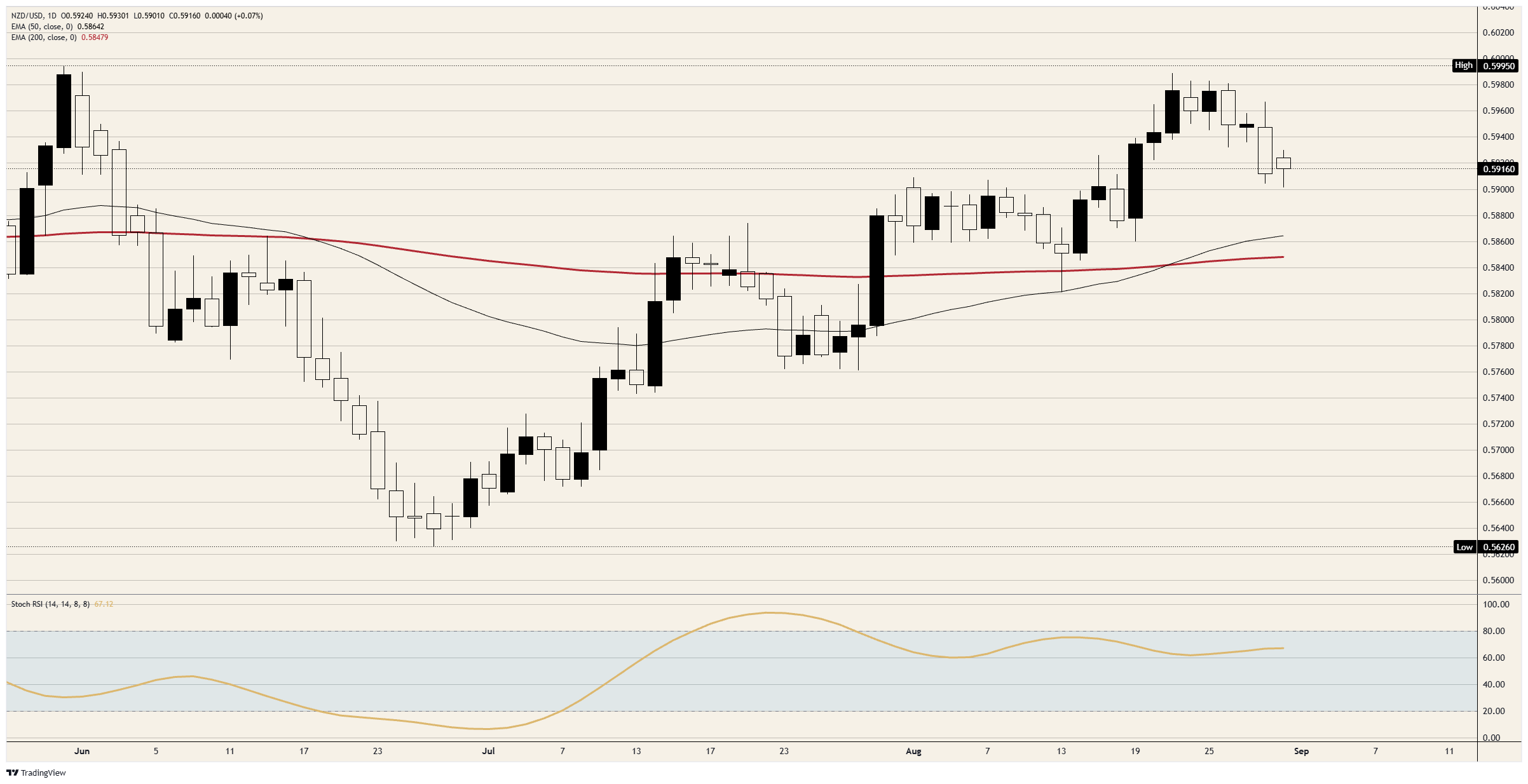
NZD/USD trades a little above 0.5900 on Monday, barely changed on the session and around seventy pips beneath the late-August peak that stalled just short of 0.6000. Four consecutive lower highs have followed that peak, and the session low has so far held the 0.5900 handle without any attempt to reclaim 0.5950. Both the 50-day Exponential Moving Average (EMA) and the 200-day converge near 0.5850 underneath.
The session's only real event was fought somewhere else
Monday's tape was set in the Gulf rather than by anything domestic. United States forces struck Iranian rocket launchers on Larak Island on Sunday, the first acknowledged American strike on Iranian positions in a month, and Tehran answered against US bases in Jordan. Crude Oil added more than 2% on the escalation and longer-dated Treasury yields rose with it.
The New Zealand Dollar sits awkwardly inside that, because a higher energy bill is imported inflation for a country that buys almost all of its fuel, which argues for the Reserve Bank of New Zealand (RBNZ) staying restrictive, while the same headline is a risk-off tax on a high-beta commodity currency. The two forces cancelled and the pair went nowhere, which is roughly the right answer given what lands on Wednesday.
The hike is the least interesting thing about Wednesday
The RBNZ raised the Official Cash Rate (OCR) to 2.50% on July 8, its first increase since 2023, and announces again at 02:00 GMT on September 2 against a 2.75% consensus. Domestic bank previews describe that quarter point as close to fully priced, which strips the decision itself of most of its capacity to move the currency. What is left to trade is the published rate track and the tone of the statement.
The range of outcomes around that track runs from matching the price to falling short of it. The two most widely followed local previews agree on the quarter point and then diverge completely. One expects the projections to signal a further increase by year end and a published peak near 3.3%, still beneath where markets have the terminal rate. The other treats two more increases this year as a low-probability scenario and expects a pause to assess instead. Neither reading is more hawkish than what is already banked.
The other half of the pair stopped standing still
For most of August the Kiwi's rate story was the only one moving, which is how the pair added close to a cent on domestic tightening expectations alone. Friday's Jackson Hole keynote from the Federal Reserve chair reset the other leg without a single data point behind it. Aggregated futures probabilities now put a September 16 increase near 65%, October at 92%, and December close to evenly split between one increase and two.
The trade underneath the August rally needs New Zealand to out-tighten the United States, not simply to tighten. A move to 2.75% still leaves the OCR three-quarters of a point beneath the floor of the current US target range of 3.50% to 3.75%, and the market now expects that floor to rise a fortnight after the RBNZ moves. A gap that wide closes only when one side stops, and as of Friday neither side is expected to. That is a regime change for a pair that spent the whole of August trading a single central bank.
Tuesday hands the pair to American data first
New Zealand Building Permits at 22:45 GMT on Tuesday, against a 3.6% decline prior, is the last domestic release before the decision three and a quarter hours later. Nothing in a monthly construction series reprices a policy meeting, and the Kiwi will arrive at 02:00 GMT carrying whatever the American session hands it.
The American session is where the week makes its opening statement, and it makes it early. The Institute for Supply Management (ISM) Manufacturing Purchasing Managers Index (PMI) prints at 14:00 GMT against a 55.2 consensus and 55.6 prior, with prices paid running at 72 against 71.1 and Job Openings and Labor Turnover Survey (JOLTS) openings at 7.3 million. Private payrolls follow on Wednesday at 47K, and Friday brings Nonfarm Payrolls at a 58K consensus against a 23K contraction, unemployment at 4.1% and average hourly earnings at 0.3% MoM.
Levels
Resistance: 0.5950 has capped the four-session decline and is the first line back. Above it sits the late-August peak just short of 0.6000, the handle that stopped the June rally and the August one alike.
Support: The 0.5900 handle is the near shelf and has held the session low. Beneath it the 0.5850 area carries both the 50-day and 200-day EMAs, and a break through that cluster opens 0.5800.
Bias: Bearish. Four lower highs into a meeting where the hike is priced and the track is expected to land beneath market pricing is a one-sided setup, and the Dollar leg repriced hawkish on Friday without needing data to do it. Invalidation on a daily close above 0.5950.
NZD/USD daily chart
New Zealand Dollar FAQs
The New Zealand Dollar (NZD), also known as the Kiwi, is a well-known traded currency among investors. Its value is broadly determined by the health of the New Zealand economy and the country’s central bank policy. Still, there are some unique particularities that also can make NZD move. The performance of the Chinese economy tends to move the Kiwi because China is New Zealand’s biggest trading partner. Bad news for the Chinese economy likely means less New Zealand exports to the country, hitting the economy and thus its currency. Another factor moving NZD is dairy prices as the dairy industry is New Zealand’s main export. High dairy prices boost export income, contributing positively to the economy and thus to the NZD.
The Reserve Bank of New Zealand (RBNZ) aims to achieve and maintain an inflation rate between 1% and 3% over the medium term, with a focus to keep it near the 2% mid-point. To this end, the bank sets an appropriate level of interest rates. When inflation is too high, the RBNZ will increase interest rates to cool the economy, but the move will also make bond yields higher, increasing investors’ appeal to invest in the country and thus boosting NZD. On the contrary, lower interest rates tend to weaken NZD. The so-called rate differential, or how rates in New Zealand are or are expected to be compared to the ones set by the US Federal Reserve, can also play a key role in moving the NZD/USD pair.
Macroeconomic data releases in New Zealand are key to assess the state of the economy and can impact the New Zealand Dollar’s (NZD) valuation. A strong economy, based on high economic growth, low unemployment and high confidence is good for NZD. High economic growth attracts foreign investment and may encourage the Reserve Bank of New Zealand to increase interest rates, if this economic strength comes together with elevated inflation. Conversely, if economic data is weak, NZD is likely to depreciate.
The New Zealand Dollar (NZD) tends to strengthen during risk-on periods, or when investors perceive that broader market risks are low and are optimistic about growth. This tends to lead to a more favorable outlook for commodities and so-called ‘commodity currencies’ such as the Kiwi. Conversely, NZD tends to weaken at times of market turbulence or economic uncertainty as investors tend to sell higher-risk assets and flee to the more-stable safe havens.
추천 기사


