


The Dollar Index falls through a war and a hawkish repricing
- DXY trades just beneath 99.50, down 0.26%, turned back at the 200-day EMA.
- The European Central Bank meets September 9-10, a week ahead of the Fed.
- September hike odds near 60% in the United States, near 84% in Japan.
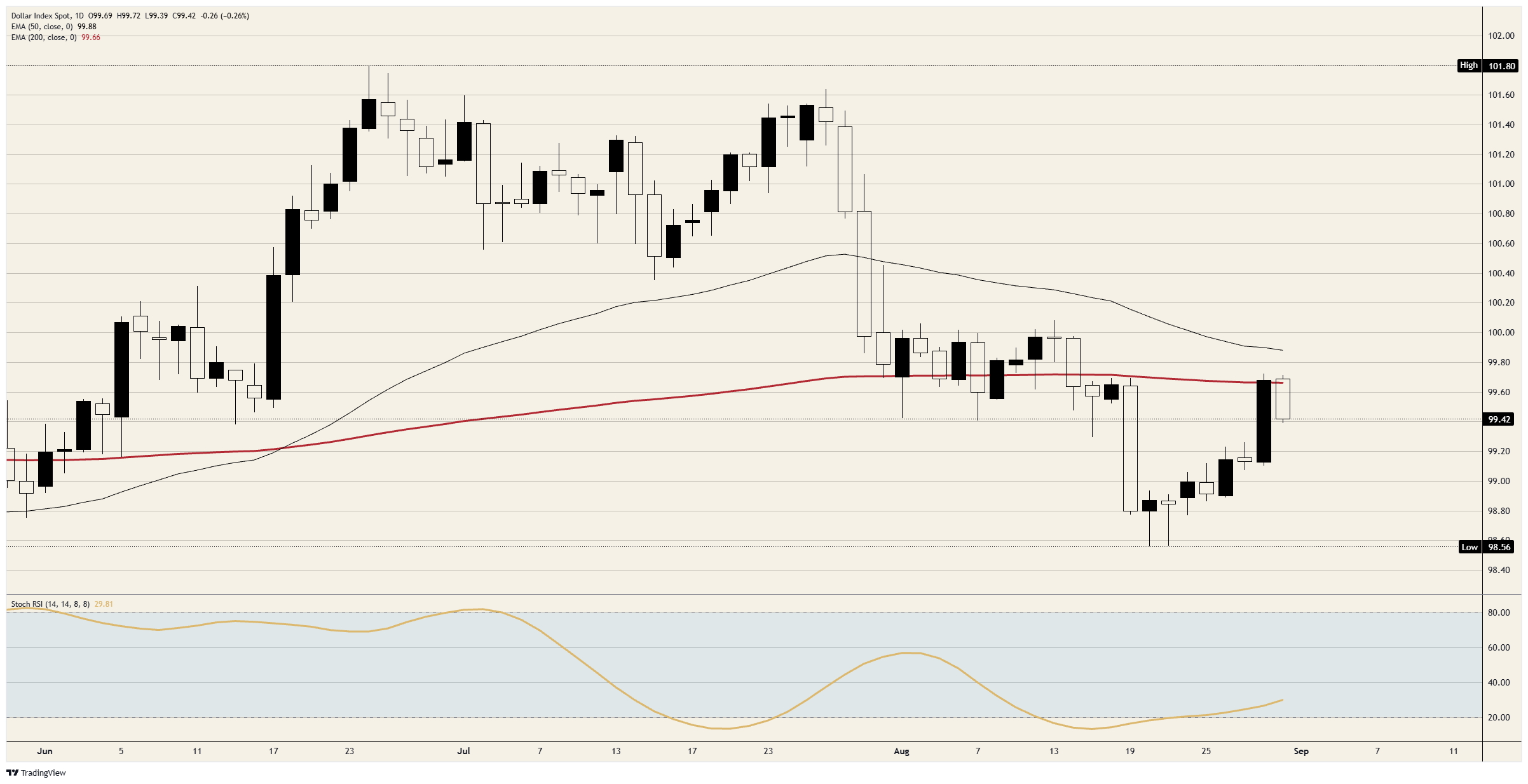
The Dollar Index trades just beneath 99.50 and 0.26% lower, on a session that handed it every input a currency is supposed to rally on. American forces struck Iranian launchers on Larak Island, Crude Oil ran better than 2% higher, yields rose across the curve, and pricing for a September Federal Reserve increase sits near 60% against roughly 35% before Friday. The Dollar opened on its own 200-day Exponential Moving Average (EMA), poked briefly above it, and has traded beneath it since.
Everybody turned hawkish at the same time
The repricing that followed Friday's Jackson Hole keynote was not an American event, and Monday made that unmistakable. Borrowing costs in the euro area and Japan reached their highest levels in years, Japanese two-year paper touched a 31-year high, German and French two-year yields went to their best since 2024, and longer-dated euro-area yields hit levels not seen in more than fifteen years.
A rate differential requires one side to move alone. What happened instead is that a barrel through the $85.00 handle raised the inflation problem for every major economy at once, and every rates market repriced the same way inside the same six hours. The Dollar cannot be paid a premium for a policy turn its counterparties are also being priced for.
The least certain hiker in its own basket
Basket construction turns that into an outright headwind. The Euro accounts for roughly 58% of the Dollar Index and the Yen for another 14%, so close to three quarters of the thing sits with two central banks now carrying a firmer expectation of a September increase than the Federal Reserve does.
The European Central Bank meets September 9-10 and is widely expected to raise, arriving a full week before the American decision on September 16, with euro-area inflation data this week likely to firm that case rather than soften it. Pricing for a Bank of Japan increase on September 18 runs near 84%. The Federal Reserve sits in the middle of that queue carrying the thinnest conviction of the three. A currency gets paid when the market expects it to tighten harder than the other side, not when the same expectation is sitting on everyone.
The August low was never a monetary event
The base this recovery is climbing off has nothing to do with the policy rate. The Dollar Index made its August low near 98.50 in the sessions after the Treasury expanded long-dated buybacks on August 19, and the mechanism behind that low is a long end carrying supply and term premium rather than rate expectations. Twenty-five basis points on the front end does not retire a single bond.
Monday restated the point in the plainest available terms. Long yields rose and the Dollar fell, which is the behaviour of a credit rather than a currency, and the 30-year reached a 19-year high in mid-August without the Dollar taking any benefit from it. A hawkish central bank helps a currency when the market is worried about inflation. It does considerably less when the market is worried about issuance.
Positioning says the same thing from the other side. A Dollar that cannot hold a gain on the most hawkish domestic headline of the summer, on a day also carrying a live military escalation, does not have buyers stacked underneath it. The haven bid that usually appears on war days went somewhere else this time, and Gold heading for its best month since January is the clearest indication of where.
The week that has to close the gap
Only a genuine American upside surprise narrows any of this, and the calendar gives it four attempts. The Institute for Supply Management (ISM) manufacturing Purchasing Managers Index (PMI) lands Tuesday at 14:00 GMT with prices paid forecast at 72 against 71.1 prior, the private payroll count follows Wednesday at 12:15 GMT at a forecast 47K, and the services reading arrives Thursday with its own prices paid line last at 70.3.
Friday carries the August employment report at 12:30 GMT, with payrolls forecast at 58K after a 23K contraction, the unemployment rate held at 4.1%, and hourly earnings accelerating to 0.3% MoM from 0.1%. The chair has already described the labour market as stable and consistent with full employment, so the report is more likely to confirm the existing path than to steepen it. The gap this index needs is a relative one, and nothing on the American calendar can shrink a relative gap on its own.
Levels to watch
Resistance: The session high stopped on the 200-day EMA, with both sitting just beneath 99.75. Above there the 50-day EMA near 100.00 is declining and has capped every attempt since the first week of August, with the late-July shelf near 100.50 beyond it.
Support: The session floor sits near 99.40, with the 99.00 handle the next shelf beneath it. Below that the August low near 98.50 is the base of the whole move and the level the buyback repricing established.
Bias: Bearish while 99.75 caps, with objectives at the 99.00 handle and then 98.50. The daily Stochastic Relative Strength Index (Stoch RSI) near 30 is turning up out of the oversold band, which normally argues for more bounce, but a bounce that fails at the 200-day EMA on the most hawkish news flow available all summer has answered the question. Invalidation on a daily close above 100.00.
DXY daily chart
US Dollar FAQs
The US Dollar (USD) is the official currency of the United States of America, and the ‘de facto’ currency of a significant number of other countries where it is found in circulation alongside local notes. It is the most heavily traded currency in the world, accounting for over 88% of all global foreign exchange turnover, or an average of $6.6 trillion in transactions per day, according to data from 2022. Following the second world war, the USD took over from the British Pound as the world’s reserve currency. For most of its history, the US Dollar was backed by Gold, until the Bretton Woods Agreement in 1971 when the Gold Standard went away.
The most important single factor impacting on the value of the US Dollar is monetary policy, which is shaped by the Federal Reserve (Fed). The Fed has two mandates: to achieve price stability (control inflation) and foster full employment. Its primary tool to achieve these two goals is by adjusting interest rates. When prices are rising too quickly and inflation is above the Fed’s 2% target, the Fed will raise rates, which helps the USD value. When inflation falls below 2% or the Unemployment Rate is too high, the Fed may lower interest rates, which weighs on the Greenback.
In extreme situations, the Federal Reserve can also print more Dollars and enact quantitative easing (QE). QE is the process by which the Fed substantially increases the flow of credit in a stuck financial system. It is a non-standard policy measure used when credit has dried up because banks will not lend to each other (out of the fear of counterparty default). It is a last resort when simply lowering interest rates is unlikely to achieve the necessary result. It was the Fed’s weapon of choice to combat the credit crunch that occurred during the Great Financial Crisis in 2008. It involves the Fed printing more Dollars and using them to buy US government bonds predominantly from financial institutions. QE usually leads to a weaker US Dollar.
Quantitative tightening (QT) is the reverse process whereby the Federal Reserve stops buying bonds from financial institutions and does not reinvest the principal from the bonds it holds maturing in new purchases. It is usually positive for the US Dollar.
추천 기사


