


The Canadian Dollar takes back two months in ten sessions
- USD/CAD trades just above 1.3900, the lowest in two months.
- Crude Oil roughly 3% higher near $81, with Brent above $86.
- July's policy report assumed 71 cents, spot trades near 72.
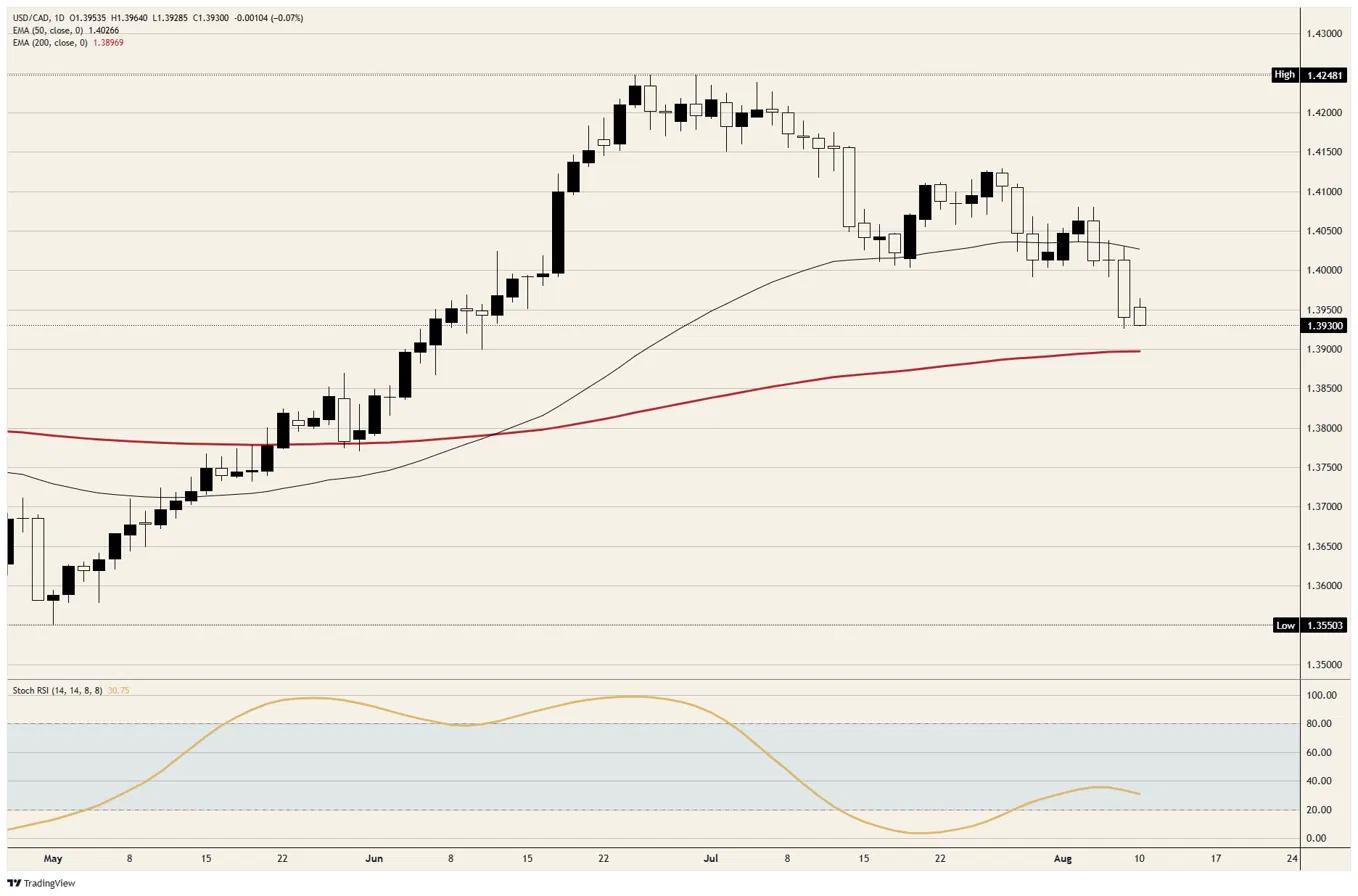
The Canadian Dollar trades at its strongest against the US Dollar since the second week of June, with the rate holding just above 1.3900 into the afternoon. This is a fourth consecutive lower session and the seventh in ten, and Monday's entire 35-pip range sits inside Friday's, pinned to its floor. Two months of Dollar gains have gone in ten trading days.
Two months, and the war took them back
The last time this rate traded here was 43 sessions ago, in the week the Strait of Hormuz shut. The whole advance the US Dollar built against the Loonie across the war has now been surrendered, and it has been surrendered while the war escalates rather than resolves, which is the opposite of the condition that was supposed to hand it back.
What changed is the mechanism rather than the news. In June a shut Strait bought the US Dollar as a haven, with a central bank on the other side of the trade whose inflation problem the shock made worse. In August the same headline buys the Loonie instead, because a barrel 3% higher is a terms-of-trade payment to a net exporter, and the first phase of any escalation in this rate has always been a Canadian bid with 1.4000 pressed.
The 71-cent assumption breaks the other way
July's Monetary Policy Report conditioned its inflation path on the Loonie averaging around 71 cents US over the projection horizon, which is a rate near 1.4085. Spot is 71.8 cents, close to a full cent stronger than the assumption and the widest that gap has run since the forecast was finalised on July 10.
The report's own arithmetic then runs both ways through a single price. Its sensitivity endnote has Brent holding between $80 and $85 in the coming months adding a tenth to three tenths of a point to inflation, and Brent trades above $86. The same barrel that lifts the inflation path bids the currency that lowers it, which leaves a central bank with a December 9 increase already fully priced and nothing domestic on the calendar to argue with.
Canada is not in the room
Nothing on the Canadian docket this week will confirm or deny any of it. The move was built entirely on the other side of the border, first by Friday's payrolls contraction and then by Monday's Crude Oil bid, against a domestic economy in technical recession, with unemployment at 6.5% and a 50% tariff on most of its goods entering the United States since July 20.
The rate channel argues the other way, which is what makes the session worth reading. Futures repriced a September increase from the Federal Reserve to 49.9% from 44.1% on Friday, and the US Dollar lost ground regardless. A currency that ignores a hawkish repricing on the other side of the trade is not being bought on the rate gap, and the barrel is the only other thing that moved.
The barrel that pays Canada is not the one quoted on the screen. Alberta's heavy grade traded at a discount of close to $19 beneath the American benchmark in May, the widest of the war, and the June and July averages on that table are still pending. Until they print, a 3% move in the headline barrel is an estimate of the transfer rather than a measurement of it.
The data week
July's Consumer Price Index (CPI) lands on Wednesday at 12:30 GMT, forecast at 0.1% MoM against a 0.4% decline in June, with the annual rate easing to 3.4% from 3.5% and core at 0.2% MoM and 2.5% YoY. That is the only release this week either side of this rate genuinely trades.
Thursday carries the Producer Price Index (PPI) at 0.2% MoM against a 0.3% decline, core at 4.2% YoY from 4.7%, and jobless claims at 201K, with two regional Federal Reserve presidents speaking either side of the release. Friday brings retail sales at 0.2% and a Michigan sentiment reading seen falling to 54 from 55.2. The Canadian side offers nothing at all, which leaves the September 2 decision as the next domestic event carrying a rate.
Levels and bias
Resistance: Just above 1.3950 capped Monday and is the first line. The 1.4000 handle and the 50-day Exponential Moving Average (EMA) sitting a fraction above it now form one band, and reclaiming it is the minimum requirement for anything bullish, with the late-July peak just above 1.4100 beyond that.
Support: The 200-day EMA near 1.3900 is the first structure beneath the market and has not been tested since May. Below it the tape thins toward 1.3850, and there is no meaningful mark on this window until the May base near 1.3550.
Bias: Bearish while the 1.4000 band caps, with the 200-day EMA near 1.3900 as the first objective and 1.3850 behind it. A daily Stochastic Relative Strength Index (Stoch RSI) near 30 is not yet oversold, leaving room for a fourth consecutive lower session to become a sixth. A daily close back above 1.4050 invalidates and reopens the late-July peak.
USD/CAD daily chart
Canadian Dollar FAQs
The key factors driving the Canadian Dollar (CAD) are the level of interest rates set by the Bank of Canada (BoC), the price of Oil, Canada’s largest export, the health of its economy, inflation and the Trade Balance, which is the difference between the value of Canada’s exports versus its imports. Other factors include market sentiment – whether investors are taking on more risky assets (risk-on) or seeking safe-havens (risk-off) – with risk-on being CAD-positive. As its largest trading partner, the health of the US economy is also a key factor influencing the Canadian Dollar.
The Bank of Canada (BoC) has a significant influence on the Canadian Dollar by setting the level of interest rates that banks can lend to one another. This influences the level of interest rates for everyone. The main goal of the BoC is to maintain inflation at 1-3% by adjusting interest rates up or down. Relatively higher interest rates tend to be positive for the CAD. The Bank of Canada can also use quantitative easing and tightening to influence credit conditions, with the former CAD-negative and the latter CAD-positive.
The price of Oil is a key factor impacting the value of the Canadian Dollar. Petroleum is Canada’s biggest export, so Oil price tends to have an immediate impact on the CAD value. Generally, if Oil price rises CAD also goes up, as aggregate demand for the currency increases. The opposite is the case if the price of Oil falls. Higher Oil prices also tend to result in a greater likelihood of a positive Trade Balance, which is also supportive of the CAD.
While inflation had always traditionally been thought of as a negative factor for a currency since it lowers the value of money, the opposite has actually been the case in modern times with the relaxation of cross-border capital controls. Higher inflation tends to lead central banks to put up interest rates which attracts more capital inflows from global investors seeking a lucrative place to keep their money. This increases demand for the local currency, which in Canada’s case is the Canadian Dollar.
Macroeconomic data releases gauge the health of the economy and can have an impact on the Canadian Dollar. Indicators such as GDP, Manufacturing and Services PMIs, employment, and consumer sentiment surveys can all influence the direction of the CAD. A strong economy is good for the Canadian Dollar. Not only does it attract more foreign investment but it may encourage the Bank of Canada to put up interest rates, leading to a stronger currency. If economic data is weak, however, the CAD is likely to fall.
추천 기사


