


EUR/USD Price Forecast: Trades near crucial level of 1.1550
- EUR/USD rises to near 1.1550 as the US Dollar faces selling pressure.
- Investors await key US economic releases, such as ADP Employment Change and the ISM Services PMI data for July.
- The ECB is expected to raise policy rates in the September meeting.
The Euro (EUR) trades 0.15% higher at around 1.1550 against the US Dollar (USD) during the European trading session on Wednesday. The major currency pair gains as the US Dollar faces selling pressure ahead of a busy North American session.
At press time, the US Dollar Index (DXY), which gauges the Greenback’s value against six major currencies, trades 0.15% lower to near 99.70.
Markets eye US data and Fed speakers amid mixed policy signals
Analysts at Danske Bank note that attention today will center on a potential SOH deal announcement alongside key US data releases, including July private sector employment from ADP and the July reading of the ISM Services index. They point out that "ADP's weekly estimates have pointed towards cooling employment growth from June," while the ISM Services print will be watched closely after "the earlier flash PMI pointing to an uptick in business activity."
On the policy front, Danske highlights a busy slate of Fed communication, with "the Fed's Cook (voter, neutral) on the wires in the evening, while Daly (non-voter) is scheduled to deliver keynote remarks overnight into Thursday." The bank also underscores the divergence in recent Fed commentary: Kansas City Fed's Schmid, described as a "non-voter, hawk," argued that monetary policy is "not yet restrictive given strong demand and investment," signaling that "further tightening may be needed." In contrast, Philly Fed's Paulson, a "voter, dove," pushed back against rapid rate hikes, saying policy is likely already "mildly restrictive" and that it "was not a close call to keep rates steady (in July)."
On the Euro front, investors seek fresh cues regarding the European Central Bank’s (ECB) interest rate expectations. Analysts at Deutsche Bank said in a note that ECB September hike pricing is around 90%.
EUR/USD technical analysis
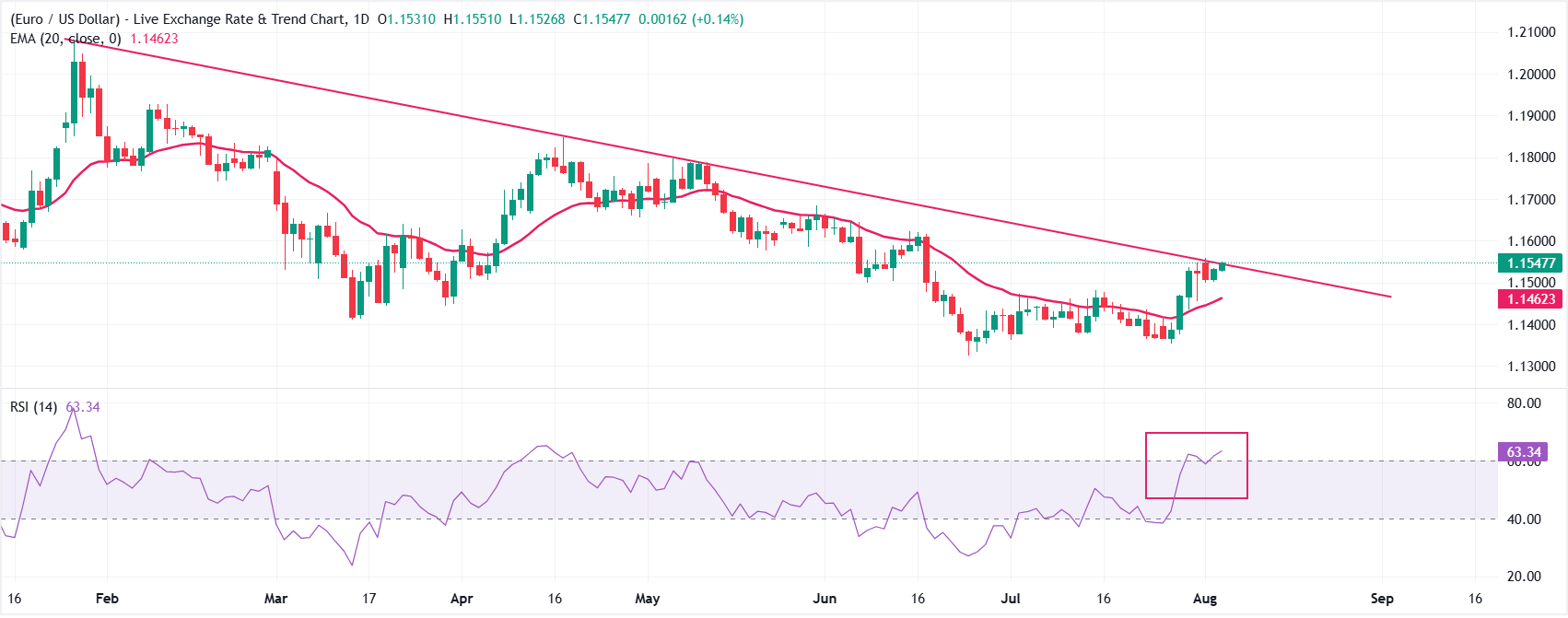
EUR/USD trades higher at around 1.1550. The pair trades close to the downward resistance trend line and above the 20-day exponential moving average (EMA) at 1.1462, which collectively suggests a constructive near-term bias.
Momentum aligns with this view, as the Relative Strength Index (RSI) at 63 is pushing into bullish territory without yet signaling extreme overbought conditions.
On the downside, immediate support is at the 20-day EMA near 1.1462, where buyers would be expected to re-emerge on a deeper pullback. Below that, the pair could extend the decline towards the July 28 low at 1.1353. Looking up, the pair could extend the advance towards 1.1600 if it manages to break above the downward-sloping trendline.
(The technical analysis of this story was written with the help of an AI tool. Know more.)
Economic Indicator
ADP Employment Change
The ADP Employment Change is a gauge of employment in the private sector released by the largest payroll processor in the US, Automatic Data Processing Inc. It measures the change in the number of people privately employed in the US. Generally speaking, a rise in the indicator has positive implications for consumer spending and is stimulative of economic growth. So a high reading is traditionally seen as bullish for the US Dollar (USD), while a low reading is seen as bearish.
Read more.Next release: Wed Aug 05, 2026 12:15
Frequency: Monthly
Consensus: 70K
Previous: 98K
Source: ADP Research Institute
Traders often consider employment figures from ADP, America’s largest payrolls provider, report as the harbinger of the Bureau of Labor Statistics release on Nonfarm Payrolls (usually published two days later), because of the correlation between the two. The overlaying of both series is quite high, but on individual months, the discrepancy can be substantial. Another reason FX traders follow this report is the same as with the NFP – a persistent vigorous growth in employment figures increases inflationary pressures, and with it, the likelihood that the Fed will raise interest rates. Actual figures beating consensus tend to be USD bullish.
추천 기사


