


Indian Rupee edges up despite surging US Treasury Yields
- The Indian Rupee gains marginally against the US Dollar at the open, even as US bond yields surge.
- The Fed left interest rates steady and warned of upside inflation risks.
- Oil prices will likely remain higher amid escalating US-Iran war.
The Indian Rupee (INR) ticks higher against the US Dollar (USD) in the opening session on Thursday. The USD/INR pair edges down to near 95.60, with the Indian currency giving a tough fight to higher United States (US) Treasury Yields.
In the Asian session, 10-year US Treasury Yields are 1.8% higher at around 4.71%, the highest level seen in 18 months. Higher US bond yields diminish the appeal of risk-sensitive currencies.
The US Dollar has also attracted some bids in the early session on Thursday after a significant fall the previous day, following the Federal Reserve’s (Fed) monetary policy announcement. At press time, the US Dollar Index (DXY), which gauges the Greenback’s value against six major currencies, trades 0.12% higher to near 100.93.
Upside US inflation risks boost Treasury Yields
In the monetary policy announcement on Wednesday, the Fed decided to leave interest rates unchanged in the range of 3.50%-3.75% for the fifth meeting in a row. The decision was expected to be a hold at a time when a resurgence in oil prices due to escalating Middle East conflicts has de-anchored inflation projections again.
The meeting was also under political pressure, as US President Donald Trump has criticized the Fed several times for not reducing interest rates. Before the meeting, Trump said Fed Chairman Kevin Warsh wanted to lower interest rates, adding that there was a good inflation report recently, costs were falling rapidly, and prices should drop significantly once the Gulf War ends.
In the monetary policy statement and the press conference, Fed Chair Warsh stressed several times bringing inflation down, and clarified that the central bank won’t hesitate to act if needed.
US bond yields are surging on expectations that the Fed needs to raise interest rates anytime this year to achieve price stability.
We think the market is ultimately telling us (and Warsh) that talk is cheap with the combination of these moves, and that it is not enough to just say and proclaim that price stability is paramount," MUFG Bank said in a note, Reuters reported. They added, "In other words, the Fed has to eventually walk the talk on inflation under this new regime."
Middle East tensions keep key oil shipping lanes constrained
Oil prices traded lower in the early trade on Thursday even as military aggression between the US and Iran continues. Earlier in the day, Iranian media said the US military hit the south-western Iranian city of Abadan as well as Qeshm Island.
At press time, the MCX Crude Oil contract expiring on August 19 trades 1.1% lower at around Rs. 8,030.
Currencies from economies, such as India, which rely heavily on oil imports to meet their energy needs, tend to underperform in a high oil price environment.
The odds of oil prices rising higher remain firm on the assumption of squeezed global energy supply due to escalating Middle East conflicts.
According to TD Securities, the renewed flare-up in regional tensions is adding to supply-side concerns in energy markets. Strategists there highlight that “the return of Iranian-US strikes after a multi-day pause, along with continued Houthi risks for Saudi energy infrastructure, are keeping flows in both the Strait of Hormuz and Bab el-Mandeb heavily constrained,” underscoring the ongoing vulnerability of critical crude and product shipping routes.
Technical Analysis: USD/INR remains below 20-day EMA
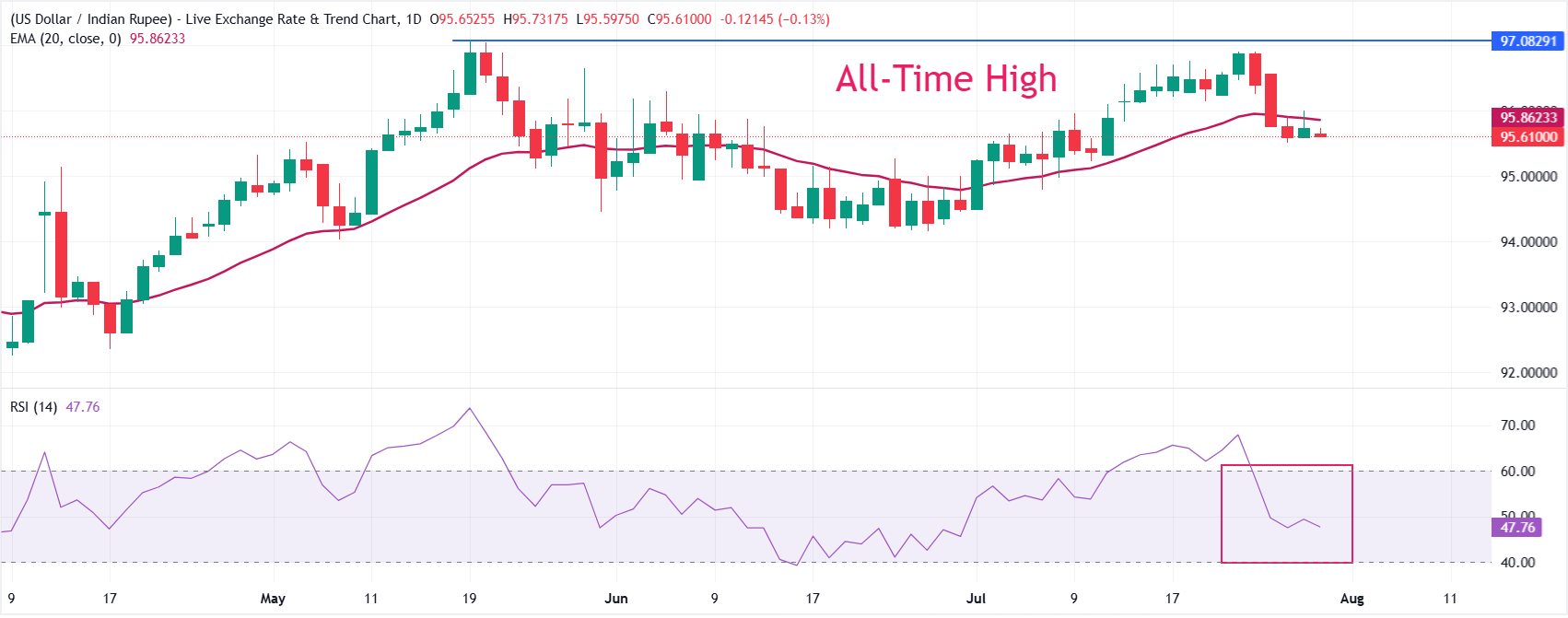
USD/INR trades slightly lower at around 95.61 at press time, maintaining a mildly bearish near-term bias as it holds below the 20-day exponential moving average (EMA) at 95.86. The pair has retreated from recent highs, and the 20-day EMA now acts as immediate overhead supply, hinting at a market that is losing upside traction.
The Relative Strength Index (RSI) at 47.76 sits just below the neutral 50 line, suggesting a lack of strong directional momentum and reinforcing a consolidative-to-soft tone while price remains capped beneath the short-term EMA.
On the topside, initial resistance is located at the 20-day EMA at 95.86, and a sustained break above this level would be needed to ease the current bearish bias and reopen the path toward the recent high of 97.10. Looking down, the key support level for the pair is 95.00.
(The technical analysis of this story was written with the help of an AI tool. Know more.)
Indian Rupee FAQs
The Indian Rupee (INR) is one of the most sensitive currencies to external factors. The price of Crude Oil (the country is highly dependent on imported Oil), the value of the US Dollar – most trade is conducted in USD – and the level of foreign investment, are all influential. Direct intervention by the Reserve Bank of India (RBI) in FX markets to keep the exchange rate stable, as well as the level of interest rates set by the RBI, are further major influencing factors on the Rupee.
The Reserve Bank of India (RBI) actively intervenes in forex markets to maintain a stable exchange rate, to help facilitate trade. In addition, the RBI tries to maintain the inflation rate at its 4% target by adjusting interest rates. Higher interest rates usually strengthen the Rupee. This is due to the role of the ‘carry trade’ in which investors borrow in countries with lower interest rates so as to place their money in countries’ offering relatively higher interest rates and profit from the difference.
Macroeconomic factors that influence the value of the Rupee include inflation, interest rates, the economic growth rate (GDP), the balance of trade, and inflows from foreign investment. A higher growth rate can lead to more overseas investment, pushing up demand for the Rupee. A less negative balance of trade will eventually lead to a stronger Rupee. Higher interest rates, especially real rates (interest rates less inflation) are also positive for the Rupee. A risk-on environment can lead to greater inflows of Foreign Direct and Indirect Investment (FDI and FII), which also benefit the Rupee.
Higher inflation, particularly, if it is comparatively higher than India’s peers, is generally negative for the currency as it reflects devaluation through oversupply. Inflation also increases the cost of exports, leading to more Rupees being sold to purchase foreign imports, which is Rupee-negative. At the same time, higher inflation usually leads to the Reserve Bank of India (RBI) raising interest rates and this can be positive for the Rupee, due to increased demand from international investors. The opposite effect is true of lower inflation.
추천 기사


