


The British Pound Sterling gets a new Prime Minister and an old problem
- GBP/USD retreats to just below 1.3500, surrendering roughly half of one percent after the week's rally stalled short of 1.3550.
- A dovish Bank of England speech and a -0.5% industrial production miss collide with hot US jobless claims and a blowout Philadelphia Fed survey.
- Andy Burnham stands unopposed for the Labour leadership and takes office Monday, with jobs and inflation data landing in his first 72 hours.
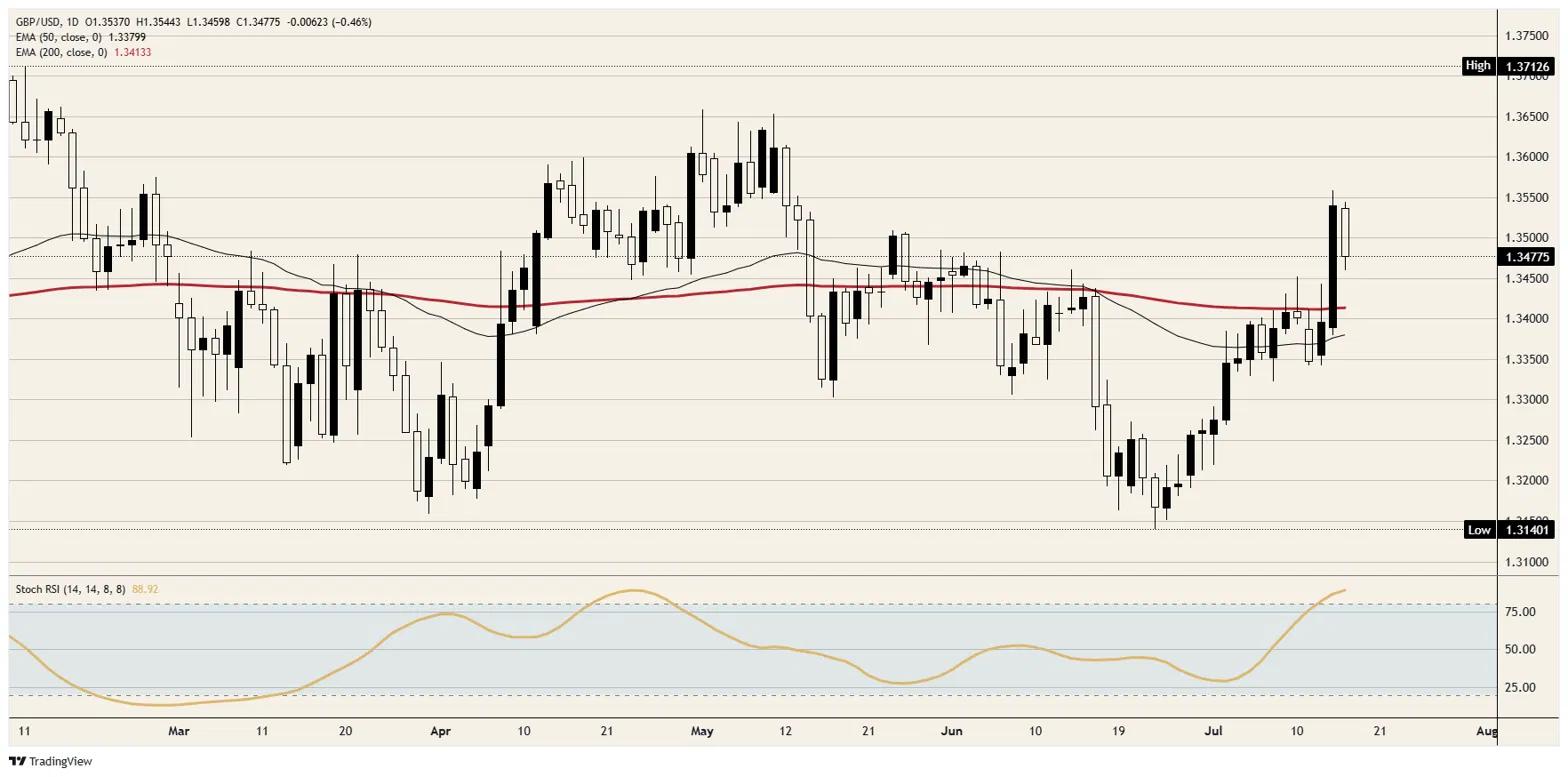
Sterling is enduring its heaviest session of the month, with GBP/USD fading around half of one percent to just below 1.3500 after the week's advance stalled short of 1.3550 for a second consecutive day. The pullback trims a July run that has carried the Pound roughly 400 pips off the yearly low printed just below 1.3150, and it arrives with the daily Stochastic Relative Strength Index pressing overbought territory near 90, exactly the setup in which extended rallies get taxed.
A dovish voice meets a hot American tape
Thursday's London data gave Sterling nothing to work with. Gross Domestic Product (GDP) grew 0.1% MoM in May, barely reversing April's contraction, while industrial production fell 0.5% against expectations for a far shallower dip, and only a modest manufacturing beat kept the morning from reading as an outright stall. A Bank of England (BoE) deputy governor then delivered remarks that markets scored as unmistakably dovish for the speaker, leaning on growth risks rather than the inflation overshoot.
The committee's official posture points the other way, and that tension is the story. The BoE held Bank Rate at 3.75% in June with two members voting for a hike, while Consumer Price Index (CPI) inflation sits at 2.8%, above target and exposed to fresh energy risk pouring out of the Gulf. A dovish speech against that backdrop reads less like guidance and more like a committee splitting in public, and Sterling has never enjoyed a split committee.
Across the Atlantic, the tape argued for the Dollar all day. Initial jobless claims fell to 208K against a 217K consensus while the Philadelphia Federal Reserve's manufacturing survey exploded to 41.4 versus 13 expected, and June retail sales held the line with the control group rising 0.5%. Rate futures continue to treat this month's Federal Reserve meeting as live for a hike, an almost surreal divergence from a central bank across the ocean drifting toward comfort with easing.
A coronation lands on Monday
British politics resolved itself with unusual speed this week. Nominations to replace Keir Starmer as Labour leader reached their deadline Thursday with Andy Burnham as the only candidate, backed by 379 of the party's 402 sitting members, and he will be confirmed at a special conference Friday before taking office as Prime Minister on Monday following an audience with the King. The succession question that shadowed Sterling for the better part of a month is over.
What replaces the uncertainty is an agenda nobody has priced. Burnham campaigned on the biggest rebalancing of power the country has seen and a national version of his Manchester playbook, which gilt markets will eventually translate into spending questions. The Pound rallied through the leadership endgame on relief alone, and from Monday the market starts grading the program instead, in the same week the data decides the BoE's August arithmetic.
The fiscal ledger is where relief could curdle. Burnham inherits a budget that already forced painful choices on his predecessor, and his instincts run toward regional investment and public spending. Gilt investors have punished far smaller ambiguities than this in recent years, and Sterling's July strength borrowed heavily from the end of the political vacuum, a loan that comes due against a hard agenda.
Five sessions of landmines
The United Kingdom publishes nearly everything that matters inside a single week. Tuesday at 06:00 GMT brings the labour market report, where the prior release showed a 31.2K claimant count jump, 100K employment growth over three months, and unemployment at 4.9%. Wednesday at 06:00 GMT delivers June CPI, previously 2.8% headline and 2.6% core, the single print most capable of deciding whether the hawkish dissenters multiply or fold.
Friday July 24 stacks retail sales, which jumped 1.2% MoM a month earlier, against preliminary Purchasing Managers Index (PMI) surveys that last showed the composite at 49.3, below the boom-bust line. The US answers with Michigan consumer sentiment Friday at 14:00 GMT, three Federal Reserve speakers later Thursday, and its own PMI round on July 24. Sterling rarely gets this many chances to be wrong in one week.
Levels and bias
Resistance: The 1.3550 area that has now turned the pair away twice caps the week, with 1.3600 behind it and the yearly high near 1.3700 the target beyond.
Support: Initial demand rests around 1.3450, ahead of the 1.3400 handle where the 200-day and 50-day Exponential Moving Averages converge to bracket the figure.
Bias: Lower. Overbought momentum is unwinding from a 400-pip run, the coming data calendar offers Sterling more ways to lose than win, and only a daily close back above 1.3550 revives the July uptrend toward 1.3700.
GBP/USD daily chart
Pound Sterling FAQs
The Pound Sterling (GBP) is the oldest currency in the world (886 AD) and the official currency of the United Kingdom. It is the fourth most traded unit for foreign exchange (FX) in the world, accounting for 12% of all transactions, averaging $630 billion a day, according to 2022 data. Its key trading pairs are GBP/USD, also known as ‘Cable’, which accounts for 11% of FX, GBP/JPY, or the ‘Dragon’ as it is known by traders (3%), and EUR/GBP (2%). The Pound Sterling is issued by the Bank of England (BoE).
The single most important factor influencing the value of the Pound Sterling is monetary policy decided by the Bank of England. The BoE bases its decisions on whether it has achieved its primary goal of “price stability” – a steady inflation rate of around 2%. Its primary tool for achieving this is the adjustment of interest rates. When inflation is too high, the BoE will try to rein it in by raising interest rates, making it more expensive for people and businesses to access credit. This is generally positive for GBP, as higher interest rates make the UK a more attractive place for global investors to park their money. When inflation falls too low it is a sign economic growth is slowing. In this scenario, the BoE will consider lowering interest rates to cheapen credit so businesses will borrow more to invest in growth-generating projects.
Data releases gauge the health of the economy and can impact the value of the Pound Sterling. Indicators such as GDP, Manufacturing and Services PMIs, and employment can all influence the direction of the GBP. A strong economy is good for Sterling. Not only does it attract more foreign investment but it may encourage the BoE to put up interest rates, which will directly strengthen GBP. Otherwise, if economic data is weak, the Pound Sterling is likely to fall.
Another significant data release for the Pound Sterling is the Trade Balance. This indicator measures the difference between what a country earns from its exports and what it spends on imports over a given period. If a country produces highly sought-after exports, its currency will benefit purely from the extra demand created from foreign buyers seeking to purchase these goods. Therefore, a positive net Trade Balance strengthens a currency and vice versa for a negative balance.
추천 기사


