


Indian Rupee slumps to fresh all-time lows on renewed US-Iran tensions
- The Indian Rupee slides to a fresh all-time low against the US Dollar, with the USD/INR jumping to 95.60.
- US-Iran renewed tensions prompt fears of a prolonged Hormuz closure.
- Investors await the India-US CPI data for April.
The Indian Rupee (INR) slumps to a fresh all-time low against the US Dollar (USD) in the opening session on Tuesday. The USD/INR pair jumps to near 95.60 as renewed tensions between the United States (US) and Iran have prompted fears of a prolonged closure of the Strait of Hormuz, a critical passage for almost 20% of global energy supply.
The continuation of the Hormuz closure is favorable for the oil prices, a scenario that bodes poorly for currencies from economies, such as India, which rely heavily on oil imports to meet their energy needs. As of writing, the WTI Oil price trades flat, slightly below $96.00.
Military actions in Middle East will likely resume
US President Donald Trump clarified on Monday that the counterproposal delivered by Iran against the one-page peace proposal was a “stupid proposal” and lacked Tehran’s decision on pursuing its nuclear ambitions. Trump added, “Ceasefire is on life support.”
Meanwhile, a report from CNN has stated that US President Trump has grown increasingly frustrated with how the Iranians are handling talks to end the conflict, and some Trump aides say that he is now more seriously considering a resumption of major combat operations than he has in recent weeks. This has renewed fears of a resumption of massacres in the Middle East.
FIIs selling spree remains intact
Amidst uncertainty surrounding India Inc.’s earnings projections due to elevated oil prices, foreign investors continue to dump their stake in the Indian stock market. So far in May, Foreign Institutional Investors (FIIs) have remained net sellers in five of six trading days and have offloaded their stake worth Rs. 19,509.91 crore.
Investors await India-US CPI data for April
During the day, investors will pay close attention to the India-US Consumer Price Index (CPI) data for April. India’s CPI data, which will be published at 04:00 PM IST (10:30 GMT), is expected to arrive higher at 3.8% Year-on-Year (YoY) from 3.4% in March. The US headline inflation, at 12:30 GMT, is estimated to have accelerated to 3.7% from the previous reading of 3.3%.
The India-US CPI data will significantly influence market expectations for the Reserve Bank of India (RBI) and the Federal Reserve’s (Fed) monetary policy outlook.
Higher US Dollar ahead of Trump’s visit to China also strengthens USD/INR
An improvement in the safe-haven demand of the US Dollar in the wake of renewed US-Iran tensions has also strengthened the USD/INR pair. As of writing, the US Dollar Index (DXY) trades 0.25% higher to near 98.15.
This week, the major trigger for global markets will be the bilateral meeting between US President Trump and Chinese leader Xi Jinping during Trump’s visit from May 13-15. Both leaders are expected to discuss mainly the Middle East situation, Taiwan, Artificial Intelligence (AI), and rare-earth elements.
Technical Analysis: USD/INR hits all-time highs near 95.60
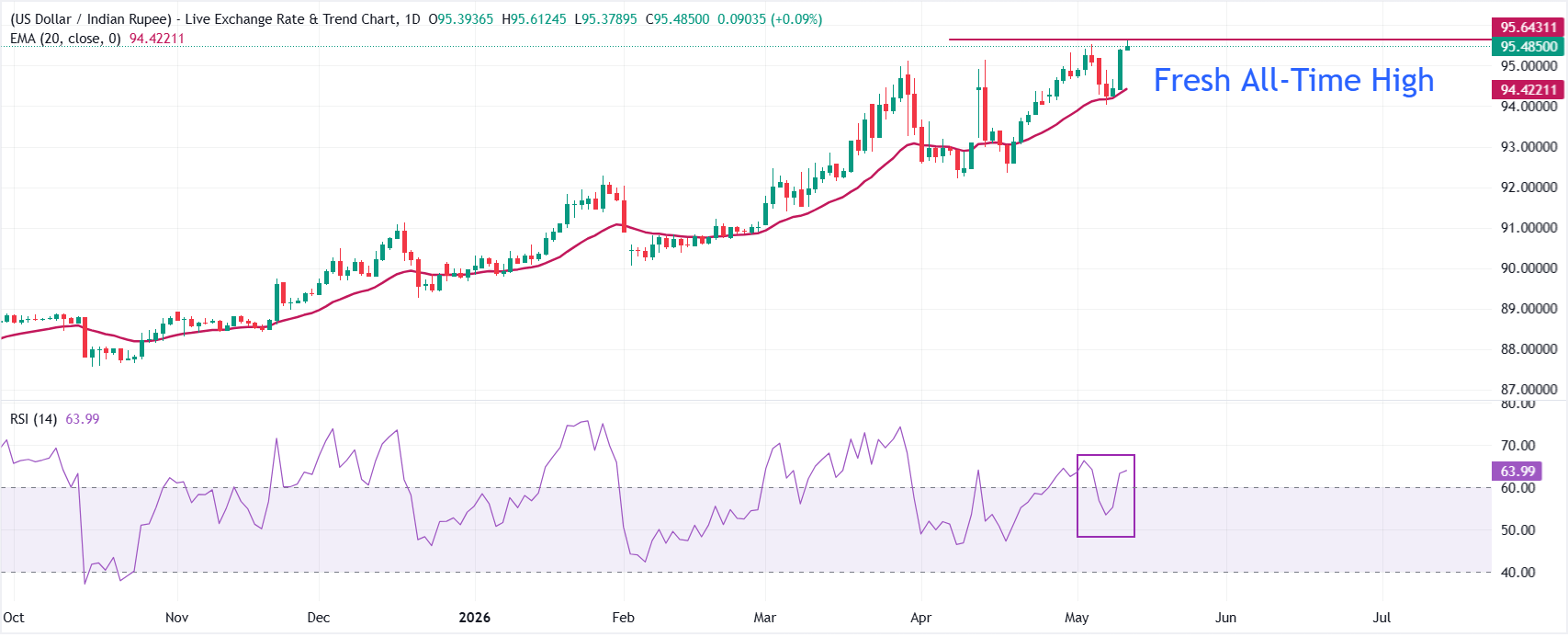
USD/INR trades higher at around 95.60, extending a bullish bias as price holds above the 20-day exponential moving average (EMA) at 94.4221. The pair is pressing fresh highs within the recent sequence of higher closes, while the Relative Strength Index (RSI) near 64 points to firm but not yet overbought upside momentum, suggesting dips may continue to attract buying interest as long as the exchange rate remains supported above the short-term EMA.
Looking up, the pair is in uncharted territory and will likely extend its advance toward 96.00. On the downside, the 20-day EMA at 94.42 will act as dynamic support; a daily close below that would lead to further correction toward 94.00.
(The technical analysis of this story was written with the help of an AI tool.)
Indian Rupee FAQs
The Indian Rupee (INR) is one of the most sensitive currencies to external factors. The price of Crude Oil (the country is highly dependent on imported Oil), the value of the US Dollar – most trade is conducted in USD – and the level of foreign investment, are all influential. Direct intervention by the Reserve Bank of India (RBI) in FX markets to keep the exchange rate stable, as well as the level of interest rates set by the RBI, are further major influencing factors on the Rupee.
The Reserve Bank of India (RBI) actively intervenes in forex markets to maintain a stable exchange rate, to help facilitate trade. In addition, the RBI tries to maintain the inflation rate at its 4% target by adjusting interest rates. Higher interest rates usually strengthen the Rupee. This is due to the role of the ‘carry trade’ in which investors borrow in countries with lower interest rates so as to place their money in countries’ offering relatively higher interest rates and profit from the difference.
Macroeconomic factors that influence the value of the Rupee include inflation, interest rates, the economic growth rate (GDP), the balance of trade, and inflows from foreign investment. A higher growth rate can lead to more overseas investment, pushing up demand for the Rupee. A less negative balance of trade will eventually lead to a stronger Rupee. Higher interest rates, especially real rates (interest rates less inflation) are also positive for the Rupee. A risk-on environment can lead to greater inflows of Foreign Direct and Indirect Investment (FDI and FII), which also benefit the Rupee.
Higher inflation, particularly, if it is comparatively higher than India’s peers, is generally negative for the currency as it reflects devaluation through oversupply. Inflation also increases the cost of exports, leading to more Rupees being sold to purchase foreign imports, which is Rupee-negative. At the same time, higher inflation usually leads to the Reserve Bank of India (RBI) raising interest rates and this can be positive for the Rupee, due to increased demand from international investors. The opposite effect is true of lower inflation.
추천 기사


