




Australian Dollar weakens despite China's RatingDog PMI uptick
- Australian Dollar weakens despite China’s RatingDog Manufacturing PMI rising to 50.3 in January from 50.1.
- Australia’s TD-MI Inflation rose 3.6% YoY in January; monthly gauge slowed to 0.2%, weakest since August.
- US Dollar may strengthen further as Trump nominates Kevin Warsh Fed Chair, signaling a more cautious approach to monetary easing.
The Australian Dollar (AUD) weakens against the US Dollar (USD) on Monday after registering over 1% losses in the previous session. The AUD/USD pair remains subdued following China's RatingDog Manufacturing Purchasing Managers' Index (PMI) data, which rose to 50.3 in January from 50.1 in December. This figure came in line with the expectations. The latest reading indicated a slight expansion in factory activity, but the fastest growth since last October.
Australia’s TD-MI Inflation Gauge rose 3.6% year-over-year (YoY) in January, up from 3.5% previously. The Monthly Inflation Gauge increased by 0.2%, slowing sharply from December’s two-year high of 1% and marking the weakest pace since August.
ANZ Job Advertisements jumped 4.4% month-over-month (MoM) in December 2025, rebounding from a revised 0.8% decline and posting the first increase since July. The rise was also the strongest monthly gain since February 2022, signaling renewed momentum in hiring toward year-end.
These data arrive ahead of the Reserve Bank of Australia’s (RBA) policy meeting on Tuesday, after the central bank held the cash rate at 3.6% for a third straight meeting in December. Policymakers are expected to remain cautious, with underlying inflation still above target and labor market conditions relatively tight, reinforcing a restrictive and data-dependent policy stance.
Australia’s Consumer Price Index (CPI) rose 3.8% YoY in December, accelerating from 3.4% previously. With headline inflation remaining above the RBA’s 2–3% target, recent PMI and employment data reinforce the case for a tighter monetary policy stance.
US Dollar inches lower ahead of ISM Manufacturing PMI
- The US Dollar Index (DXY), which measures the value of the US Dollar against six major currencies, is edging lower after registering more than 1% gains in the previous session and trading near 97.10 at the time of writing. US ISM Manufacturing PMI data for January will be eyed later in the day.
- The Greenback gains ground after US President Donald Trump’s nomination of Kevin Warsh as the next Federal Reserve (Fed) Chair. Markets interpreted Warsh’s appointment as signaling a more disciplined and cautious approach to monetary easing.
- The US Dollar also gained traction as risk sentiment improved after the US Senate reached an agreement to advance a government funding package, thereby averting a shutdown, according to Politico.
- US producer-side inflation firmed, moving further away from the Federal Reserve’s 2% target and reinforcing the central bank’s policy stance. US PPI inflation holds steady at 3.0% year-over-year (YoY) in December, unchanged from November and above expectations for a moderation to 2.7%. Core PPI, excluding food and energy, accelerated to 3.3% YoY from 3.0%, defying forecasts for a decline to 2.9% and highlighting persistent upstream price pressures.
- St. Louis Fed President Alberto Musalem said additional rate cuts are not warranted at this stage, characterizing the current 3.50%–3.75% policy rate range as broadly neutral. Similarly, Atlanta Fed President Raphael Bostic urged patience, arguing that monetary policy should remain modestly restrictive.
- Australia’s RBA Trimmed Mean inflation increased to 0.2% month-over-month (MoM) and 3.3% year-over-year (YoY). The monthly CPI rose 1.0% in December, up from 0% previously and above the 0.7% forecast.
- Australia’s export prices rose 3.2% quarter-on-quarter (QoQ) in Q4 2025, rebounding from a 0.9% fall in Q3 and marking the first increase in three quarters, as well as the strongest gain in a year. Meanwhile, import prices climbed 0.9%, beating expectations for a 0.2% decline and reversing a 0.4% drop in Q3.
- Markets now price in over a 70% chance of a 25-basis-point (bps) hike by the RBA from the 3.6% cash rate, up from 60% before the release, with rates fully priced at 3.85% by May and around 4.10% by September.
Australian Dollar falls toward confluence support around 0.6900
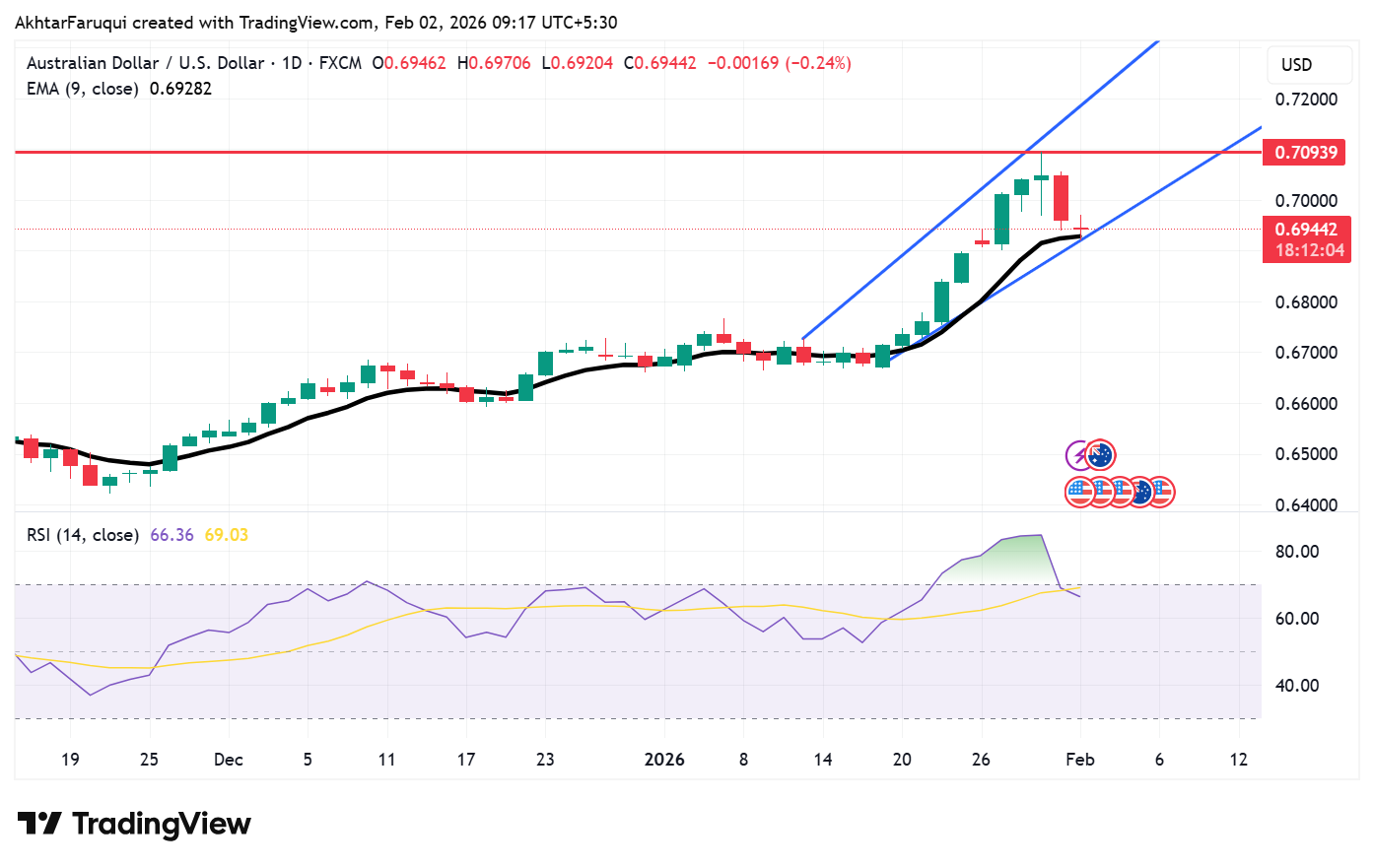
The AUD/USD pair is trading around 0.6940 on Monday. Daily chart analysis indicates that the pair is rising within the ascending channel pattern, indicating a persistent bullish bias. The 14-day Relative Strength Index (RSI) has pulled back from the 70 level to 67; it typically signals bullish momentum cooling, not reversing.
The AUD/USD pair could rebound toward 0.7093, the highest level since February 2023, which was recorded on January 29. Further advances would support the pair to test the upper boundary of the ascending channel around 0.7190. On the downside, the primary support lies at confluence at the nine-day Exponential Moving Average (EMA) of 0.6927, aligned with the lower ascending channel boundary around 0.6920.
Australian Dollar Price Today
The table below shows the percentage change of Australian Dollar (AUD) against listed major currencies today. Australian Dollar was the weakest against the Euro.
| USD | EUR | GBP | JPY | CAD | AUD | NZD | CHF | |
|---|---|---|---|---|---|---|---|---|
| USD | -0.15% | -0.03% | 0.14% | 0.17% | 0.21% | -0.02% | -0.11% | |
| EUR | 0.15% | 0.12% | 0.29% | 0.33% | 0.36% | 0.14% | 0.05% | |
| GBP | 0.03% | -0.12% | 0.17% | 0.21% | 0.24% | 0.02% | -0.07% | |
| JPY | -0.14% | -0.29% | -0.17% | 0.04% | 0.08% | -0.15% | -0.24% | |
| CAD | -0.17% | -0.33% | -0.21% | -0.04% | 0.03% | -0.19% | -0.28% | |
| AUD | -0.21% | -0.36% | -0.24% | -0.08% | -0.03% | -0.23% | -0.31% | |
| NZD | 0.02% | -0.14% | -0.02% | 0.15% | 0.19% | 0.23% | -0.09% | |
| CHF | 0.11% | -0.05% | 0.07% | 0.24% | 0.28% | 0.31% | 0.09% |
The heat map shows percentage changes of major currencies against each other. The base currency is picked from the left column, while the quote currency is picked from the top row. For example, if you pick the Australian Dollar from the left column and move along the horizontal line to the US Dollar, the percentage change displayed in the box will represent AUD (base)/USD (quote).
Australian Dollar FAQs
One of the most significant factors for the Australian Dollar (AUD) is the level of interest rates set by the Reserve Bank of Australia (RBA). Because Australia is a resource-rich country another key driver is the price of its biggest export, Iron Ore. The health of the Chinese economy, its largest trading partner, is a factor, as well as inflation in Australia, its growth rate and Trade Balance. Market sentiment – whether investors are taking on more risky assets (risk-on) or seeking safe-havens (risk-off) – is also a factor, with risk-on positive for AUD.
The Reserve Bank of Australia (RBA) influences the Australian Dollar (AUD) by setting the level of interest rates that Australian banks can lend to each other. This influences the level of interest rates in the economy as a whole. The main goal of the RBA is to maintain a stable inflation rate of 2-3% by adjusting interest rates up or down. Relatively high interest rates compared to other major central banks support the AUD, and the opposite for relatively low. The RBA can also use quantitative easing and tightening to influence credit conditions, with the former AUD-negative and the latter AUD-positive.
China is Australia’s largest trading partner so the health of the Chinese economy is a major influence on the value of the Australian Dollar (AUD). When the Chinese economy is doing well it purchases more raw materials, goods and services from Australia, lifting demand for the AUD, and pushing up its value. The opposite is the case when the Chinese economy is not growing as fast as expected. Positive or negative surprises in Chinese growth data, therefore, often have a direct impact on the Australian Dollar and its pairs.
Iron Ore is Australia’s largest export, accounting for $118 billion a year according to data from 2021, with China as its primary destination. The price of Iron Ore, therefore, can be a driver of the Australian Dollar. Generally, if the price of Iron Ore rises, AUD also goes up, as aggregate demand for the currency increases. The opposite is the case if the price of Iron Ore falls. Higher Iron Ore prices also tend to result in a greater likelihood of a positive Trade Balance for Australia, which is also positive of the AUD.
The Trade Balance, which is the difference between what a country earns from its exports versus what it pays for its imports, is another factor that can influence the value of the Australian Dollar. If Australia produces highly sought after exports, then its currency will gain in value purely from the surplus demand created from foreign buyers seeking to purchase its exports versus what it spends to purchase imports. Therefore, a positive net Trade Balance strengthens the AUD, with the opposite effect if the Trade Balance is negative.
추천 기사


