




EUR/USD slides below 1.2000 as strong-Dollar rhetoric revives Greenback
- EUR/USD drops over 0.7% after Bessent reaffirms US commitment to a strong-Dollar policy.
- Dollar rebounds ahead of the Fed decision, erasing losses sparked by Trump’s remarks.
- ECB officials warn prolonged Dollar weakness could push Eurozone inflation below target.
EUR/USD dives over 0.70% on Wednesday below the 1.2000 figure as the US Treasury Secretary Scott Bessent denied intervention rumors in the FX markets and reiterated the strong Dollar policy. Therefore, broad US Dollar weakness triggered by US President Trump, is fading ahead of the Fed’s decision. The pair trades at 1.1939.
Euro tumbles as Treasury Secretary Bessent dismisses FX intervention rumor
In an interview with CNBC, Scott Bessent commented that they do not intervene in the markets to propel the Japanese Yen. He added that the “US always has a strong dollar policy, but a strong dollar policy means setting the right fundamentals.”
Bessent comments outweighed US President Donald Trump remarks on Tuesday, in which he said the Dollar was doing “great,” when asked about the depreciation of the Greenback. His answer gave the green light to traders, who drove the US Dollar Index (DXY) to four-year lows.
In the meantime, traders brace for the Federal Reserve’s monetary policy decision, followed by the Fed Chair Jerome Powell press conference. He is expected to lay the ground for interest rates at least of the first quarter, as he ends his term on May.
In the Eurozone, GfK Consumer Confidence in Germany for February, improved. Meanwhile, members of the European Central Bank (ECB) expressed worries in regard to a weaker US Dollar, warning that it could drive down inflation past the ECB’s 2% goal.
Daily market movers: Euro treads water amid US Dollar strength
- The Euro drops as the buck recovers ahead of the Fed’s meeting. The US Dollar Index (DXY) which tracks the strength of the American currency against other six, is up 0.82% at 96.60.
- A hawkish outcome from the Federal Open Market Committee could accelerate a pullback in Gold, particularly if the Federal Reserve signals that the labor market has stabilized while inflation remains elevated—a combination that would likely boost the US Dollar.
- By contrast, a dovish message would emphasize that economic activity is expanding at a moderate pace, with risks to both sides of the dual mandate broadly balanced, while acknowledging continued fragility in the labor market. Under that scenario, the US Dollar could weaken sharply, opening the door for Gold to push toward fresh record highs.
- German GfK Consumer Confidence rose to -24.1 from -26.9 in January. The survey showed that the desire to buy improved and to save was mostly stable in January. Economic and income expectations improved as well.
- ECB’s Francois Villeroy de Galhau said “We are closely monitoring this appreciation of the euro and its possible implications for lower inflation.” He added that the weaker US Dollar against the euro reflected lower confidence amid unpredictable US economic policy.
- ECB Vice President Luis de Guindos said last summer that an EUR/USD exchange rate around 1.20 would be acceptable but warned that levels above that threshold could pose challenges.
- Prime Market Terminal data shows that traders are expecting 44 basis points of easing by the Federal Reserve towards the end of the year.
Technical outlook: EUR/USD to trade sideways within 1.1900-1.1950 ahead of the Fed’s meeting
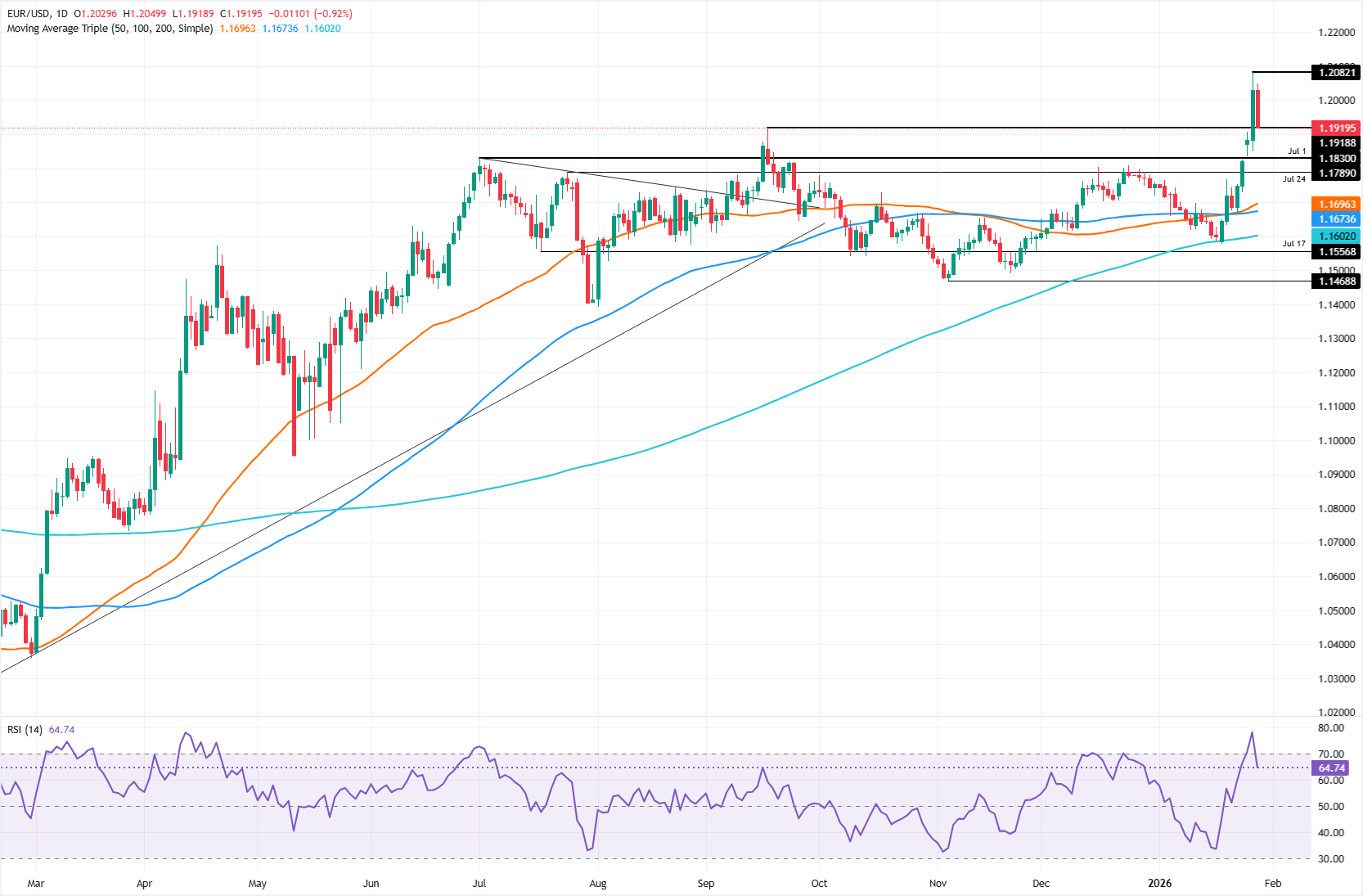
EUR/USD is retreating from yearly highs of 1.2082, with the shared currency seems poised to bottom at around 1.1900, to remain sideways waiting for the Fed’s decision. The Relative Strength Index (RSI) confirms the previously mentioned, as the RSI exited overbought territory, aiming towards its neutral level.
A Fed’s hawkish outcome could sent the EUR/USD tumbling below 1.1900, opening the door to test the July 1 daily high at 1.1830, ahead of 1.1800. Conversely, if policymakers are still seeing weakness in the labor market, the EUR/USD could rally towards 1.2000 and challenge the yearly high.
Euro FAQs
The Euro is the currency for the 20 European Union countries that belong to the Eurozone. It is the second most heavily traded currency in the world behind the US Dollar. In 2022, it accounted for 31% of all foreign exchange transactions, with an average daily turnover of over $2.2 trillion a day. EUR/USD is the most heavily traded currency pair in the world, accounting for an estimated 30% off all transactions, followed by EUR/JPY (4%), EUR/GBP (3%) and EUR/AUD (2%).
The European Central Bank (ECB) in Frankfurt, Germany, is the reserve bank for the Eurozone. The ECB sets interest rates and manages monetary policy. The ECB’s primary mandate is to maintain price stability, which means either controlling inflation or stimulating growth. Its primary tool is the raising or lowering of interest rates. Relatively high interest rates – or the expectation of higher rates – will usually benefit the Euro and vice versa. The ECB Governing Council makes monetary policy decisions at meetings held eight times a year. Decisions are made by heads of the Eurozone national banks and six permanent members, including the President of the ECB, Christine Lagarde.
Eurozone inflation data, measured by the Harmonized Index of Consumer Prices (HICP), is an important econometric for the Euro. If inflation rises more than expected, especially if above the ECB’s 2% target, it obliges the ECB to raise interest rates to bring it back under control. Relatively high interest rates compared to its counterparts will usually benefit the Euro, as it makes the region more attractive as a place for global investors to park their money.
Data releases gauge the health of the economy and can impact on the Euro. Indicators such as GDP, Manufacturing and Services PMIs, employment, and consumer sentiment surveys can all influence the direction of the single currency. A strong economy is good for the Euro. Not only does it attract more foreign investment but it may encourage the ECB to put up interest rates, which will directly strengthen the Euro. Otherwise, if economic data is weak, the Euro is likely to fall. Economic data for the four largest economies in the euro area (Germany, France, Italy and Spain) are especially significant, as they account for 75% of the Eurozone’s economy.
Another significant data release for the Euro is the Trade Balance. This indicator measures the difference between what a country earns from its exports and what it spends on imports over a given period. If a country produces highly sought after exports then its currency will gain in value purely from the extra demand created from foreign buyers seeking to purchase these goods. Therefore, a positive net Trade Balance strengthens a currency and vice versa for a negative balance.
추천 기사


