

EUR/USD hesitates as growing geopolitical risks weigh
- EUR/USD finds support near 1.1750 after pulling back from three-month highs past 1.1800.
- Growing geopolitical risks are likely to limit the Euro's upside attempts.
- Investors await the release of the minutes of the last Fed Monetary policy meeting.
EUR/USD is practically flat on Tuesday, trading near 1.1770 at the time of writing amid the current market lull ahead of the New Year holiday. The common currency has found support not far from the three-month highs in the 1.1800 area, but the rising geopolitical tensions are weighing on risk appetite on thinned year-end trading, keeping the Euro's (EUR) upside attempts limited.
The US Dollar, on the other hand, is on track to close its worst yearly performance in almost a decade. Monetary policy divergence between the European Central Bank (ECB), which seems to have reached the end of its easing cycle, and the US Federal Reserve (Fed), which is expected to cut rates between one and three times next year, underpins the pair, which shows a nearly 14% appreciation in 2025.
Against this background, the market awaits the US central bank to release the minutes of its December Monetary policy meeting, due at 19:00 GMT. The Fed delivered a widely expected rate cut two weeks ago and signalled 25 basis points of further cuts in 2026, amid a widely split monetary policy committee. Furthermore, Chairman Jerome Powell ends his term next May and will be replaced by a more dovish successor. All things considered, the market is betting on a significantly steeper easing cycle in the US.
Euro Price Today
The table below shows the percentage change of Euro (EUR) against listed major currencies today. Euro was the strongest against the US Dollar.
| USD | EUR | GBP | JPY | CAD | AUD | NZD | CHF | |
|---|---|---|---|---|---|---|---|---|
| USD | -0.07% | -0.09% | -0.02% | -0.09% | -0.35% | -0.24% | -0.14% | |
| EUR | 0.07% | -0.02% | 0.04% | -0.02% | -0.28% | -0.16% | -0.07% | |
| GBP | 0.09% | 0.02% | 0.08% | -0.00% | -0.26% | -0.15% | -0.06% | |
| JPY | 0.02% | -0.04% | -0.08% | -0.08% | -0.33% | -0.23% | -0.09% | |
| CAD | 0.09% | 0.02% | 0.00% | 0.08% | -0.25% | -0.14% | -0.06% | |
| AUD | 0.35% | 0.28% | 0.26% | 0.33% | 0.25% | 0.11% | 0.20% | |
| NZD | 0.24% | 0.16% | 0.15% | 0.23% | 0.14% | -0.11% | 0.09% | |
| CHF | 0.14% | 0.07% | 0.06% | 0.09% | 0.06% | -0.20% | -0.09% |
The heat map shows percentage changes of major currencies against each other. The base currency is picked from the left column, while the quote currency is picked from the top row. For example, if you pick the Euro from the left column and move along the horizontal line to the US Dollar, the percentage change displayed in the box will represent EUR (base)/USD (quote).
Daily Digest Market Movers: US Dollar's upside attempts remain limited
- The Euro (EUR) is picking up again following a shallow correction from three-month highs. The pair maintains its broader bullish trend intact, with market expectations of further Fed rate cuts keeping US Treasury yields and the US Dollar depressed.
- On the geopolitical front, the Russian government announced the revision of its negotiating position with Ukraine after accusing Kyiv of attacking one of Russian President Vladimir Putin's residences. Ukrainian authorities have denied the allegations, but the fate of the peace talks has come into question.
- In Asia, China has been carrying out military drills around the island of Taiwan, which are expected to continue on Tuesday. These maneuvers came a few days after the US announced an agreement to send a $11 billion weapons package to the island, an escalation of the tensions in an already volatile area.
- And if that was not enough, US President Donald Trump threatened another attack in Iran if the Islamic Republic attempts to rebuild its nuclear weapons program. These threats have had so far a limited impact on FX markets, but the growing geopolitical risks in the hottest regions of the world are likely to keep risk appetite subdued and limit the Euro's upside attempts.
- In the US on Monday, Pending Home Sales increased 3.3% in November, with purchasing contracts reaching their highest level in three years. Homebuying accelerated from the 2.4% monthly rise seen in October, against expectations of a slowdown to 1%. The data's positive impact on the US Dollar, however, was minimal.
Technical Analysis: EUR/USD supported by the ascending trendline, near 1.1760
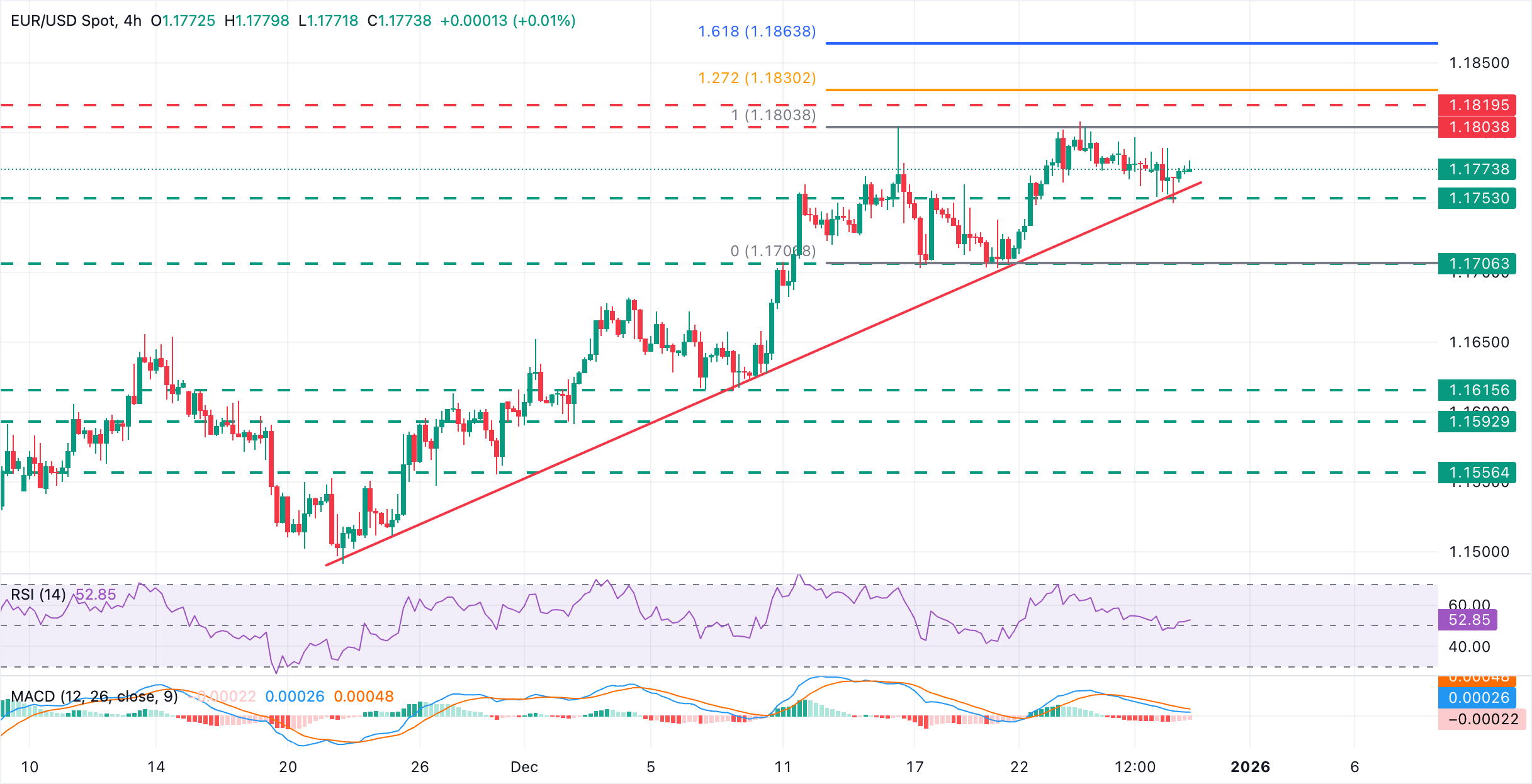
The EUR/USD pair's reversal from last week's high at 1.1808 has found support at the ascending trendline support from mid-November lows, now at 1.1760. Upside attempts, however, remain limited, with technical indicators showing a mild bearish momentum. The 4-hour Relative Strength Index (RSI) is hovering around neutral levels, and the Moving Average Convergence Divergence (MACD) indicator remains below zero, although showing a flattening curve.
Bears are facing support at the convergence of the mentioned trendline, around 1.1760, and Tuesday's lows at 1.1750. A confirmation below this level is needed to challenge the broader bullish trend and bring the December 17 and 19 lows, near 1.1700, into focus.
To the upside, immediate resistance is at the 1.1805 area, where the pair was capped on December 16 and 24. This level is likely to challenge bulls ahead of the September 23 and 24 highs near 1.1820. Further up, the 161.8% Fibonacci extension of the December 19-24 rally, at 1.1863, emerges as a plausible target.
Central banks FAQs
Central Banks have a key mandate which is making sure that there is price stability in a country or region. Economies are constantly facing inflation or deflation when prices for certain goods and services are fluctuating. Constant rising prices for the same goods means inflation, constant lowered prices for the same goods means deflation. It is the task of the central bank to keep the demand in line by tweaking its policy rate. For the biggest central banks like the US Federal Reserve (Fed), the European Central Bank (ECB) or the Bank of England (BoE), the mandate is to keep inflation close to 2%.
A central bank has one important tool at its disposal to get inflation higher or lower, and that is by tweaking its benchmark policy rate, commonly known as interest rate. On pre-communicated moments, the central bank will issue a statement with its policy rate and provide additional reasoning on why it is either remaining or changing (cutting or hiking) it. Local banks will adjust their savings and lending rates accordingly, which in turn will make it either harder or easier for people to earn on their savings or for companies to take out loans and make investments in their businesses. When the central bank hikes interest rates substantially, this is called monetary tightening. When it is cutting its benchmark rate, it is called monetary easing.
A central bank is often politically independent. Members of the central bank policy board are passing through a series of panels and hearings before being appointed to a policy board seat. Each member in that board often has a certain conviction on how the central bank should control inflation and the subsequent monetary policy. Members that want a very loose monetary policy, with low rates and cheap lending, to boost the economy substantially while being content to see inflation slightly above 2%, are called ‘doves’. Members that rather want to see higher rates to reward savings and want to keep a lit on inflation at all time are called ‘hawks’ and will not rest until inflation is at or just below 2%.
Normally, there is a chairman or president who leads each meeting, needs to create a consensus between the hawks or doves and has his or her final say when it would come down to a vote split to avoid a 50-50 tie on whether the current policy should be adjusted. The chairman will deliver speeches which often can be followed live, where the current monetary stance and outlook is being communicated. A central bank will try to push forward its monetary policy without triggering violent swings in rates, equities, or its currency. All members of the central bank will channel their stance toward the markets in advance of a policy meeting event. A few days before a policy meeting takes place until the new policy has been communicated, members are forbidden to talk publicly. This is called the blackout period.
추천 기사


