

Robinhood plans 24/7 stock trading as Wall Street moves toward crypto hours

Fuente Cryptopolitan

On September 29, Robinhood announced that it intends to allow clients to participate in trading in a selection of US stocks and ETFs around the clock during weekends, bringing equity trading to the level of continuous operation that has been characteristic of cryptocurrency markets for years.

This decision, as per Reuters, enhances Robinhood’s current 24-hour weekday market as exchanges, regulators, and clearinghouses reconsider the duration of the operation of conventional markets. This change can be beneficial or harmful for crypto as non-stop trading methods lose their uniqueness and conventional finance is starting to resemble the market form that was popularized by crypto trading.

Weekend stock trading, pending a regulator’s sign-off

Robinhood has partnered with overnight trading infrastructure provider Bruce ATS to launch weekend trading. The service is still undergoing a regulatory review, and only a limited number of equities and ETFs will be offered at launch.

The company already runs a 24 Hour Market from Sunday evening through Friday evening. Reuters said that about 10 months after overnight weekday trading launched in 2023, as much as 25% of daily volume on the busiest days was happening outside standard hours.

“Our focus this year is making Robinhood the best place for active traders by giving them the tools that are typically reserved for hedge funds, quants and a lot of big active trading firms,” vice president of product management Abhishek Fatehpuria told Reuters.

Wall Street is drifting toward always-on markets

Robinhood joins a growing trend toward markets that operate around the clock. Speaking during an FIA roundtable event, Liz Martin, the chief of derivatives at Coinbase, shared information about the firm’s experience with the launch of its 24/7 futures trading in May 2025 and its record of trading billion-dollar volumes every weekend during major news events.

According to Thomas Texier of Marex Clearing, large asset management firms and corporates are looking to hedge over the weekend rather than waiting for the working week. However, implementing this change is easier said than done, since a 24/7 marketplace entails higher requirements for clearing, staffing, settlement and risk management.

The CFTC and the tokenization backdrop

Regulators are gearing up for the change as CFTC has issued guidelines on 24/7 trading, clearing, and settlement as more markets transcend the traditional trade opening and closing.

Adding tokenization to the mix, Citi’s Tokenization 2030 report indicates the tokenized asset market is currently at $ 17 billion and forecasts $5.5 trillion by 2030, with US equities and Treasuries emerging as leaders. The report asserts that digital natives are expecting 24/7 access to the market.

Access is not the same as liquidity

Longer trading periods don’t necessarily mean better markets. Robinhood has cautioned that night trading can lead to lower liquidity, higher volatility, and wider spreads. Reuters, on the other hand, has pointed out that markets with limited liquidity can result in unfavorable rates for traders.

So the decision to proceed to 24/7 trading will be based not only on the accessibility of capital but also on whether there will be enough suppliers and consumers.
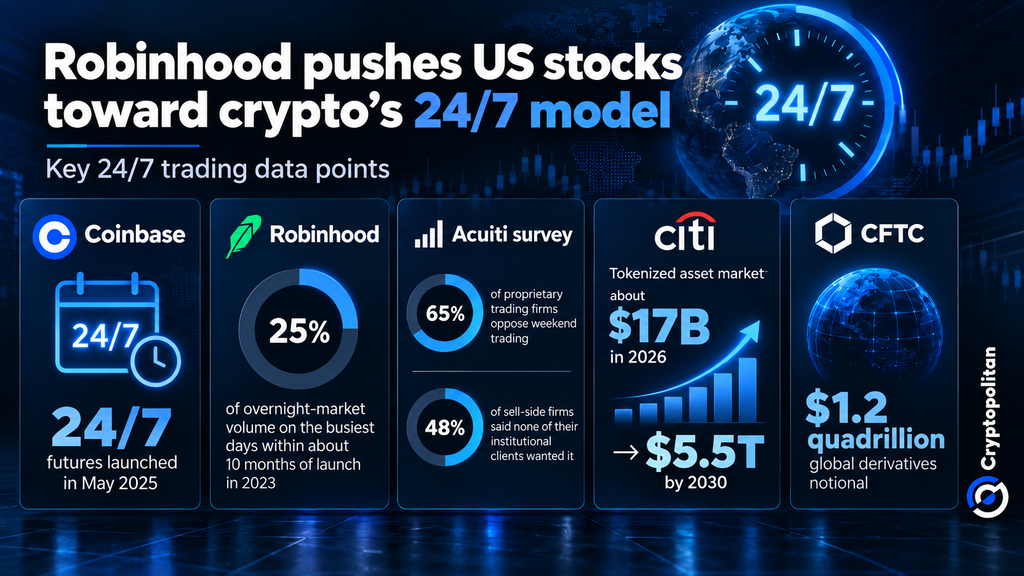
24/7 Trading Data: Robinhood, Coinbase, Tokenization and the Shift to Always-On Markets

Does 24/7 stock trading dull crypto’s edge?

For crypto, the impact is mixed. Weekend stock trading makes “markets never close” less unique as a selling point. But it also makes nonstop access feel more normal and could strengthen the case for tokenized securities built on infrastructure designed to operate continuously.

If US equities keep moving toward crypto’s clock, the bigger question may be whether traditional markets eventually adopt more than just their trading hours — including parts of their settlement architecture.

The smartest crypto minds already read our newsletter. Want in? Join them.

Descargo de responsabilidad: Sólo con fines informativos. Rentabilidades pasadas no son indicativas de resultados futuros.
placeholder
Previsión del precio del WTI: Mantiene las ganancias de la recuperación por debajo de 89.00$; carece de convicción alcistaEl West Texas Intermediate (WTI) —el precio de referencia del Petróleo Crudo estadounidense— avanza ligeramente el miércoles, revirtiendo parte de las fuertes pérdidas de la jornada anterior hasta alcanzar mínimos de más de tres semanas, aunque carece de continuidad
Autor  FXStreet
10 hace una horas
El West Texas Intermediate (WTI) —el precio de referencia del Petróleo Crudo estadounidense— avanza ligeramente el miércoles, revirtiendo parte de las fuertes pérdidas de la jornada anterior hasta alcanzar mínimos de más de tres semanas, aunque carece de continuidad
placeholder
El WTI cae cerca de 91.00$ mientras las exportaciones de crudo de Oriente Próximo se recuperanEl petróleo West Texas Intermediate (WTI) ha reducido sus ganancias recientes del día anterior, cotizando alrededor de 91.10$ por barril durante el horario europeo del martes. Los precios del petróleo crudo se han relajado tras un rebote de las exportaciones en septiembre por parte de importantes productores de Oriente Medio.
Autor  FXStreet
El dia de ayer 09: 17
El petróleo West Texas Intermediate (WTI) ha reducido sus ganancias recientes del día anterior, cotizando alrededor de 91.10$ por barril durante el horario europeo del martes. Los precios del petróleo crudo se han relajado tras un rebote de las exportaciones en septiembre por parte de importantes productores de Oriente Medio.
placeholder
El rendimiento del bono estadounidense a 10 años repunta hasta el 5,236%, máximo desde junio de 2007El bono americano a 10 años se sitúa en el 5,236% al cierre del 28 de septiembre, su nivel más alto desde junio de 2007. El giro restrictivo de la Fed, los datos económicos sólidos y la débil demanda en las subastas explican el movimiento, que presiona a la baja a bolsas, oro y EUR/USD.
Autor  Mitrade Team
El dia de ayer 06: 54
El bono americano a 10 años se sitúa en el 5,236% al cierre del 28 de septiembre, su nivel más alto desde junio de 2007. El giro restrictivo de la Fed, los datos económicos sólidos y la débil demanda en las subastas explican el movimiento, que presiona a la baja a bolsas, oro y EUR/USD.
placeholder
Oro: La tendencia bajista persiste por debajo de la DMA de 200 – Societe GeneraleLos analistas de Société Générale señalan que el precio del Oro no ha logrado mantener las ganancias por encima de su media móvil de 200 días, reforzando el impulso bajista. Está en curso un retroceso a corto plazo, con una resistencia clave en el máximo de giro reciente cerca de los 4.315$
Autor  FXStreet
9 Mes 28 Día Lun
Los analistas de Société Générale señalan que el precio del Oro no ha logrado mantener las ganancias por encima de su media móvil de 200 días, reforzando el impulso bajista. Está en curso un retroceso a corto plazo, con una resistencia clave en el máximo de giro reciente cerca de los 4.315$
placeholder
EUR/USD cae a 1,1377, el euro registra su peor mes desde junio frente al dólarEl EUR/USD cotiza en 1,1377 el 28 de septiembre y acumula una caída del 1,7% en septiembre, su peor mes desde junio. La presión vendedora responde al diferencial de tasas entre la Fed y el BCE, la escalada geopolítica en Oriente Medio y unos datos económicos insuficientes para revertir la tendencia. Los analistas vigilan el soporte de 1,1350 y 1,1324.
Autor  Mitrade Team
9 Mes 28 Día Lun
El EUR/USD cotiza en 1,1377 el 28 de septiembre y acumula una caída del 1,7% en septiembre, su peor mes desde junio. La presión vendedora responde al diferencial de tasas entre la Fed y el BCE, la escalada geopolítica en Oriente Medio y unos datos económicos insuficientes para revertir la tendencia. Los analistas vigilan el soporte de 1,1350 y 1,1324.
goTop
quote