

US senator urges Treasury and DOJ to investigate Tether over Iran-linked USDT

Fuente Cryptopolitan

US authorities are expanding the investigation of the crypto system that Iran is reportedly using to transfer money, now putting Tether at the center of the issue. On September 28, Senator Richard Blumenthal of the Senate Permanent Subcommittee on Investigations (PSI) called on the Treasury and Justice Department to look further into Tether. The company responded and stated that it has assisted in freezing almost $550 million in USDT associated with Iran in 2026.

In the eyes of global crypto firms, their more pertinent fear does not lie within a short-term market crash but the imminent rise in sanctions and compliance issues regarding the services offered by their companies and the way funds flow through their platforms.

Two sides of the same wallet data

On September 28, Blumenthal made the PSI results public in Washington, D.C. Investigators looked into 846 wallet accounts that had been flagged or were being targeted for confiscation due to their connections to Iran. According to the report, 84% of the wallets made transactions exclusively or almost exclusively in USDT.

“Tether and its flagship token have become central to Iran’s shadow banking system” – Sen. Richard Blumenthal, September 28 PSI release

He referred the findings to Treasury Secretary Scott Bessent and Attorney General Todd Blanche for possible violations of sanctions and the Bank Secrecy Act. Blumenthal also noted Cantor Fitzgerald’s approximately 5% stake in Tether, as well as its connection with Commerce Secretary Howard Lutnick’s family.

The following day, Tether made a statement explaining that it was responsible for the freezing of approximately $550 million in USDT related to Iran’s central bank and other sanctioned entities in 2026.

“USD₮ is not a haven for sanctioned actors…” – CEO Paolo Ardoino, Tether’s September 28 statement

According to Tether, the company cooperates with over 340 law enforcement agencies in 67 countries.
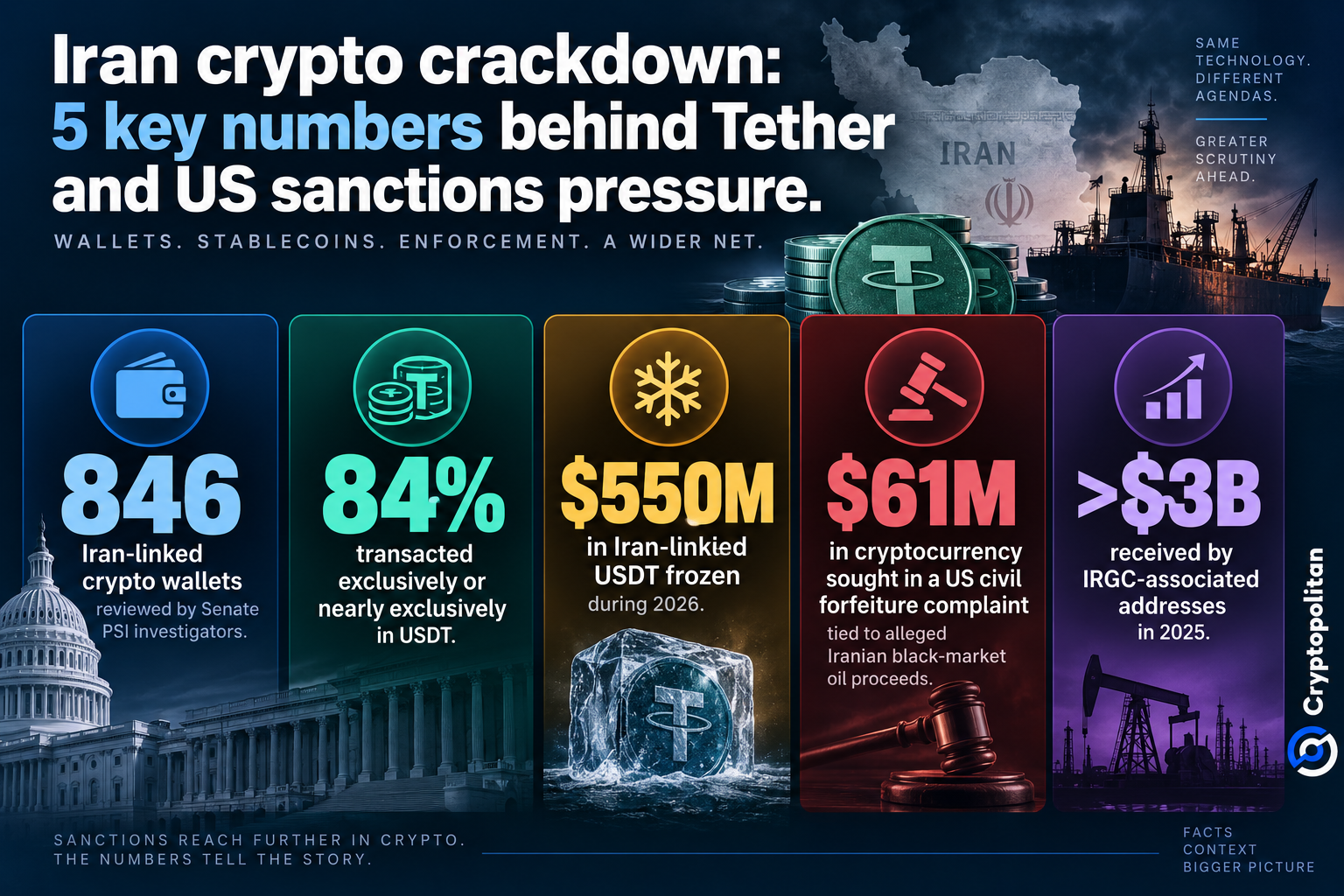
Iran crypto crackdown: 5 key figures behind Tether and US sanctions pressure

Enforcement is climbing the whole stack

The Tether dispute forms only a part of a wider campaign launched by the US against Iran. On August 24, the Treasury Department launched Operation Economic Outcast, which aims to include nearly 60 entities linked to Iran, in addition to making digital assets one of the five designated sectors subject to sanctions.

According to TRM Labs, this development raises the chances of secondary sanctions being imposed on exchanges, OTC brokers, payment service providers, and other entities supporting Iran’s cryptocurrency industry.

On September 14, the federal prosecutors filed a civil forfeiture case to recover approximately $61 million in cryptocurrencies believed to be linked to black market oil sales from Iran. The prosecutors informed that a related group of wallets has processed funds of about $1.5 billion regarded as illegal.

Chainalysis also reported that IRGC-related wallets received more than $3 billion up to the year 2025.

Why exchanges are watching more than Tether

The US authorities are treating stablecoins, exchanges, wallets and crypto-for-oil networks more and more as a part of the same sanctions environment. Cryptopolitan has recently reported that the US authorities are investigating whether Binance has knowingly processed Iran-related trades.

For global crypto firms, the pressure is likely to show up in stricter checks on who they do business with and greater exposure to secondary sanctions. What happens next depends on whether Treasury or the Justice Department follows up on Blumenthal’s referral, and whether that leads crypto companies to tighten how they screen for Iran-linked activity.

If you're reading this, you’re already ahead. Stay there with our newsletter.

Descargo de responsabilidad: Sólo con fines informativos. Rentabilidades pasadas no son indicativas de resultados futuros.
placeholder
El cobre toca máximos históricos, LME alcanza los 14.779 dólares por tonelada en la sesiónEl precio del cobre marcó máximos históricos en septiembre de 2026, con la LME tocando 14.779 dólares por tonelada y COMEX en 6,739 dólares por libra. La oferta minera cayó un 1,1% interanual y los inventarios se desplazaron masivamente hacia Estados Unidos. El artículo analiza los soportes y resistencias clave, así como cuatro factores críticos que determinarán la dirección futura del precio del cobre.
Autor  Mitrade Team
9 Mes 10 Día Jue
El precio del cobre marcó máximos históricos en septiembre de 2026, con la LME tocando 14.779 dólares por tonelada y COMEX en 6,739 dólares por libra. La oferta minera cayó un 1,1% interanual y los inventarios se desplazaron masivamente hacia Estados Unidos. El artículo analiza los soportes y resistencias clave, así como cuatro factores críticos que determinarán la dirección futura del precio del cobre.
placeholder
Precio petróleo hoy: El Brent acumula cinco sesiones consecutivas de caídasEl precio del petróleo cae por cinco sesión consecutiva. El Brent cerró el 22 de septiembre en 99,25 dólares y el WTI en 94,99. El aumento de la oferta saudí y la menor tensión geopolítica presionan los precios a la baja. Los inventarios de crudo en Estados Unidos subieron 1,786 millones de barriles.
Autor  Mitrade Team
9 Mes 23 Día Mier
El precio del petróleo cae por cinco sesión consecutiva. El Brent cerró el 22 de septiembre en 99,25 dólares y el WTI en 94,99. El aumento de la oferta saudí y la menor tensión geopolítica presionan los precios a la baja. Los inventarios de crudo en Estados Unidos subieron 1,786 millones de barriles.
placeholder
EUR/USD cae a 1,1377, el euro registra su peor mes desde junio frente al dólarEl EUR/USD cotiza en 1,1377 el 28 de septiembre y acumula una caída del 1,7% en septiembre, su peor mes desde junio. La presión vendedora responde al diferencial de tasas entre la Fed y el BCE, la escalada geopolítica en Oriente Medio y unos datos económicos insuficientes para revertir la tendencia. Los analistas vigilan el soporte de 1,1350 y 1,1324.
Autor  Mitrade Team
El dia de ayer 08: 17
El EUR/USD cotiza en 1,1377 el 28 de septiembre y acumula una caída del 1,7% en septiembre, su peor mes desde junio. La presión vendedora responde al diferencial de tasas entre la Fed y el BCE, la escalada geopolítica en Oriente Medio y unos datos económicos insuficientes para revertir la tendencia. Los analistas vigilan el soporte de 1,1350 y 1,1324.
placeholder
El rendimiento del bono estadounidense a 10 años repunta hasta el 5,236%, máximo desde junio de 2007El bono americano a 10 años se sitúa en el 5,236% al cierre del 28 de septiembre, su nivel más alto desde junio de 2007. El giro restrictivo de la Fed, los datos económicos sólidos y la débil demanda en las subastas explican el movimiento, que presiona a la baja a bolsas, oro y EUR/USD.
Autor  Mitrade Team
4 hace una horas
El bono americano a 10 años se sitúa en el 5,236% al cierre del 28 de septiembre, su nivel más alto desde junio de 2007. El giro restrictivo de la Fed, los datos económicos sólidos y la débil demanda en las subastas explican el movimiento, que presiona a la baja a bolsas, oro y EUR/USD.
placeholder
El WTI cae cerca de 91.00$ mientras las exportaciones de crudo de Oriente Próximo se recuperanEl petróleo West Texas Intermediate (WTI) ha reducido sus ganancias recientes del día anterior, cotizando alrededor de 91.10$ por barril durante el horario europeo del martes. Los precios del petróleo crudo se han relajado tras un rebote de las exportaciones en septiembre por parte de importantes productores de Oriente Medio.
Autor  FXStreet
2 hace una horas
El petróleo West Texas Intermediate (WTI) ha reducido sus ganancias recientes del día anterior, cotizando alrededor de 91.10$ por barril durante el horario europeo del martes. Los precios del petróleo crudo se han relajado tras un rebote de las exportaciones en septiembre por parte de importantes productores de Oriente Medio.
goTop
quote