


Dario Amodei Predicted at Davos in January 2025 That AI Could Surpass Humans “at Almost Everything” Within Two to Three Years. With Anthropic Now Filing for a $1.4 Trillion IPO, Is That Timeline Still on Track?
Key Points
Anthropic CEO Dario Amodei expects AI to become better than humans at most tasks, and soon.
Per the AI benchmarks that exist, large language models are indeed becoming far more capable with each new version.
- Motley Fool Issues Rare "Total Conviction" Buy Alert ›
At the World Economic Forum in Davos in January 2025, Anthropic CEO Dario Amodei said that within two to three years, AIs like those produced by his company could be "better than almost all humans at almost everything."
With January 2027 practically right around the corner and the Anthropic initial public offering set for Nov. 18, it's worth considering whether Amodei's timeline looks viable.
Missed AI’s "Act 1"? Act 2 Could Be 15x Bigger. Most investors think they missed the AI boat because they didn't buy Nvidia in 2005. But according to our analysts, we’re only at the end of "Act 1"—the R&D phase. "Act 2" is the global rollout. Continue »
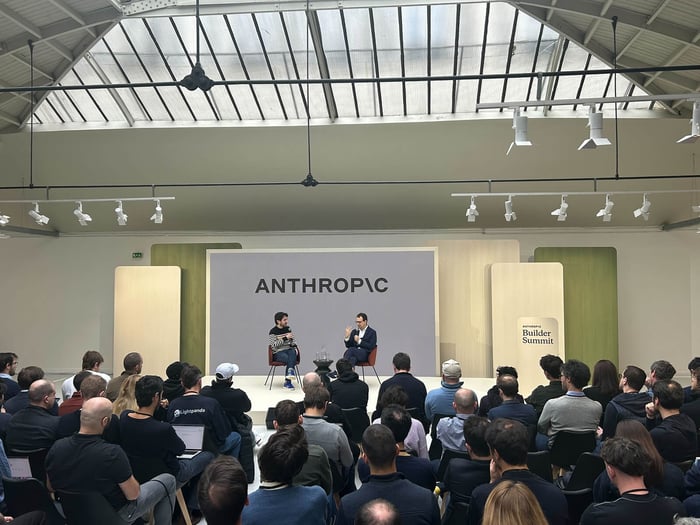
Image source: Anthropic.
AI is advancing at the pace of a rocket blasting off
Anthropic's IPO will be valued at about $1.4 trillion, and its launch will set the tone for how the entire cohort of AI stocks performs afterward. Whether the company's shares subsequently trend upward or downward will depend a lot on how well it can convince investors that Amodei's prediction about the capabilities of AI is in the process of becoming reality. If the narrative is seen as believable, it would justify even larger investments. If it’s viewed as hype intended to raise more capital from credulous investors to earn a higher valuation, a more bearish response could evolve.
As of today, on several benchmarks of carefully scoped problems with verifiable, objective answers, large language models (LLMs) such as those Anthropic develops are already outperforming humans. We know that because Stanford University's AI Index, along with many other organizations, tracks benchmarks used to compare human performance on certain tasks with that of AI models.
So, if you're like many people, and your last exposure to an AI model was seeing it fail to correctly count the number of R's in the word "strawberry" -- a classic and often comedic stumbling block for the generation of AI models from 2023 and 2024 -- it's time to update your mental model, because simple gotchas like that are nearly extinct.
Those results support Amodei's hypothesized trajectory about AI progress compared to human ability. But it's also clear that even the most sophisticated AI models today cannot fully surpass a human worker across the entirety of their job — at least, not yet — even if those models can handle many individual tasks better.
The Remote Labor Index, a benchmark published by the Center for AI Safety (CAIS), tests whether AI agents can deliver contracted work from paid freelance projects to a quality level that a human client would accept. As of July 1, CAIS reported that the top agent in its test set, Anthropic's Claude Fable 5, had its work product accepted in only 15.8% of cases, up from 2.5% eight months earlier. Then, with the launch of Claude Fable 5.2 in November, that figure jumped to upward of 40%.
As you can see, the trend is moving quickly and has maintained roughly the same pace across consecutive new model launches.
Will Anthropic's AI beat almost everyone by 2028?
Anthropic isn't shy about its confidence in its AI models. Its IPO disclosure filing from Oct. 26 explicitly states that the company expects AI models that match or exceed top human experts across professional and scientific fields to be widely available within a few years, and it also plans to extend Claude to work with robotics.
While progress on the robotics front is slower than in software, the point is that with enough computing power and training data, Anthropic's AI will eventually be able to operate robotic limbs to accomplish tasks as effectively as a human can, and then even more effectively after that.
Assume that the Remote Labor Index's top score doubles every eight months, which would be considerably slower than its pace so far. The top score would then near 82.6% by July 2027, putting AI on track to handle most remote work by 2028. If that pace worries you, that's fair, and owning Anthropic stock could be one way to potentially hedge a portion of your downside risk.
Anthropic's revenue for the first nine months of 2026 was $33.2 billion, 13 times its haul in the same period of 2025. But at a valuation of $1.4 trillion, Anthropic stock would be expensive, costing about 21 times its annualized third-quarter sales.
Amodei himself is a wild card, and it is possible that he'll intentionally slow his company's growth in the name of avoiding some kind of AI-generated disaster. That type of development slowdown might not dent its revenue, but it could still weigh on the stock.
As of now, however, it's my assessment that Amodei's prediction is on track to be fulfilled either by 2028 or shortly after.
Missed Nvidia in 2009? This Rare Signal Is Flashing Again
In 2009, a "Double Down" signal flashed for a little-known chipmaker called Nvidia. If you’d invested $5,000 then, you’d be sitting on $2,029,659 today.*
Now, for the first time in years, that same "Total Conviction" signal is flashing for a company 1/100th the size of Nvidia. It’s a key player in the $1.8 trillion space race, and with the stock recently sitting 20% off its highs, the window to get in early is closing fast.
Continue »
*Stock Advisor returns as of November 17, 2026.
The Motley Fool has a disclosure policy.
Recommended Articles


