


Visa and American Express Both Raised Their Dividends 16% This Year, but Only 1 of the Stocks Is Up in 2026
Key Points
While both are large, successful, and have daunting moats, Amex has had its stumbles lately.
Investors haven't forgiven Amex for missing analyst revenue estimates in two consecutive quarters.
- Motley Fool Issues Rare "Total Conviction" Buy Alert ›
Was it coincidence or a keeping-up-with-the-Joneses strategy?
Last month, payment card giant Visa (NYSE:V) announced a 16% dividend raise. That came less than eight months after longtime rival American Express (NYSE:AXP) declared its own 16% hike. And those increases followed a nearly 15% dividend raise trumpeted by their veteran peer Mastercard as 2025 came to a close. Despite the matching 16% bumps, the stock prices of Visa and Amex have traveled in strikingly different directions this year.
Missed Nvidia in 2009? This Rare Signal Is Flashing Again. In 2009, a "Double Down" signal flashed for a little-known chipmaker called Nvidia. For the first time in years, that same "Total Conviction" signal is flashing for a company 1/100th the size of Nvidia. Continue »

Image source: Getty Images.
A tale of two trajectories
To put it briefly, Visa stock is up, and Amex is down; the former has risen by nearly 22% year to date, well higher than the S&P 500 index's 8% gain, while Amex has fallen by almost 14%. For the curious, Mastercard is also in index-beating territory, with a nearly 16% increase. Here's how that looks on a handy graph:
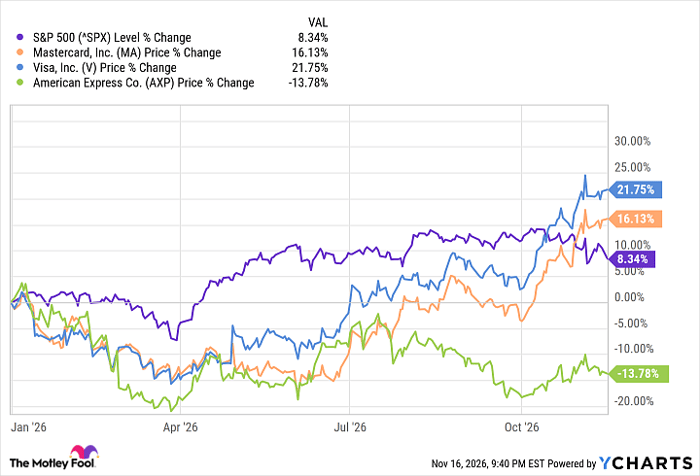
^SPX data by YCharts
One big factor in that divergence is recent quarterly performance. Both Visa and Amex routinely post very healthy growth rates on both the top and bottom lines. After all, paying for basically anything by card -- from snacks to utility bills to large pieces of furniture -- is the rule rather than the exception for consumers these days. Marry that with a still-thriving economy (despite some pull-back due to rising prices), and you've got a fine source of organic growth for payment card companies.
With this, investors expect Visa, Amex, and Mastercard to not only perform well, but to outperform. For the most part, all three deliver... well, at least they did, until Amex's last two reported quarters. In both its second and third frames, it missed -- if only barely -- the consensus analyst estimate for revenue. Technically, the company underperformed, which was a psychological blow to investors.
Amex also struggled to contain expenses; one reason its competitive moat is high is the many perks it offers cardholders through its vaunted Amex Rewards program. These aren't free for the company to provide, plus in our current age where consumers often value experiences over material items, uptake of those goodies has been brisk lately. In the second quarter, total expenses grew by 12% year over year, outpacing the 10% rise in revenue. The subsequent quarter was a wash, with both increasing by 9%. Investors are far more comfortable when revenue growth eclipses spending.
Open versus closed
With Visa, Amex, or Mastercard, it's important to be aware of the difference between an open-loop and closed-loop operator. Visa and Mastercard are the former; this means they act only as facilitators of transactions made on the cards bearing their logos. They extend none of the credit; instead, this is done (typically) by banks or other financial institutions.
Closed-loop operators, exemplified by Amex, span the entire credit card ecosystem. They are both the transaction facilitator and the issuer, so when you swipe with an Amex, the company is also lending you the money.
There are pluses and minuses with each model. Very briefly, I'll sum up my favorite advantages: Open-loopers are asset-light, collecting a tiny percentage of every transaction from their massive volume -- after all, who doesn't have at least one Visa or Mastercard these days? Closed-loop operators, unlike their rivals, don't have to split transaction fees with intermediaries such as issuers. Also, they earn revenue from card fees and the interest charged to folks who don't pay their balances on time.
Two other developments are negatively impacting Amex, as a closed-looper, and benefiting the two others. One is the federal government's long-simmering Credit Card Competition Act (CCCA), which would require large banks to use more than one payment network to process credit card transactions. This means no more exclusivity for Visa or Mastercard, which is currently common industry practice. Closed-loop companies would be exempt from this requirement, to the obvious advantage of Amex.
The fact that this act has essentially gone nowhere in Congress -- despite President Donald Trump promising more than once he'd sign it into law if it's passed -- is a drag on Amex stock and a boon for Visa and Mastercard.
The second of the two developments is the Federal Reserve's interest rate hike in September and, given the persistence of inflation, the possibility that more raises are on the way. Again, Amex acts as an issuer, so it's interest rate sensitive. Yes, it'll earn more revenue from cardholders carrying over balances, but those people could rein in their spending as their APRs rise.
Fantastic plastic
While I believe Visa fully deserves that index-topping rise in its share price, I don't feel Amex is being treated fairly with the decline in its equity.
The latter company -- a longtime favorite of beloved master investor Warren Buffett, by the way -- boasts an enviable set of advantages. Despite having many ambitious competitors, its plastic is still considered to be the most prestigious by many consumers, who are willing to fork over the often high annual "membership fee" for the privilege of holding it. Meanwhile, the average Amex cardholder is relatively affluent and likes using their Centurion or Platinum card to buy things. It's telling that even through lean economies, Amex has usually managed to post healthy top- and bottom-line growth.
On top of that, its dividend yield beats Visa's, at 1.1% versus 0.7%, and its forward P/E is far lower (less than 16 against 28).
I've been bullish on both companies for quite some time, but with Amex's recent downward trajectory, I'd be more inclined to buy that stock than I would Visa.
Should you buy stock in Visa right now?
Before you buy stock in Visa, consider this:
The Motley Fool Stock Advisor analyst team just identified what they believe are the 10 best stocks for investors to buy now… and Visa wasn’t one of them. The 10 stocks that made the cut could produce monster returns in the coming years.
Consider when Netflix made this list on December 17, 2004... if you invested $1,000 at the time of our recommendation, you’d have $335,171!* Or when Nvidia made this list on April 15, 2005... if you invested $1,000 at the time of our recommendation, you’d have $1,000,640!*
Now, it’s worth noting Stock Advisor’s total average return is 823% — a market-crushing outperformance compared to 208% for the S&P 500. Don't miss the latest top 10 list, available with Stock Advisor, and join an investing community built by individual investors for individual investors.
See the 10 stocks »
*Stock Advisor returns as of November 17, 2026.
American Express is an advertising partner of Motley Fool Money. Eric Volkman has no position in any of the stocks mentioned. The Motley Fool has positions in and recommends American Express, Mastercard, and Visa. The Motley Fool has a disclosure policy.
Recommended Articles


