


Nvidia's Ousted CEO Said a 1-Gigawatt Data Center Delay Costs $10 Billion a Quarter. Here's Why That Matters for Power Stocks.
Key Points
AI adoption growth continues unfazed.
Energy remains one of the most promising AI trades.
- 10 stocks we like better than Nvidia ›
Former Nvidia (NASDAQ: NVDA) CEO Jensen Huang repeatedly warned the market about key bottlenecks to AI growth. And it's no wonder. As the world's largest supplier to the AI industry, Nvidia is not only reliant on long-term demand growth for AI technologies but also wants that growth runway to unfold as quickly and smoothly as possible.
Last month, Huang quantified some of the lost economic potential when projects are delayed even just a few months.
Missed Nvidia in 2009? This Rare Signal Is Flashing Again. In 2009, a "Double Down" signal flashed for a little-known chipmaker called Nvidia. For the first time in years, that same "Total Conviction" signal is flashing for a company 1/100th the size of Nvidia. Continue »
To be clear, Huang has come under scrutiny since he made these comments, for reasons completely unrelated to data center costs and Nvidia's potential. Nvidia's board is investigating reports that Huang was targeted by a Chinese spy operation. Nvidia also issued a press release in which Huang admitted to an affair with a former executive at Singapore-based chip company Megaspeed.
On Nov. 12, Huang resigned and is no longer CEO of Nvidia. But it doesn't diminish his expertise in discussing data center costs.
A month ago, Huang outlined the total cost to construct a new 1 GW data center: roughly $50 billion. Such a facility, he claims, could generate around $40 billion in annual revenue. A three-month delay in construction, then, could result in $10 billion in lost revenue potential. Huang stressed how acutely aware the industry is of this lost economic potential, highlighting that "10 billion worth of revenues will make anybody anxious."
There are many reasons why a data center could face delays. Nvidia is looking to clear up some construction hurdles by shifting more of the assembly process to the supply chain rather than on-site workers. This means more data center components will be able to enter operation faster, with fewer potential bottlenecks.
Arguably, the biggest potential bottleneck for AI data construction in the long term, however, has nothing to do with on-site assembly.
Power is the biggest bottleneck to scaling AI data centers
AI adoption rates are through the roof. Experts don't expect the pace of corporate and consumer adoption of AI technologies to slow for years to come. But as a report from McKinsey & Co. pointed out earlier this year, "there are real constraints on growth." Given how energy-intensive data centers are, bringing new energy capacity online will be critical to meeting rising end-market demand for AI technologies.
"Incumbents can't meet demand for power," observes McKinsey & Co. The global consultancy isn't the only group concerned with AI's desperate need for more energy. "One of the clearest constraints on the AI build-out is energy," Morgan Stanley warns. "Power is emerging as the binding constraint of the AI build-out," J.P. Morgan adds. "A lack of capital is not the most pressing bottleneck for AI progress -- it's the power needed to fuel it," confirms Goldman Sachs.
Without more power, the pace and scale of the data center build-out will almost certainly be constrained, costing AI companies heavily in lost revenue potential.
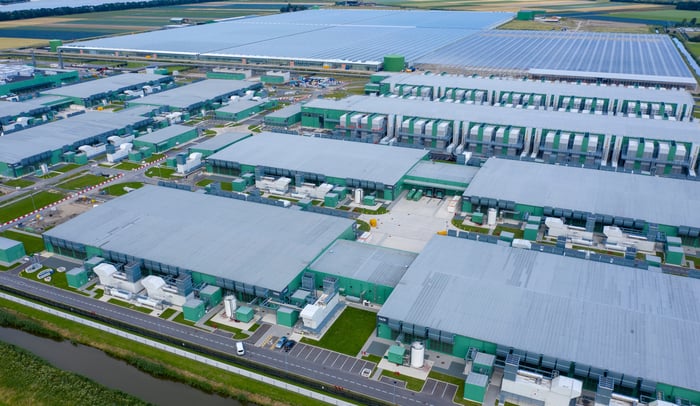
Image source: Getty Images.
How should investors position their portfolio with the AI industry's desperate need for more energy in mind? There are two approaches.
The first is to expose your portfolio to next-gen energy companies such as NuScale Power (NYSE: SMR) and Oklo Inc. (NYSE: OKLO). These firms specialize in small modular reactors, or SMRs. At least in theory, SMRs can be built faster with lower upfront capital needs than conventional nuclear power plants. That's a benefit for AI companies looking to scale quickly and affordably. Only a handful of SMR systems have ever been successfully commercialized; however, this makes these stocks more of a high-risk, high-upside-potential investment.
A more risk-conscious investment would be a company like Constellation Energy (NASDAQ: CEG) or Bloom Energy Corp. (NYSE: BE).
Constellation is already one of the largest nuclear energy producers in the U.S. By expanding existing facilities and restarting older plants, It has significantly increased its ability to generate nuclear power, signing power purchase agreements with several major AI operators.
Bloom, meanwhile, develops solid oxide fuel cell systems that convert natural gas, biogas, or hydrogen into electricity. These systems allow data centers to generate their own power, minimizing reliance on the grid. Sales growth is expected to exceed 100% this year, with economies of scale contributing to healthy profit growth.
While most AI investors are focused on AI stocks, exposure to the AI economy can be gained at a lower premium by investing strategically in power stocks.
Should you buy stock in Nvidia right now?
Before you buy stock in Nvidia, consider this:
The Motley Fool Stock Advisor analyst team just identified what they believe are the 10 best stocks for investors to buy now… and Nvidia wasn’t one of them. The 10 stocks that made the cut could produce monster returns in the coming years.
Consider when Netflix made this list on December 17, 2004... if you invested $1,000 at the time of our recommendation, you’d have $335,171!* Or when Nvidia made this list on April 15, 2005... if you invested $1,000 at the time of our recommendation, you’d have $1,000,640!*
Now, it’s worth noting Stock Advisor’s total average return is 823% — a market-crushing outperformance compared to 208% for the S&P 500. Don't miss the latest top 10 list, available with Stock Advisor, and join an investing community built by individual investors for individual investors.
See the 10 stocks »
*Stock Advisor returns as of November 14, 2026.
JPMorgan Chase is an advertising partner of Motley Fool Money. Ryan Vanzo has no position in any of the stocks mentioned. The Motley Fool has positions in and recommends Bloom Energy, Constellation Energy, Goldman Sachs Group, JPMorgan Chase, and Nvidia. The Motley Fool has a disclosure policy.
Recommended Articles


