


Micron's Chinese Rival CXMT Just Grew Its Sales More Than Sevenfold. I'd Buy Micron Stock Now.
Key Points
CXMT's third-quarter revenue climbed 613% year over year to around 118.7 billion yuan.
Micron's fiscal fourth-quarter revenue of $54.2 billion was about three times CXMT's latest quarter.
CXMT plans to release server memory modules based on a new chip design by the end of 2026.
- Motley Fool Issues Rare "Total Conviction" Buy Alert ›
Shares of memory chipmaker Micron Technology (NASDAQ:MU) have seen a tough few months. At around $892 as I write, the stock's down about 26% from its late-June record close.
Then, on Oct. 30, China's largest maker of DRAM (dynamic random-access memory, the chips that store data when a phone, PC, or server is running) posted results that are hard to ignore. ChangXin Memory Technologies (SHSE:688825), better known as CXMT, said its third-quarter revenue climbed 613% year over year to around 118.7 billion yuan (about $18 billion). In other words, it sold over seven times as much as it did in the same quarter in 2025.
Missed Nvidia in 2009? This Rare Signal Is Flashing Again. In 2009, a "Double Down" signal flashed for a little-known chipmaker called Nvidia. For the first time in years, that same "Total Conviction" signal is flashing for a company 1/100th the size of Nvidia. Continue »
A rival growing so fast in DRAM deserves attention. But I think CXMT's report says more about memory prices than about Micron's future, and it doesn't change my view that Micron stock is a buy.
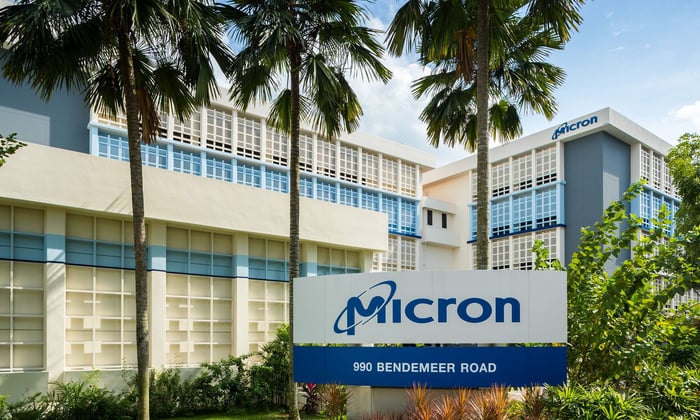
Image source: Micron.
CXMT's surge is mainly about prices
CXMT gave a simple reason for the jump. It linked the growth to a global DRAM shortage, which lifted both the number of chips it sold and the prices it got for them.
Showing how much of this comes down to pricing, CXMT's gross margin hit around 89.5% in the third quarter, up about 2 percentage points from the second quarter. Net profit attributable to shareholders was around 54.4 billion yuan (about $8 billion), against a loss a year before. Notably, the pace is slowing. Revenue grew around 19% from the second quarter, after almost doubling from the first quarter to the second.
The same shortage is boosting Micron's results, of course. In the fiscal fourth quarter of 2026 (the period ended Sept. 3), Micron's gross margin was 86.8% -- up from 44.7% in the same quarter of fiscal 2025. When even a far smaller rival reports margins like these, it's arguably a sign that memory prices are still high across the industry.
The size gap
Even after its sevenfold jump, CXMT's last quarter was only about a third the size of Micron's. The U.S. memory maker's revenue hit $54.2 billion for its fiscal fourth quarter, and management expects about $61.5 billion for this quarter.
Industry tracker TrendForce estimated that CXMT's share of global DRAM revenue rose to 9.5% in the second quarter, up from 7.6% in the first. Micron's share was 23.3%.
CXMT also doesn't yet compete much where Micron is growing fastest. The Chinese company has traditionally focused on consumer electronics. Its server memory modules based on a new, denser chip design are planned for launch by the end of 2026.
Micron, though, now gets most of its sales from data centers. Its cloud memory and core data center units together took in about $34.3 billion for fiscal Q4, or about 63% of revenue, up from about 54% a year before. What's more, the core data center unit alone grew 56% from the fiscal third quarter. The part of Micron that looks most like CXMT is its mobile and client unit, which sells memory for phones and PCs. Revenue there hit $13.1 billion for fiscal Q4, 14% more than in the fiscal third quarter.
That's still a big business, and it's likely where Micron might feel Chinese competition first.
Still a buy?
The bigger risk is the capacity CXMT can now afford to add. It credited its own capacity build-out with some of its growth. And after selling new shares in a public offering during the quarter, it finished September with around 285 billion yuan (about $43 billion) in cash.
Micron, which had about $73.5 billion in cash and marketable investments at the end of its fiscal year, sees the threat, too. In its last annual report, it warned about "increasing competition and DRAM and NAND oversupply" linked to heavy investment by the Chinese government and state-affiliated firms like CXMT.
Memory booms tend to end when new supply arrives, and a well-funded rival might make that ending come sooner.
Micron's stock price, however, seems to reflect much of that risk already. Micron earned $74.33 per share in fiscal 2026, so the stock trades at around 12 times earnings -- even though management expects revenue to keep climbing this quarter. Investors look to be bracing for profits to shrink.
Yes, CXMT might take more of the market for phone and PC memory over time, and Micron's margins likely won't stay around 87% forever. But for now, CXMT's report points to a shortage that's still lifting prices for both companies.
I'd buy Micron stock at today's price. I'd just consider building a position bit by bit, because memory prices can turn fast.
Should you buy stock in Micron Technology right now?
Before you buy stock in Micron Technology, consider this:
The Motley Fool Stock Advisor analyst team just identified what they believe are the 10 best stocks for investors to buy now… and Micron Technology wasn’t one of them. The 10 stocks that made the cut could produce monster returns in the coming years.
Consider when Netflix made this list on December 17, 2004... if you invested $1,000 at the time of our recommendation, you’d have $334,793!* Or when Nvidia made this list on April 15, 2005... if you invested $1,000 at the time of our recommendation, you’d have $1,257,420!*
Now, it’s worth noting Stock Advisor’s total average return is 874% — a market-crushing outperformance compared to 209% for the S&P 500. Don't miss the latest top 10 list, available with Stock Advisor, and join an investing community built by individual investors for individual investors.
See the 10 stocks »
*Stock Advisor returns as of October 31, 2026.
Daniel Sparks and his clients do not have positions in any of the stocks mentioned. The Motley Fool has positions in and recommends Micron Technology. The Motley Fool has a disclosure policy.
Recommended Articles


