


President Donald Trump Claims, "Tariffs Are Making Us Much Richer," but Economists Show They Have Unintended Consequences
Key Points
The Dow Jones Industrial Average, S&P 500, and Nasdaq Composite have delivered well-above-average returns with Donald Trump in the White House.
Tariffs are a foundational part of Trump’s economic plan, and they’re projected to bring in more than $1.4 trillion in revenue over the next decade.
Unfortunately, several reports suggest that Trump’s tariffs are doing more harm than good.
- Motley Fool Issues Rare "Total Conviction" Buy Alert ›
President Donald Trump has been in the White House for nearly six years, spanning two nonconsecutive terms. Over that time, the iconic Dow Jones Industrial Average (DJINDICES:^DJI), benchmark S&P 500 (SNPINDEX:^GSPC), and growth-dependent Nasdaq Composite (NASDAQINDEX:^IXIC) have delivered well-above-average annual returns, compared to most other presidents since the late 1890s.
One of the key catalysts powering Wall Street's bull market, the artificial intelligence (AI) infrastructure build-out, was well underway before Trump's second term began. But make no mistake about it: Wall Street and investors have also benefited immensely from the president's Tax Cuts and Jobs Act (signed into law in December 2017), which lowered the peak marginal corporate income tax rate to 21% (the lowest rate since 1939), fueling record S&P 500 share buybacks.
Missed AI’s "Act 1"? Act 2 Could Be 15x Bigger. Most investors think they missed the AI boat because they didn't buy Nvidia in 2005. But according to our analysts, we’re only at the end of "Act 1"—the R&D phase. "Act 2" is the global rollout. Continue »
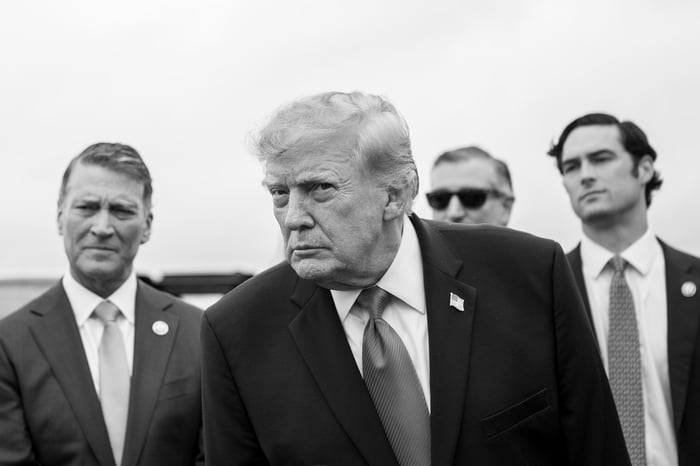
President Trump's tariff and trade policy may be doing more harm than good. Image source: Official White House Photo by Molly Riley.
President Trump has also made tariffs a huge part of his economic growth plan. Said Trump,
Tariffs are my favorite word. They're going to make America rich. It's making us much richer than we ever thought. We're taking in trillions of dollars.
While the projection for tariff revenue has, indeed, soared over the next decade, Trump's tariffs also come with an assortment of unintended consequences, according to economists.
President Trump is leaning heavily on tariffs
Although we've been hearing a lot about tariffs during Trump's second term, they've been a theme throughout his presidency. In 2018, the president imposed tariffs on an assortment of goods from China, sparking a trade war.
In early April 2025, Donald Trump unveiled his "Liberation Day" tariffs, consisting of a sweeping global duty and higher reciprocal tariffs on dozens of countries deemed to have unfavorable trade imbalances with America. These tariffs remained in place until the U.S. Supreme Court struck them down in a February 2026 ruling.
Trump: Tariffs are making us much richer than we ever thought—we're taking in trillions of dollars https://t.co/LJFdqsx5Cv
— Acyn (@Acyn) September 10, 2026
The president's newest round of tariffs was announced in late July, featuring a 10% to 12.5% sweeping duty on most imports from over 80 countries.
The purpose of these tariffs is threefold:
- To protect American jobs
- To encourage overseas companies to manufacture goods bound for the U.S. in this country
- To make U.S.-made products more price-competitive with those imported
According to Washington, D.C.-based think tank The Tax Foundation, which has been regularly updating its Tax Foundation General Equilibrium Model to account for dozens of tariff changes since April 2025, the president's tariffs are projected to bring in $1.426 trillion in revenue from 2026 to 2035. While it's not the "trillions of dollars" Trump proclaimed the U.S. was bringing in from tariffs, there is a path to significant revenue collection over the next decade.
Unfortunately, economists have also shown that President Trump's tariff and trade policy comes with several unintended and undesirable consequences.

Image source: Getty Images.
Trump's tariffs are potentially bad news for consumers, the economy, and Wall Street
To begin with, The Tax Foundation's model estimates that hours worked would convert to a loss of 338,000 full-time-equivalent jobs. Furthermore, it projects that U.S. gross domestic product (GDP) would decline by 0.4%. In other words, The Tax Foundation foresees the president's tariffs hindering, not helping, the U.S. economy over the next decade.
But these long-term projections might be the least of consumers' and Wall Street's worries.
According to a newly released report ("How Fast Do Tariffs Pass Through into Consumer Prices") by three New York Federal Reserve economists writing for Liberty Street Economics, the president's tariffs are having a decisively negative impact on consumer prices.
The trio of economists estimate that the president's 2025 tariffs added 2.9 percentage points to consumer prices by February 2026. The real kick in the pants is that prices would have declined without Trump's tariffs.
New from the New York Fed: "By February 2026, tariffs had contributed 2.9 pp to goods price inflation, and without them goods prices would have fallen slightly." About one quarter of every point in higher tariff rates shows up in consumer prices within one year. • A 10% across-the-board tariff yields a 2.6% rise in consumer goods prices after one year. • About two thirds of the increase comes from pricier imports, which get passed through quickly. • Another third comes from U.S. made goods, as producers face higher input costs and less import competition. This takes longer, about 6-12 months, to filter through.
— Nick Timiraos (@NickTimiraos) October 6, 2026
In addition to tariffs adding to consumer costs on a near one-for-one basis, assigning duties to unfinished imported goods, such as steel, can increase domestic manufacturing costs. Furthermore, economists suggest that when U.S. goods were notably cheaper than imported products, domestic producers would occasionally raise their prices to capture some of this difference.
In December 2024, a separate report from Liberty Street Economics ("Do Input Tariffs Protect U.S. Firms?") found that Trump's 2018 China tariffs increased consumer prices and led to worse future real outcomes for public companies whose stock declined on tariff announcement days. Specifically, these businesses witnessed drop-offs in labor productivity, employment, sales, and profits from 2019 to 2021.
What's especially damning for Wall Street is the effect tariffs are having on the prevailing inflation rate. Although tariffs are one of several puzzle pieces boosting consumer prices, they've also played a role in prompting the Federal Reserve to act. In September, the Federal Open Market Committee (FOMC) kicked off only its fourth rate-hiking cycle of the 21st century.
Between the inflationary effects of the Iran war, the AI infrastructure build-out, and Trump's tariff and trade policy, it's likely that the FOMC will get more aggressive with interest rate hikes in 2027 to deliver price stability. If this happens, it could slow the partially debt-driven AI data center build-out. A historically pricey stock market can ill afford any slowdown from its leading catalyst.
While Trump's tariffs are on track to bring in well over $1 trillion in revenue for the U.S. government over the next decade, their cost to consumers, the U.S. economy, and Wall Street may be far greater.
Should you buy stock in S&P 500 Index right now?
Before you buy stock in S&P 500 Index, consider this:
The Motley Fool Stock Advisor analyst team just identified what they believe are the 10 best stocks for investors to buy now… and S&P 500 Index wasn’t one of them. The 10 stocks that made the cut could produce monster returns in the coming years.
Consider when Netflix made this list on December 17, 2004... if you invested $1,000 at the time of our recommendation, you’d have $334,631!* Or when Nvidia made this list on April 15, 2005... if you invested $1,000 at the time of our recommendation, you’d have $1,312,844!*
Now, it’s worth noting Stock Advisor’s total average return is 893% — a market-crushing outperformance compared to 213% for the S&P 500. Don't miss the latest top 10 list, available with Stock Advisor, and join an investing community built by individual investors for individual investors.
See the 10 stocks »
*Stock Advisor returns as of October 31, 2026.
Sean Williams has no position in any of the stocks mentioned. The Motley Fool has no position in any of the stocks mentioned. The Motley Fool has a disclosure policy.
Recommended Articles


