


Warren Buffett’s Blunt Warning to Wall Street Has Reached Deafening Levels. Here’s the 1 Move You Should Make Now.
Key Points
Warren Buffett delivered six decades of market-beating gains as CEO of Berkshire Hathaway.
Today, after retiring, he remains chairman emeritus -- and continues to offer investors investing inspiration.
- 10 stocks we like better than S&P 500 Index ›
Investors listen closely to the words of Warren Buffett because he's proven his deep understanding of the stock market over time. The billionaire, at the helm of Berkshire Hathaway for 60 years, led the holding company to market-beating gains over that period by focusing on buying quality companies at reasonable prices and holding them for the long term. Buffett retired at the start of this year but remains involved in the company as chairman emeritus.
Over the past few years, Buffett has delivered a significant warning to Wall Street as the S&P 500 has progressively climbed through this bull market to reach multiple record highs. The warning has come in a few forms, from actions to words. For example, Berkshire Hathaway was a net seller of stocks for 14 straight quarters through the second quarter of this year. And in recent months, Buffett's warning reached deafening levels. Let's zoom in for a close look -- and consider the one move you should make now.
Missed AI’s "Act 1"? Act 2 Could Be 15x Bigger. Most investors think they missed the AI boat because they didn't buy Nvidia in 2005. But according to our analysts, we’re only at the end of "Act 1"—the R&D phase. "Act 2" is the global rollout. Continue »

Warren Buffett. Image source: The Motley Fool.
The S&P 500's performance in recent years
So, first, let's take a look at what's happened in the stock market over the past few years. The artificial intelligence (AI) boom clearly has been driving this momentum, as many of the biggest AI stocks -- from Nvidia to Microsoft -- are heavily weighted in the S&P 500. Investors have jumped into the space, pushing these stocks to double- and triple-digit gains, on optimism about the power of AI to transform the way businesses operate and, as a result, favor corporate earnings growth.
But this rush into AI stocks and other growth players also pushed valuations higher, and the S&P 500 Shiller CAPE ratio shows that stocks are trading at a historically high level -- in the past, when this has happened, declines have followed.
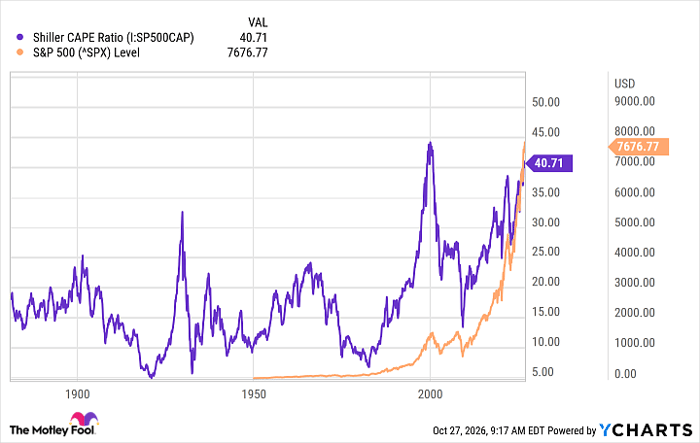
Shiller CAPE Ratio data by YCharts
Meanwhile, the current economic situation, with higher inflation and potentially another interest rate hike on the horizon to tame it, isn't supportive of positive stock market performance. And investors have worried that tech giants' enormous investment in AI infrastructure may not bear as much fruit as expected.
Though the S&P 500 and AI stocks have felt some downward pressure due to these concerns, overall, they have continued to climb. The S&P 500 is heading for a 12% increase this year, after a 78% gain over the past three years.
Buffett speaks about the "gambling" in the stock market
Now, let's consider Buffett's warning to Wall Street. This time, it came in the form of words at Berkshire Hathaway's shareholders' meeting in May. Speaking to CNBC, Buffett said that "gambling" in the market has reached a peak.
"We've never had people in a more gambling mood than now," he said, referring to individuals favoring a quick gain, often in the short-term options or predictions markets.
This, along with the high valuations of stocks right now, set against general economic concerns, could result in declines ahead.
So, should you really invest in this environment? It's important to remember that Buffett has always opted for long-term investing, and he's never sold off his positions just because the general market backdrop seemed unfavorable. Instead, Buffett has remained loyal to his investing principles regardless of the market environment -- and that means holding onto his stocks through tough market times.
What investors should do now
With this in mind, the one move you should make now is the same: You should hold onto quality stocks even through today's uncertainties and through any potential downturn. It's a mistake to panic-sell when times are tough for two reasons. First, you may lose money on the investment, or, if you've held for a short period and profited, you might face a heavier tax burden than if you had sold after a number of years.
Second, you might miss out on the stock's potentially strong long-term performance. While it may fall today or in the coming months, over time, this tough period may be just a detail — with gains far overshadowing the declines.
So, even though Buffett's words may be seen as a warning to Wall Street about excessive exuberance and gambling, there's still reason to be optimistic about your portfolio. If you make the important move of committing to long-term investing, you're likely to score a win — just like Buffett.
Should you buy stock in S&P 500 Index right now?
Before you buy stock in S&P 500 Index, consider this:
The Motley Fool Stock Advisor analyst team just identified what they believe are the 10 best stocks for investors to buy now… and S&P 500 Index wasn’t one of them. The 10 stocks that made the cut could produce monster returns in the coming years.
Consider when Netflix made this list on December 17, 2004... if you invested $1,000 at the time of our recommendation, you’d have $344,608!* Or when Nvidia made this list on April 15, 2005... if you invested $1,000 at the time of our recommendation, you’d have $1,327,222!*
Now, it’s worth noting Stock Advisor’s total average return is 904% — a market-crushing outperformance compared to 211% for the S&P 500. Don't miss the latest top 10 list, available with Stock Advisor, and join an investing community built by individual investors for individual investors.
See the 10 stocks »
*Stock Advisor returns as of October 28, 2026.
Adria Cimino has no position in any of the stocks mentioned. The Motley Fool has positions in and recommends Berkshire Hathaway, Microsoft, and Nvidia. The Motley Fool has a disclosure policy.
Recommended Articles


