




AMD Extends Five-Day Slump Below $400, Faces Risk of Over 30% Drop
TradingKey - AMD breaks below the $400 mark, facing over 30% downside risk after a five-day losing streak.
On November 25, Eastern Time, Advanced Micro Devices (AMD) extended its multi-day slump, falling another 6.6% in pre-market trading today to break below the $400 threshold again, trading at around $386. Over the past five trading sessions, AMD's stock price has continued its descent, tumbling more than 23% cumulatively and severely denting investor bullish sentiment. The market has grown wary that if buyers fail to swiftly reclaim the $400 defense line, the stock could face the risk of a deep 30% pullback, potentially testing the $270–$300 range.
AMD's recent stock decline has been driven by multiple factors, beginning with broad-based volatility across the semiconductor sector and anxieties over a potential peak in AI capital expenditures. Since November, U.S. chip stocks have experienced extreme volatility, with Nvidia (NVDA) management changes and the dramatic twist of Jensen Huang returning as CEO triggering sector-wide swings. Furthermore, market concerns over whether cloud hyperscalers will slow the growth of their AI capital expenditures, alongside rising memory prices and shortages squeezing the PC and server supply chains, have all exerted valuation compression pressure on high-beta chip stocks.
In mid-to-late November, newer AMD firmware was discovered in products from Inspur Information, a Chinese server manufacturer on the U.S. Department of Commerce's Entity List, sparking market concerns over U.S. export control compliance and potential regulatory investigations. In addition, intensifying congressional discussions over the approval of AI chip export licenses to China have prompted short-term investors to question the company's fourth-quarter revenue guidance of approximately $17 billion and the ramp-up pace of Helios racks.
Another contributing factor is that AMD's potential resale registration filing sparked concerns over equity dilution and share overhang. On November 23, AMD filed a prospectus covering the registration for the potential future resale by certain shareholders of up to approximately 336.9 million shares (representing about 20.5% of the company's equity). Although AMD is not issuing new shares to raise capital through this filing and will not receive any proceeds from the resale, and certain terms had already been known to the market since the OpenAI partnership in October 2025, it has nevertheless exacerbated short-term sensitivity regarding share supply and dilution amid highly volatile market conditions.
In the short term, AMD is in a tug-of-war where fundamentals and long-term AI secular themes remain expanding, but near-term technicals are weak, and policy and macroeconomic noise persist. If hawkish inflation data stokes tightening expectations, if broad semiconductor and AI computing stocks continue to face institutional trimming, or if a new wave of regulatory and media scrutiny emerges over China export compliance, AMD's stock price could test lower support zones, closing in on the $300 round number, or even sink under extreme deleveraging toward the $270 support level—a level converted from late-2025 support.
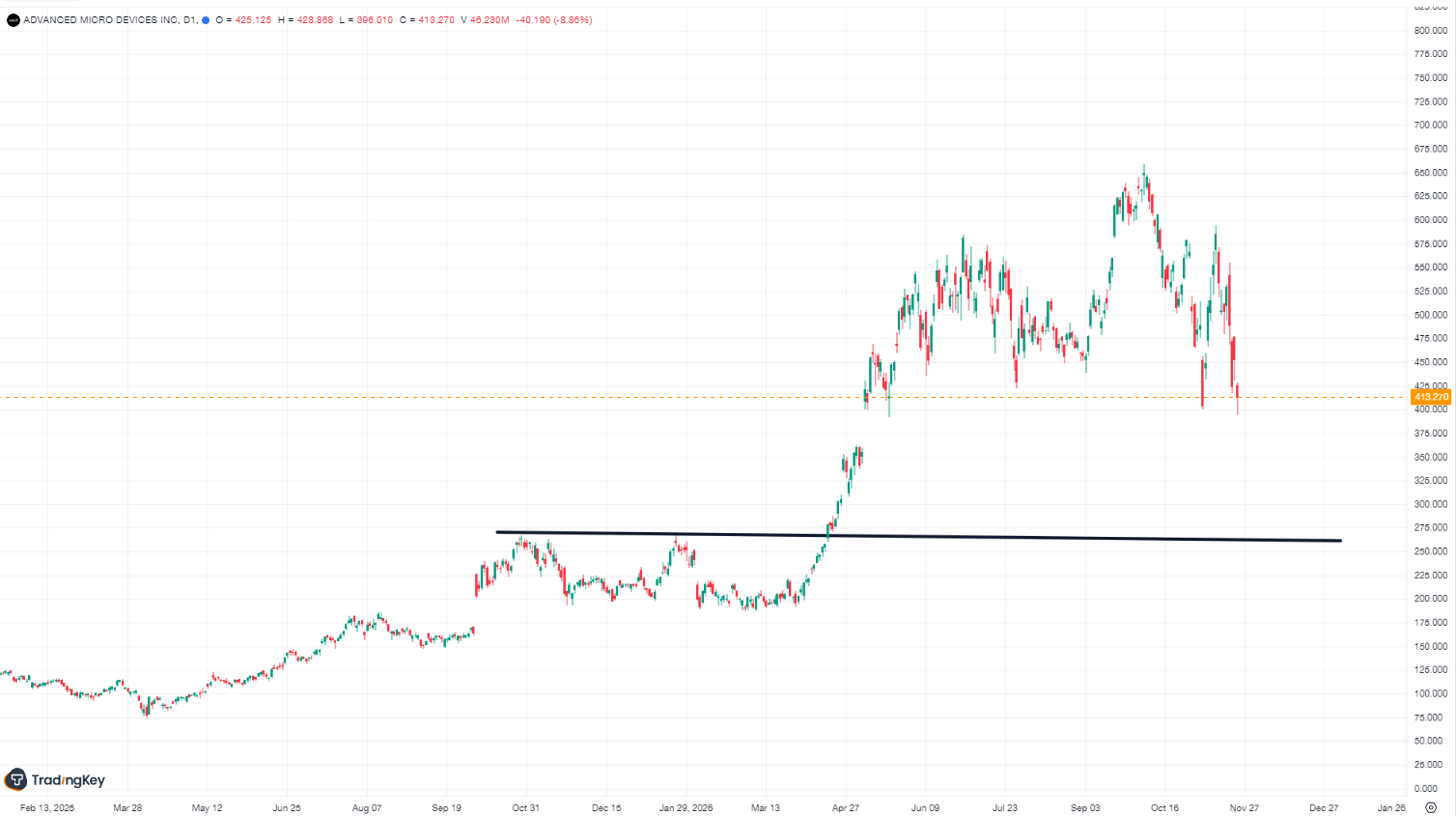 AMD stock chart (daily), Source: TradingKey
Conversely, if October PCE inflation data shows no unexpected jump, U.S. Treasury yields stabilize, and export control concerns do not worsen further, AMD's stock price will likely absorb selling pressure within the $383–$415 range, stage a rebound powered by weekly oversold momentum, and retest the $420–$460 resistance band.
Recommended Articles


