




Wall Street Is Ignoring Bristol Myers Squibb's Cash Machine -- and That's an Opportunity for Income Investors
Key Points
The average pharmaceutical stock yields 1.4%, while Bristol Myers Squibb yields 4%.
Bristol Myers Squibb is working through a transition period as older drugs lose patent protection.
The drug maker's "growth" products are gaining traction.
- 10 stocks we like better than Bristol Myers Squibb ›
Bristol Myers Squibb (NYSE: BMY) traces its history back to the mid-1800s. It is a proven survivor in the highly competitive and innovation-driven pharmaceutical sector. That can't save the company from the normal dynamics of the drug industry, as it works through a period of elevated patent expirations. Investor concerns about patent expirations, however, have turned the company into a dividend machine, yielding 4%. The average pharma stock yields just 1.4%.
Here's why Bristol Myers Squibb could be a buying opportunity for long-term income investors. And it all boils down to the success of the company's "growth portfolio," which is increasingly powering its cash flow.
Missed AI’s "Act 1"? Act 2 Could Be 15x Bigger. Most investors think they missed the AI boat because they didn't buy Nvidia in 2005. But according to our analysts, we’re only at the end of "Act 1"—the R&D phase. "Act 2" is the global rollout. Continue »

Image source: Getty Images.
Bristol Myers Squibb's troubles are entirely normal
The pharmaceutical sector follows a normal cycle that every company goes through. To simplify it, a company invests heavily in research and development to identify and secure approval for new drugs; the drugs have strong sales during a period of patent exclusivity; and then sales fall off when the patent expires and generic competition enters the market.
Investors inevitably get worried when patent expirations come up, because it means revenues are going to come under pressure. Right now, Bristol Myers Squibb has some big patent expirations on the horizon, and the stock's price has been relatively weak. However, dividend investors need to put this situation into perspective. The healthcare giant still has a well-covered dividend, highlighted by a 55% trailing 12-month payout ratio in the third quarter.
And revenues from what the company calls its "legacy portfolio" aren't exactly falling off a cliff just yet. In the third quarter, sales from this collection of drugs rose 1%. These drugs represent just over 40% of revenues. The other 60% is the cash flow machine you want to watch.
The "growth portfolio" is doing well
In the third quarter, the drugs Bristol Myers Squibb puts in its "growth portfolio" generated 12% revenue growth. The list of drugs here includes Opdivo Qvantig, Breyanzi, Reblozyl, Camzyos, and Opdualag. Don't worry too much about the names; just note that it is a fairly long list. This isn't a one-trick pony business. Bristol Myers Squibb is a respected, diversified industry giant with a long and successful history in drug development. And it is already seeing material success on that front.
To be fair, investors aren't exactly ignoring this fact. As the chart below highlights, the stock is up from its lows, and the dividend yield isn't as attractive as it was when it was roughly 6%. Still, the yield is well above the market average and that of the average pharma stock, so there's a very good reason for dividend investors to jump on this cash-flow machine.
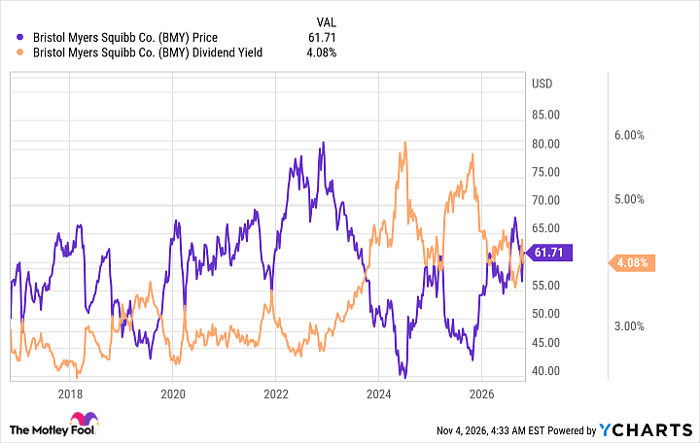
BMY data by YCharts
The 40% of revenues that fall into the "legacy portfolio" is a problem. And investors need to monitor what's going on with that portfolio. However, it is entirely normal for drugs to become less profitable as generic competition enters the market. So Bristol Myers Squibb is just working through a transition period that it has worked through many times before. If history is any guide, it will survive this period in relative stride.
Bristol Myers Squibb's problem boils down to one drug
All of that said, the real issue for Bristol Myers Squibb is the drug Eliquis, which had sales of nearly $4.7 billion in the third quarter. It accounts for most of the company's $5.4 billion of "legacy portfolio" revenues. It will be a big hit when this drug loses patent protection, and there's a lot riding on finding a replacement.
But the "growth portfolio", which generates revenues of $7.6 billion, includes a dozen drugs, and revenue growth across the group has been strong. If you recognize the cash flow machine that's building in this portfolio, you might find Bristol Myers Squibb and its above-average yield an attractive addition to your passive income portfolio.
Should you buy stock in Bristol Myers Squibb right now?
Before you buy stock in Bristol Myers Squibb, consider this:
The Motley Fool Stock Advisor analyst team just identified what they believe are the 10 best stocks for investors to buy now… and Bristol Myers Squibb wasn’t one of them. The 10 stocks that made the cut could produce monster returns in the coming years.
Consider when Netflix made this list on December 17, 2004... if you invested $1,000 at the time of our recommendation, you’d have $341,966!* Or when Nvidia made this list on April 15, 2005... if you invested $1,000 at the time of our recommendation, you’d have $1,146,819!*
Now, it’s worth noting Stock Advisor’s total average return is 852% — a market-crushing outperformance compared to 203% for the S&P 500. Don't miss the latest top 10 list, available with Stock Advisor, and join an investing community built by individual investors for individual investors.
See the 10 stocks »
*Stock Advisor returns as of November 7, 2026.
Reuben Gregg Brewer has no position in any of the stocks mentioned. The Motley Fool has positions in and recommends Bristol Myers Squibb. The Motley Fool has a disclosure policy.
Recommended Articles


