




I've Held Microsoft for 10 Years. Here's Why I'm Not Selling a Single Share.
Key Points
Microsoft is as diversified a tech company as you'll find, with billions using its software and hardware.
Microsoft remains one of the most profitable and highest-revenue-generating companies in the world.
Microsoft Azure reached $100 billion in revenue for the first time in Microsoft's recent fiscal year.
- 10 stocks we like better than Microsoft ›
When you're investing, you should always do so with a long-term mindset. People don't always want to hear this, but it's about gradually building wealth over time, not searching for a get-rich-quick scheme. It's easier said than done, but one of the best ways to do it is to hold onto great companies for the long haul.
One of my longest holdings is Microsoft (NASDAQ: MSFT), which I bought just over 10 years ago. It's been a lucrative rollercoaster ride, and despite its underperformance this year, it's a stock I haven't even considered selling.
Missed Nvidia in 2009? This Rare Signal Is Flashing Again. In 2009, a "Double Down" signal flashed for a little-known chipmaker called Nvidia. For the first time in years, that same "Total Conviction" signal is flashing for a company 1/100th the size of Nvidia. Continue »
My reason? It's the tech sector's Swiss Army knife.
Microsoft has its hands in many jars
Few companies are as diversified as Microsoft, especially in the tech world. It has a strong case for being the most diversified tech company in the world, with tons of software and hardware, the world's second-largest cloud platform (Azure), Xbox, LinkedIn, and more.
Over a billion people use various Microsoft products and services, making it one of the most relied-upon tech companies in the world. That doesn't guarantee success, but it's one of the surest ways to accomplish sustained success, which Microsoft has shown us.
The number of users Microsoft has matters, but I like looking closer at how many of those users are other businesses. Microsoft is extremely important to the global business world. And when companies hit rough times, you can bet they'll cut many expenses before cutting enterprise software like Microsoft 365 (Excel, Teams, Outlook, etc.), Azure, or Windows.
Microsoft is a certified cash machine
It's not all that matters in every situation, but I have always preferred cash machines. Microsoft easily checks that box.
In its fiscal year 2026 (ended June 30), it made $331.8 billion in revenue, $155.2 billion in operating income (profit from its core businesses), and $133.7 billion in net income. Year over year (YoY), those were up 18%, 21%, and 31%, respectively. Over the past decade, all three have grown impressively for a company of Microsoft's size.
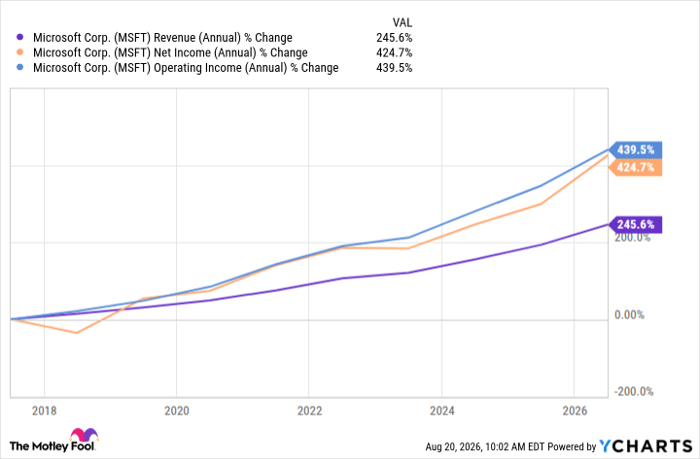
MSFT Revenue (Annual) data by YCharts
The financial flexibility Microsoft has, given how much money it makes, allows it to pay dividends, buy back shares, and reinvest in the company to keep growing and keep up with the rapidly changing tech world. It has consistently done so, too.
Microsoft has increased its annual dividend for 21 straight years and spent $22.3 billion on share repurchases and $145 billion on capital expenditures in the past fiscal year.
AI spending is being put to good use
There were many concerns at the beginning of this year about Microsoft's AI spending plans, but my stance was that, with as much money as Microsoft has and makes, it's better to overspend to ensure you keep up with the AI arms race than underspend and risk falling behind in what many are considering one of the most important tech revolutions since the internet.
Microsoft has spent a lot, no doubt ($41 billion in the latest quarter, up 70% YoY), but its recent earnings show a much clearer return on investment than investors may have expected earlier in the year. It's why its stock is up over 23% since reporting its latest earnings (as of Aug. 20).

Image source: The Motley Fool.
One of the best ways to measure the return on investment from AI spending is to look at cloud and Azure performance, since that's where businesses invest in AI tools. This fiscal year, Azure reached $100 billion in revenue for the first time, total Microsoft Cloud revenue increased 27% YoY to $214 billion, and its backlog grew 84% YoY to $678 billion.
How the AI boom eventually pans out remains to be seen, but one thing is for sure: Microsoft's business is built to thrive with or without the AI windfall. That's why it's one of my largest holdings, and why I don't plan to sell a single Microsoft share for the foreseeable future.
Should you buy stock in Microsoft right now?
Before you buy stock in Microsoft, consider this:
The Motley Fool Stock Advisor analyst team just identified what they believe are the 10 best stocks for investors to buy now… and Microsoft wasn’t one of them. The 10 stocks that made the cut could produce monster returns in the coming years.
Consider when Netflix made this list on December 17, 2004... if you invested $1,000 at the time of our recommendation, you’d have $429,223!* Or when Nvidia made this list on April 15, 2005... if you invested $1,000 at the time of our recommendation, you’d have $1,318,055!*
Now, it’s worth noting Stock Advisor’s total average return is 965% — a market-crushing outperformance compared to 212% for the S&P 500. Don't miss the latest top 10 list, available with Stock Advisor, and join an investing community built by individual investors for individual investors.
See the 10 stocks »
*Stock Advisor returns as of August 22, 2026.
Stefon Walters has positions in Microsoft. The Motley Fool has positions in and recommends Microsoft. The Motley Fool has a disclosure policy.
Recommended Articles


