




Billionaire David Tepper Sold His Fund's Sandisk Stake in Favor of This Trillion-Dollar Artificial Intelligence (AI) Chip Stock
Key Points
Sandisk has emerged as one of the market's top-performing semiconductor stocks this year.
While memory and storage remain crucial for AI infrastructure, Broadcom may offer better long-term upside.
It designs custom accelerators for hyperscalers and is on pace to generate more than $100 billion in AI revenue.
- 10 stocks we like better than Broadcom ›
As founder of the hedge fund company Appaloosa Management, David Tepper has built a reputation for bold, often contrarian bets -- particularly in distressed assets. Investors monitor his moves closely because his track record includes legendary gains even during the toughest economic cycles.
New 13F filings reveal that during the second quarter, Appaloosa sold its entire position in Sandisk (NASDAQ: SNDK) while initiating a new stake in Broadcom (NASDAQ: AVGO). These moves offer a window into how Tepper is navigating the current chapter of the artificial intelligence (AI) revolution.
Missed Nvidia in 2009? This Rare Signal Is Flashing Again. In 2009, a "Double Down" signal flashed for a little-known chipmaker called Nvidia. For the first time in years, that same "Total Conviction" signal is flashing for a company 1/100th the size of Nvidia. Continue »
Image source: The Motley Fool.
Why selling Sandisk stock makes sense
Sandisk produces NAND flash memory, the high-speed storage technology that powers solid-state drives (SSDs). In the AI infrastructure era, these products have become indispensable because AI data centers require vast amounts of fast, dense storage to hold training data and inference workloads. AI-driven demand has fueled NAND prices sharply in recent quarters, shifting Sandisk's revenue mix toward enterprise data center customers. Revenue and margins are expanding dramatically as sales surge and pricing power returns to the storage specialist.
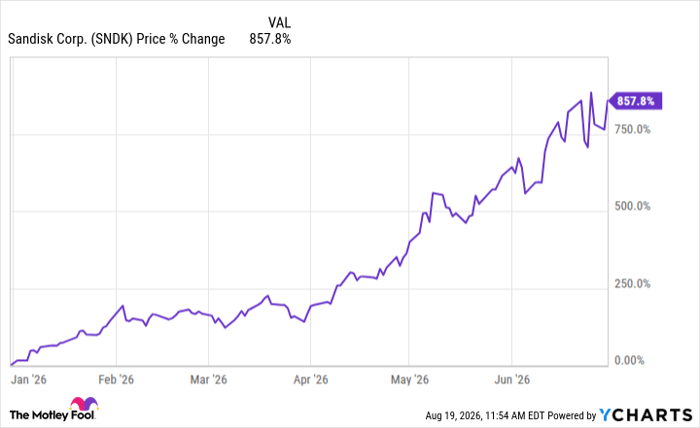
Filings show that Tepper initiated the Sandisk position during the first quarter of 2026 and subsequently exited completely sometime in the second quarter. While exact entry and exit prices are private, the timing alone implies substantial gains.
SNDK data by YCharts.
Taking profits after such a parabolic move signals discipline. Smart investors understand that memory and storage markets are cyclical, meaning Sandisk's valuation may already price in much of the near-term AI surge. By securing gains after a single quarter, Tepper reduces exposure to unwanted volatility while freeing capital for other opportunities.

David Tepper. Image source: Getty Images.
Why Broadcom might appeal to Tepper
Broadcom designs and supplies semiconductors and infrastructure software. Over the last few years, the company has focused on custom AI accelerators known as XPUs. These chips are designed alongside hyperscale customers, rather than being sold as general-purpose products.
Broadcom makes Google's Tensor Processing Units (TPUs) as well as Meta Platforms' MTIA chips. The company also expanded relationships with OpenAI, Anthropic, and Apple, further diversifying the customer base. Broadcom also supplies high-speed networking silicon that connects large clusters of these accelerators, giving the company exposure to both the compute and interconnect layers of the AI chip stack.
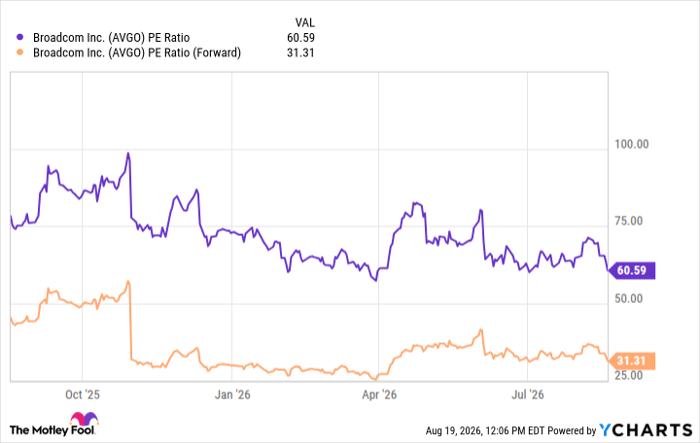
Despite trading at a lofty valuation based on price-to-earnings (P/E) and forward earnings multiples, Broadcom remains an attractive opportunity given its growth potential. AI semiconductor revenue is scaling rapidly, with management guiding for more than $100 billion in this segment alone by fiscal 2027.
AVGO PE Ratio data by YCharts.
Robust operating margins, a wide competitive moat in custom silicon, and a backlog of multi-year orders support Broadcom's premium valuation profile. For an investor like Tepper, the combination of visible multi-year growth, sticky customer relationships, and market leadership in a shift toward specialized AI hardware may outweigh rich multiples.
Should investors follow Tepper's lead and buy Broadcom stock?
Tepper's rotation away from a high-flying memory name into a broader AI infrastructure stock reflects disciplined capital allocation rather than an endorsement of any specific stock. Smart investors can reasonably take note of his logic: Book gains after an abnormal rally and redeploy capital into a company with deeper competitive advantages and potentially longer runway.
While Sandisk's recent pullback from its June peak has so far validated Tepper's exit, Broadcom's elevated valuation leaves little room for error. Against this backdrop, simply following Tepper's trade carries risks.
In my eyes, the more prudent approach is to study his underlying thesis rather than copying the ticker symbols. Investors who share Tepper's conviction in sustained AI capex spending from big tech may find Broadcom a compelling long-term holding. With that said, those who prefer pure play memory exposure could still find opportunities in the sector even after volatility subsides.
Regardless, Tepper's latest moves underscore a timeless lesson: Even the best investment ideas eventually require some harvesting, and the strongest portfolios always adjust to the market rather than remaining static.
Should you buy stock in Broadcom right now?
Before you buy stock in Broadcom, consider this:
The Motley Fool Stock Advisor analyst team just identified what they believe are the 10 best stocks for investors to buy now… and Broadcom wasn’t one of them. The 10 stocks that made the cut could produce monster returns in the coming years.
Consider when Netflix made this list on December 17, 2004... if you invested $1,000 at the time of our recommendation, you’d have $429,223!* Or when Nvidia made this list on April 15, 2005... if you invested $1,000 at the time of our recommendation, you’d have $1,318,055!*
Now, it’s worth noting Stock Advisor’s total average return is 965% — a market-crushing outperformance compared to 212% for the S&P 500. Don't miss the latest top 10 list, available with Stock Advisor, and join an investing community built by individual investors for individual investors.
See the 10 stocks »
*Stock Advisor returns as of August 22, 2026.
Adam Spatacco has no position in any of the stocks mentioned. The Motley Fool has positions in and recommends Apple, Broadcom, and Meta Platforms. The Motley Fool has a disclosure policy.
Recommended Articles


