




Billionaire Investor David Tepper Recently Dumped Appaloosa Management's Stake in Sandisk and Initiated a New Position In a Stock That Some Wall Street Experts Think Could Eventually Be Worth $10 Trillion
Key Points
David Tepper ran Appaloosa Management for over 25 years, generating spectacular returns. Now, the billionaire runs Appaloosa as a family office.
Tepper sold Sandisk, a memory maker, which was a multibagger in the second quarter alone.
Tepper also took a new position in a stock generating quite a lot of buzz in the market.
- 10 stocks we like better than Space Exploration Technologies ›
There aren't too many investors better than David Tepper.
Tepper worked at Goldman Sachs for seven years, starting in 1985. He then founded his own fund, Appaloosa Management, in 1993. From 1993 to 2019, Appaloosa generated average annual returns of 25%, putting it in a league with the great Warren Buffett.
Missed Nvidia in 2009? This Rare Signal Is Flashing Again. In 2009, a "Double Down" signal flashed for a little-known chipmaker called Nvidia. For the first time in years, that same "Total Conviction" signal is flashing for a company 1/100th the size of Nvidia. Continue »
In 2019, Tepper converted Appaloosa into a family fund, which he still runs today. In the second quarter, Appaloosa exited its stake in Sandisk and initiated a new position in a company that some Wall Street experts think could one day be worth $10 trillion.
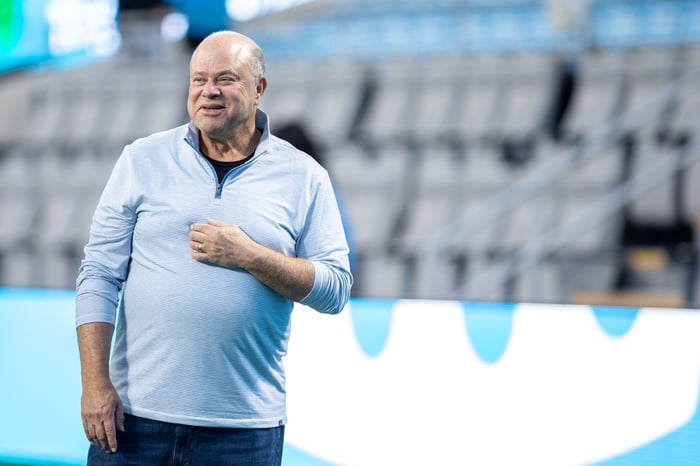
David Tepper. Image source: Getty Images.
Exiting Sandisk: Fading memory
In Q2, Appaloosa sold its nearly $179 million position in the NAND flash memory maker Sandisk.
Memory stocks, which supply data to graphics processing units (GPUs) that handle artificial intelligence inference, have delivered incredible performance this year. That's because demand for memory has become constrained as GPU clusters and data centers have scaled.
Sandisk makes NAND flash memory, which is less expensive, longer-term storage that can retain data even when a system's power is off. In data centers, NAND is typically used to store massive data sets that can be quickly loaded into the GPUs.
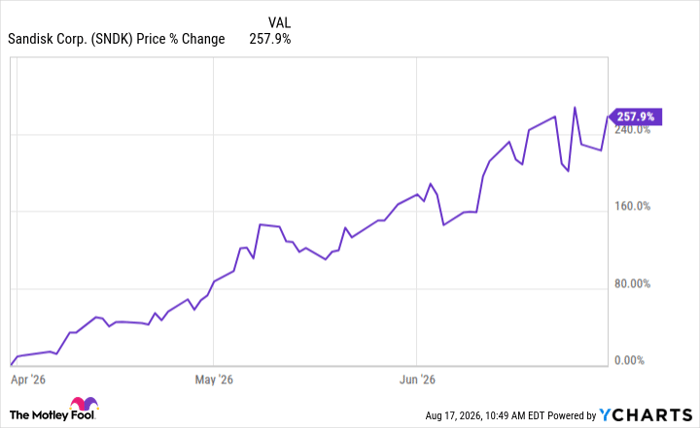
SNDK data by YCharts.
Analysts and experts have previously estimated that NAND supply will be constrained until the second half of 2027, which has led to higher prices for companies like Sandisk. According to Counterpoint Research, Sandisk controlled roughly 13% of global market share, based on revenue, in the first quarter of 2026.
Memory stocks typically trade at low multiples because they are considered cyclical. When supply is constrained, the memory companies work hard to catch up to demand. But when they do, demand typically fades, leading to a supply glut.
Some investors believe the AI supercycle has fundamentally changed the memory industry, whereas others believe history is bound to repeat itself. Tepper appears to be in the latter group and sold Sandisk after an incredible Q2.
Buying an AI stock with the potential to excel
At the end of Q2, Appaloosa disclosed a nearly $38.5 million position in Space Exploration Technologies Corp. (NASDAQ: SPCX), holding 225,000 shares.
It's unclear whether Tepper and his team bought the stock in SpaceX's initial public offering or on the open market. Appaloosa buys plenty of AI stocks, so it's understandable why the fund would be interested.
SpaceX is a highly debated stock, given that it raised nearly $86 billion in the largest IPO ever. With a current valuation closing in on $2 trillion, some analysts think the company is grossly overvalued, while others suggest SpaceX could be worth $10 trillion one day.
In late July, Raymond James analyst Brian Gesuale issued a strong buy rating and an $800 price target, implying a valuation of over $10 trillion. Gesuale's thesis is built on the idea that SpaceX's super-heavy-lift, fully reusable rocket, Starship, will be able to conduct flights weekly and perhaps even daily.
Gesuale compares this potential innovation to railroads or the internet, with Starship eventually being able to cut orbital delivery costs by about 99%. This would pave the way for much of SpaceX's ambitions in space, including orbital data centers, which could quickly take significant market share in AI compute.
Another big believer in SpaceX is the billionaire hedge fund manager Ron Baron, whose fund has already made a fortune by backing SpaceX CEO Elon Musk through investments in Tesla and SpaceX.
Baron Capital invested heavily in SpaceX in the private markets, and the stock now represents over 30% of Baron Capital's total $69 billion in assets under management as of June 30.
Baron thinks there is no one like Musk. He estimates that SpaceX's terrestrial data centers cost about half of what other data center companies are building, and have been completed in one-third of the time.
Baron's estimates for SpaceX down the line range from $10 trillion to $40 trillion.
Based on Appaloosa's smaller position in SpaceX, which currently comprises 0.5% of the portfolio, Tepper does not appear to be all in yet. However, he clearly sees enough potential to take a chance at it, or enough hype to take a shorter-term position.
Should you buy stock in Space Exploration Technologies right now?
Before you buy stock in Space Exploration Technologies, consider this:
The Motley Fool Stock Advisor analyst team just identified what they believe are the 10 best stocks for investors to buy now… and Space Exploration Technologies wasn’t one of them. The 10 stocks that made the cut could produce monster returns in the coming years.
Consider when Netflix made this list on December 17, 2004... if you invested $1,000 at the time of our recommendation, you’d have $432,621!* Or when Nvidia made this list on April 15, 2005... if you invested $1,000 at the time of our recommendation, you’d have $1,335,314!*
Now, it’s worth noting Stock Advisor’s total average return is 973% — a market-crushing outperformance compared to 213% for the S&P 500. Don't miss the latest top 10 list, available with Stock Advisor, and join an investing community built by individual investors for individual investors.
See the 10 stocks »
*Stock Advisor returns as of August 20, 2026.
Bram Berkowitz has no position in any of the stocks mentioned. The Motley Fool has positions in and recommends Goldman Sachs Group and Tesla. The Motley Fool has a disclosure policy.
Recommended Articles


